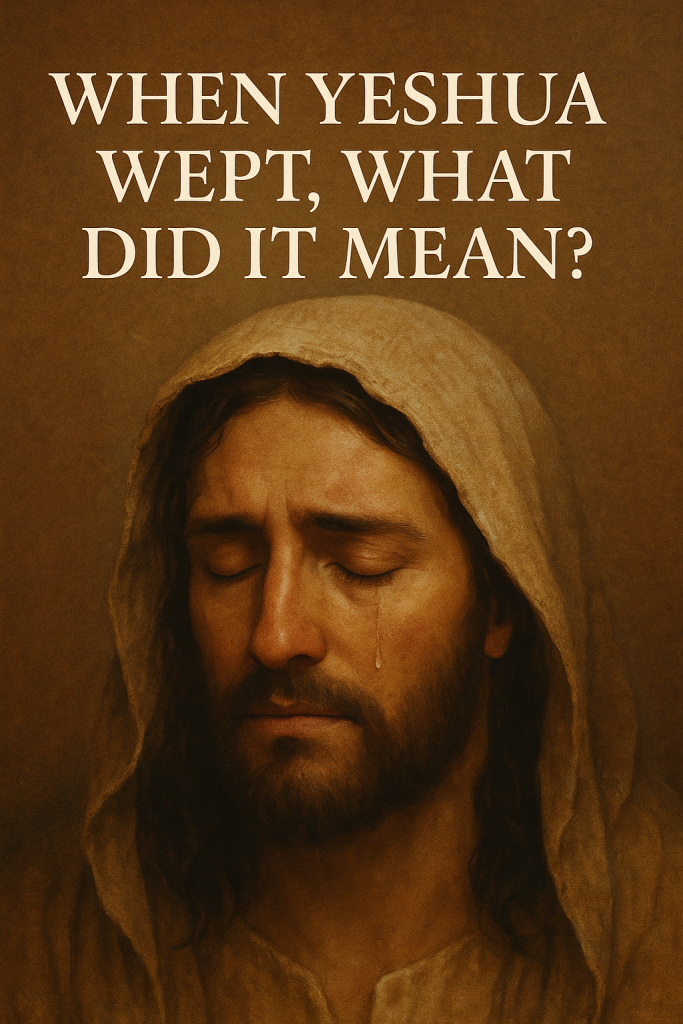
There are moments in Scripture when the veil lifts just enough for us to see the heart of God, and one of the clearest is when He weeps. Think about that. The God who speaks galaxies into motion lets tears fall. Not because He is weak, and not because He is shocked by human suffering, but because real love never stands far away. Love steps right into the ache.
In Psalm 56:8 You have counted my wanderings, put my tears in Your bottle, are they not in Your book, the word dimah (דִּמְעָה, tear) is not common water. It is something kept. Something treasured. David is not just being poetic, he is telling us that God is close enough to catch what falls from our faces, close enough to treat each tear as meaningful.
Sometimes grief comes like a thunderbolt. It hits unexpectedly, shakes the chest, and presses the heart until it aches in ways we didn’t know were possible. That first loss, the one that broke through in a new and shattering way, left a mark that tears sometimes still trace, even years later. The grief of that moment was so intense it left the body echoing the sorrow of the soul. God’s heart is present in those moments, carrying the sudden rupture, gathering every tear in His bottle.
Other losses, even when deeply felt, can land differently. When someone we love lives near us, part of our daily world, the absence, though sorrowful, sometimes presses more quietly. It is a soft ache rather than a crushing blow. God weeps in both kinds of grief. He shares the sudden, piercing sorrow and the steady, lingering sadness. He feels what breaks us in ways that catch us by surprise, and what hums quietly beneath the surface. He never distances Himself from either.
And then the prophets open the window even wider. In Jeremiah 9:1 Oh that my head were waters and my eyes a fountain of tears, the weeping is not Jeremiah’s alone. It is God’s sorrow voiced through the prophet. The Hebrew bekhi (בְּכִי, weeping) describes that deep, chest shaking cry, the kind that happens when someone you love keeps choosing danger over safety. God is not weeping because His plans failed. He is weeping because His people are breaking themselves. And they did it because they could have walked with Him, but chose not to.
And then we come to the moment where heaven’s compassion takes on human eyes.
In John 11:35 Yeshua wept, the Greek edakrysen (ἐδάκρυσεν, He shed tears) paints a picture of quiet tears slipping down His face. Not the loud wailing of the mourners, but gentle grief, personal, steady, full of meaning. He knew the solution was already present. Yet He still let Himself feel the sorrow of a broken world. This is what love does. It enters the moment, even when it carries the answer.
But when He looked over Jerusalem, everything changed.
In Luke 19:41 When He approached and saw the city, He wept over it, the word eklausen (ἔκλαυσεν, He cried aloud) shows us this was no quiet moment. This was full sobbing, the deep cry of a heart torn open. And why. Because the city had every reason to recognize Him, every prophecy, every sign, every covenant thread, yet they could have known Him but chose not to. That choice is what broke Him. He was not crying because He was offended. He was crying because they were lost and did not want to be found.
And then there is Gethsemane, the place where grief reaches its deepest human echo. Hebrews 5:7 In the days of His flesh, Yeshua offered up prayers and supplications, with loud cries and tears to the One able to save Him from death, gives us a peek into the weight He carried. The Greek krauge (loud cries, screams) shows us the intensity of this moment. This was not a quiet sorrow or gentle mourning. This was the agony of the Son of God standing under the full measure of human sin and separation, feeling the crushing weight of the cup He would drink for our sake. He did not shrink from it. He faced it. And through it, He trusted The Father enough to bring every dread, every sorrow, every burden into His presence. That is divine courage. That is divine love.
Prophecy, too, reminds us that God’s grief over His people is relentless, tender, and personal. In Hosea 11:8-9 How can I give you up, Ephraim? How can I hand you over, Israel? My heart recoils within Me, all My compassion is stirred, the Hebrew racham (רַחַם, compassion, womb-like love) paints a picture of divine mercy as tender, protective, and almost parental. God’s heart aches over those who could have known Him, but chose not to. He does not simply enforce justice from afar. He carries the pain of the choices of His covenant people, feeling the grief they create in the context of His covenant love.
And Scripture goes even deeper. In Isaiah 63:9 In all their affliction He was afflicted, the Hebrew tsar (צַר, pressed in distress) shows a God who steps inside the pressure with His people. He does not stand on the sidelines. He enters the squeeze. The holy God of creation does not stay untouched by covenant pain. He shares it.
Science tries to explain tears as chemical signals, hormones, neural circuits, and reflex responses, but even that system reveals design. The body was wired to express sorrow physically because the One who designed it knew relationship would cost something. Tears are the overflow of meaning. And the One who shaped the universe is close enough to gather every drop.
So what do the tears of God tell us?
They tell us His holiness is not cold. His sovereignty is not distant. His power is not detached. They tell us that the same God who sculpted the laws of physics is the God who wept at a friend’s tomb, wept over a city that could have embraced Him but chose not to, wept in the garden with loud cries and tears, and wept over the wound of sin carved into humanity.
If He wept then, He is near now. Not helpless, not hopeless, but present with love that refuses to grow numb (Psalm 34:18 The Lord is near to the brokenhearted, saves those crushed in spirit). Love that still sees every tear, every ache, every wound (Revelation 21:4 He will wipe away every tear from their eyes, and death shall be no more, neither shall there be mourning nor crying nor pain anymore). Love that understands when we have every reason to walk with Him, but sometimes choose not to (Isaiah 63:9 In all their affliction He was afflicted). And love that keeps reaching anyway (Luke 19:41 When He drew near and saw the city, He wept over it).
And one day, He will wipe every tear by His own hand. Not just remove them, but wipe them. Close enough to touch your face.
If this message blessed you, please leave a comment. I look forward to hearing from you.
Image done by chatgpt at my direction