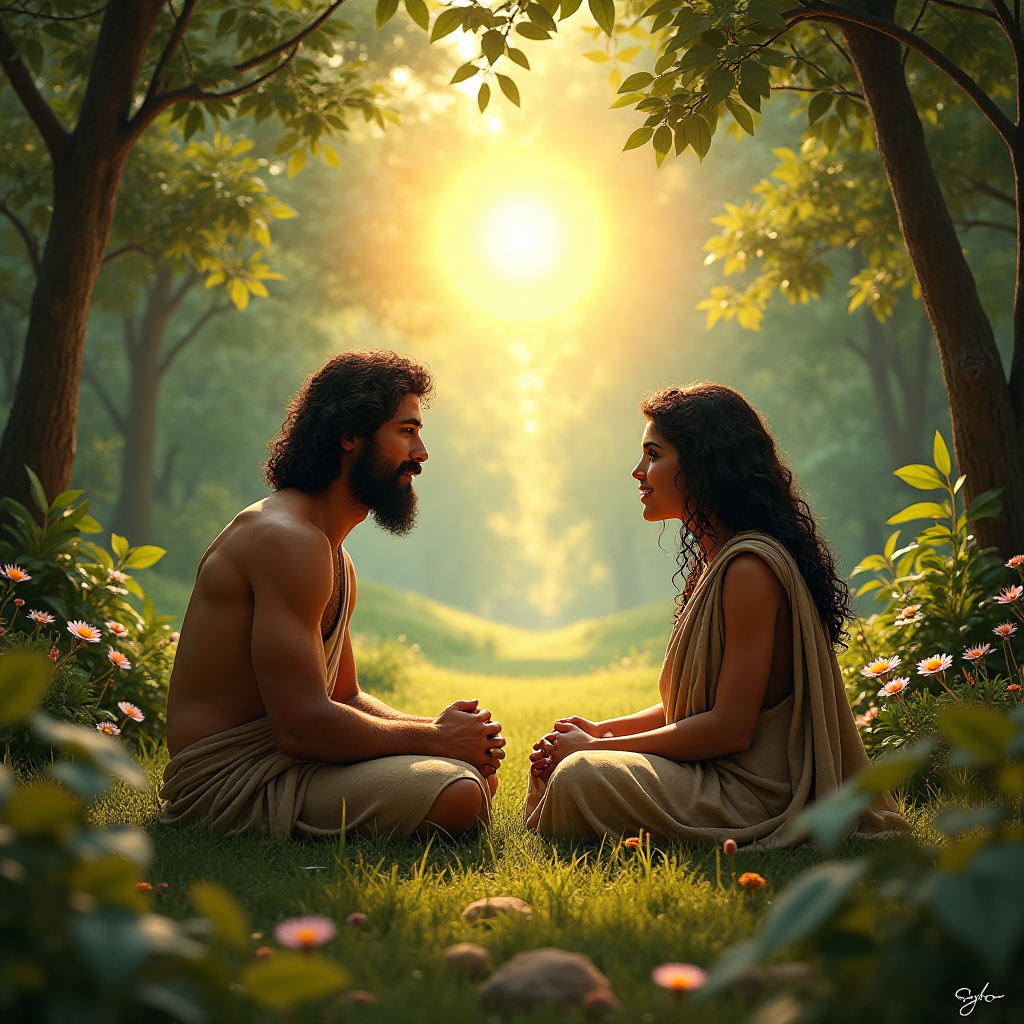
When we read the opening chapters of Genesis, it can be tempting to rush. The words feel familiar. We think we know the story: God created the world, Adam and Eve sinned, and humanity has been trying to cope ever since. But the original Hebrew writers were deliberate, careful, and profoundly precise in the words they chose. Hebrew is not abstract or philosophical. It is concrete, rooted in the everyday, and deeply connected to real life. Each word carries meaning that reaches beyond the surface, and when we slow down and let the text speak for itself, the story becomes far more vivid and powerful than we may have realized.
Genesis opens with a simple statement that contains infinite depth: “In the beginning God created the heavens and the earth” (Genesis 1:1). The Hebrew verb used here is bara (בָּרָא, to create with purpose). This word is reserved for God’s creative action alone. It never describes random events, trial and error, or the processes of human craftsmanship. When God bara, He brings something into existence fully formed, with intention, order, and meaning. The universe did not stumble into being; it was spoken into being by the Word of God. Later, Scripture emphasizes that God’s care continues. Psalm 104:29–30 tells us: “When you hide your face, they are dismayed; when you take away their breath, they die and return to their dust. When you send forth your Spirit, they are created, and you renew the face of the ground.” Creation is sustained by God; it does not operate independently. Every tree, every animal, every breath of wind exists because God is actively maintaining it.
The story moves quickly from the cosmos to humanity. In Genesis 2:7, we read: “Then the Lord God formed the man of dust from the ground and breathed into his nostrils the breath of life, and the man became a living being (nephesh chayyah).” Here, the Hebrew word for man, adam (אָדָם, human), is drawn from adamah (אֲדָמָה, ground). Humanity is literally earth-formed.This is not a metaphor. It tells us we are connected to the soil beneath our feet, to the world around us, and to the physical, tangible creation God made. Our bodies come from the same earth as the trees, the animals, the rivers, and the stones. This connection carries responsibility: to care for what we are part of, to cultivate it, and to honor the God who formed it.
The life of the human being is described with another critical Hebrew term: nephesh chayyah (נֶפֶשׁחַיָּה, living being, whole person). Adam was not created with a soul placed inside him as if it were a separate component. He became a living being in totality: body, breath, and consciousness together. Animals are also called nephesh, as in Genesis 1:20: “Let the waters swarm with swarms of living creatures, and let birds fly above the earth across the expanse of the heavens,” and Genesis 1:24: “And God said, ‘Let the earth bring forth living creatures according to their kinds; livestock and creeping things and beasts of the earth according to their kinds.’ And it was so.” The Hebrew understanding of life does not divide a person into a mortal body and an immortal soul. Life is holistic, and the departure of God’s breath ends that life.
The breath that animates life comes directly from God. Job 34:14–15 reminds us: “If he should set his heart on it and gather to himself his Spirit and his breath, all flesh would perish together, and man would return to dust.” Similarly, Ecclesiastes 12:7 says: “And the dust returns to the earth as it was, and the spirit returns to God who gave it.” Life is a gift from God, not an inherent property of our bodies. Death is not an ongoing conscious state. It is a sleep, a cessation of breath, awaiting the resurrection that God has promised. Here are a few Biblical references for this:
John 11:11: Jesus says Lazarus has “fallen asleep”
Acts 7:60: Stephen “fell asleep” in death
Acts 13:36: David “fell asleep and was buried”
1 Thessalonians 4:13–15: Paul calls believers who have died as “fallen asleep”
1 Corinthians 15:6: Refers to those who “fell asleep” at the time of Christ’s resurrection
The Hebrew word ruach (רוּחַ, breath, wind, spirit) captures this dual meaning beautifully. In Genesis 1:2, the Spirit of God hovers over the waters: “The earth was without form and void, and darkness was over the face of the deep. And the Spirit of God (ruach Elohim) was hovering over the face of the waters.” In humans, ruach represents the breath and power of life. When it leaves, life ends. Psalm 146:4 explains: “When their spirit (ruach) departs, they return to the ground; on that very day their plans perish.” God’s Spirit animates, sustains, and returns. There is no immortal soul that survives independent of God. They are not up in the stars watching or protecting anyone. They are dead… asleep until the final resurrection. … like it or not, it’s true. God said it, I believe it. We should pray for mercy for them for that time.
God entrusted humanity with responsibility over creation. In Genesis 1:28, He blesses Adam and Eve and instructs them: “Be fruitful and multiply and fill the earth and subdue it (kavash) and have dominion over the fish of the sea and over the birds of the heavens and over every living thing that moves on the earth.” The Hebrew verb kavash (כָּבַשׁ, to bring under order, cultivate) emphasizes stewardship, not exploitation. Humanity’s role is to partner with God in cultivating and caring for creation, not to dominate or destroy it.
Then comes the fall. When God calls to Adam, Genesis 3:9 records: “But the Lord God called to the man and said to him, ‘Where are you (ayyeh)?’” The word ayyeh (אַיֶּה, where? but carrying the sense of relational brokenness) is more than a question of location. It signals a fracture in humanity’s relationship with God. Shame, fear, and avoidance replace the trust and intimacy that were meant to define life with God.
Yet even in this brokenness, God shows mercy. Genesis 3:21 says: “And the Lord God made for Adam and for his wife garments of skins and clothed them.” The Hebrew word kuthoneth (כֻּתֹּנֶת, long tunic) reminds us that God covers and protects, even in judgment. He does not abandon humanity; He begins the work of restoration immediately.
The Hebrew word for sin is chata (חָטָא, to miss the mark). Sin is failing to live according to God’s design, falling short of the purpose He intended for creation. As Romans 3:23 states: “For all have sinned and fall short of the glory of God.” Sin is relational, practical, and cosmic in scope. It disturbs the order God established, separates humans from Him, and disrupts harmony with the earth.
Redemption is expressed by the Hebrew ga’al (גָּאַל, to restore or reclaim). To be redeemed is to be restored to God’s purpose and relationship. Through Jesus Christ, God restores what was broken. The resurrection demonstrates that God’s plan is always about life, restoration, and order, not escaping or denying the body. 1 Corinthians 15:42–44 explains: “So is it with the resurrection of the dead. What is sown is perishable; what is raised is imperishable. It is sown in dishonor; it is raised in glory. It is sown in weakness; it is raised in power. It is sown a natural body; it is raised a spiritual body. If there is a natural body, there is also a spiritual body.”
Faith, then, is not about rejecting the earth or longing to leave it behind. It is about embracing life as God created it, living in His design, caring for creation, walking with Him, and trusting in His promise of resurrection. From Genesis onward, the Bible tells a single, coherent story of creation, fall, and restoration; of God shaping, sustaining, and reclaiming His world and humanity within it.
This story is not abstract. Every Hebrew word, every breath, every act of cultivation, every call of God carries meaning. Life is grounded in God’s order, sustained by His Spirit, and restored through His redemption. By understanding the text in its original language, in its concrete and lived reality, we see that our purpose is neither hidden nor unattainable. We are called to live fully, earth-connected, God-centered, and resurrection-ready.
The opening chapters of Genesis are an invitation: to slow down, to observe carefully, to notice the words God inspired, and to see our lives within the larger story. We are dust-formed, breath-filled, relational beings, tasked with stewardship and called to restoration. Every moment is an opportunity to align with God’s design, to cultivate creation, to walk in relationship, and to trust in His ultimate redemption. From the dust of the ground to the breath of God, to the promise of resurrection, the narrative of Genesis is the foundation of all Scripture: God creating, humanity faltering, and God restoring. It is the story of life itself, holistic, purposeful, and filled with hope.
If you liked this message, please leave a comment! I would love to hear from you.
Image made by deepdream.ai
.
.