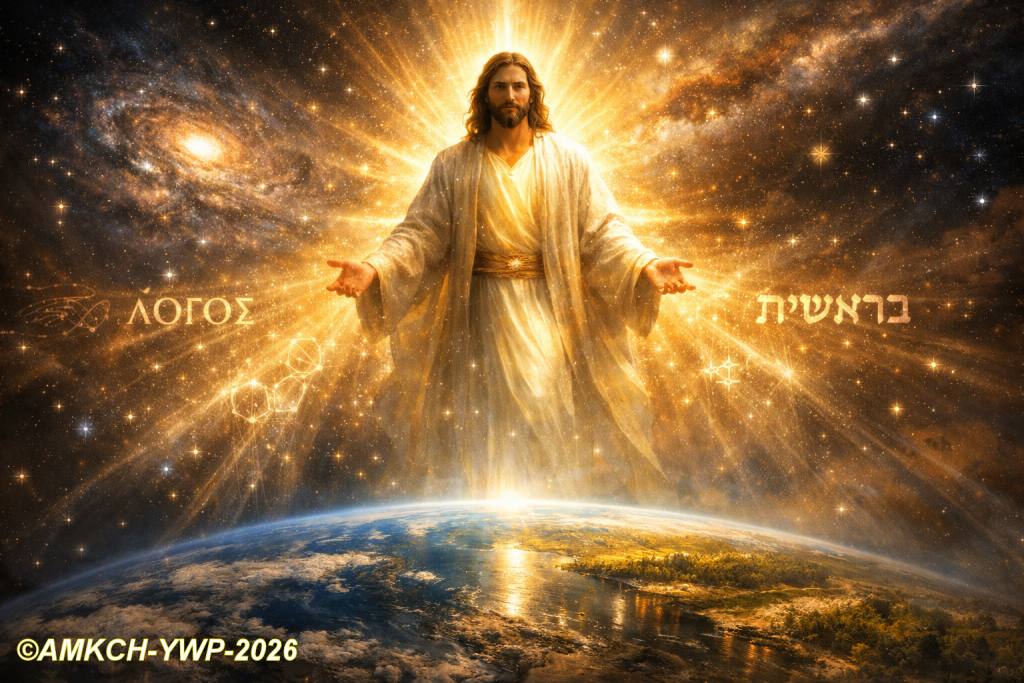
In the beginning, before time itself was measured, before the foundations of the heavens and the earth were laid, there existed λόγος logos (Word, principle of reason, divine expression). John 1:1 tells us plainly, “In the beginning was the Word, and the Word was with God, and the Word was God.” The Greek verb ἦν ēn (was, existed continually, eternal being) anchors this declaration in eternal reality. The Word is not a concept, not a mere metaphor, but reality itself, the channel through which creation breathes and moves. Word In The Beginning
To grasp this fully, one must step back to the Torah, to the opening of Genesis, where it is written, Genesis 1:1, “In the beginning, God created the heavens and the earth.” The Hebrew בְּרֵאשִׁית berēshith (in the beginning, at the start of time and existence) parallels John’s opening. The Word, λόγος logos, is the active agent of this creation, not separate from God but the manifest expression of His will, the divine thought given form. Just as God spoke, “Let there be light,” the cosmos obeyed, for the Word carries inherent power.
Consider the Hebrew term for God in Genesis, אֱלֹהִים Elohim (powerful one, Creator, plural majesty). The Word was not only with Elohim, it was fully God, fully eternal. The plural form hints at the fullness of His being, a complex unity that is mysterious yet real. The New Testament writers, steeped in the Greek philosophical understanding, chose λόγος logos to communicate this eternal principle. Logos, in the Hellenistic world, implied reason, order, and the organizing principle behind the cosmos. But John transforms this for the Hebrew mind: it is not abstract reasoning alone; it is a Person, Yeshua, the divine expression through whom life and light come.
In examining the Word’s relationship to life, we find in John 1:4 that “In him was life, and that life was the light of men.” The Greek ζωή zōē (life, the very essence of living being) is more than biological vitality; it is the fullness of existence, the sustaining energy of the universe itself. The light, φῶς phōs (illumination, revelation, guiding brightness), is inseparable from life. Without the Word, nothing can exist, for all things are held in the pattern He spoke into being. Even modern science whispers this truth: the universe is finely tuned, governed by laws that allow life to flourish. The constants of physics—the speed of light, gravitational pull, the balance of matter—are not random but evidence of the ordering Word. It is as if the cosmos itself remembers the voice of the Creator, vibrating in harmony with the eternal logos.
Returning to the Torah, consider the act of God speaking the cosmos into being. “God said, ‘Let there be light,’ and there was light,” Genesis 1:3. The Hebrew אָמַר amar (said, commanded, decreed with authority) conveys not gentle suggestion but the power of will made manifest. In John, the Greek λόγος fulfills the same role: divine speech is active, creative, and eternal. Yeshua, the Word, is not a tool but the living expression of God’s mind and heart. Everything that exists, every atom and star, every thought and heartbeat, owes its origin and sustenance to this Word.
The phrase “the Word was with God” emphasizes intimacy and distinction. The Greek πρὸς pros (toward, with, in relational closeness) suggests a relationship, a mutual indwelling. This is not a distant abstraction; it is companionship and unity. The Word exists in perfect harmony with God, sharing in His essence, His will, and His glory. In the Tanakh, the Spirit of God hovering over the waters, ר֣וּחַ אֱלֹהִים ruach Elohim (wind, breath, spirit of God), Genesis 1:2, is a precursor, a sign of the same dynamic force that animates creation. Here, the Word is the eternal companion of God, co-eternal, co-active, the conduit of divine purpose.
Yet John goes further: “and the Word was God.” This is not merely poetic expression. It is a declaration of identity. The Word is not created; He is eternal. The Greek θεός theos (God, divine being, ultimate reality) affirms that Yeshua shares fully in the divine nature. In Hebrew thought, the idea of God dwelling among men, as seen in the Shekinah presence, points to a relational God who chooses to enter His creation. The Word embodies this presence fully. In this, science and faith converge: the universe is not an accident; it is orchestrated with intelligence, coherence, and purpose that mirror the eternal mind of God. The fine-tuning of physical laws, the mathematical precision woven into the fabric of space and time, all testify to the living Word behind creation.
Consider also the Jewish understanding of wisdom. In Proverbs, we read of חָכְמָה ḥokhmah (wisdom, skill, insight)_ as being present at creation: “The Lord possessed me at the beginning of His work, the first of His acts of old,” Proverbs 8:22-23. John’s Logos is the culmination of this wisdom, not abstract but incarnate in Yeshua. The Word is wisdom, life, and light—all perfectly united. The Psalmist cries, “The heavens declare the glory of God, and the firmament shows His handiwork,” Psalm 19:1, and we see here that the Word is the underlying architect, the reason behind the visible glory.
The opening chapter of John also reminds us of testimony and revelation. “He was in the world, and the world was made through Him, yet the world did not know Him,” John 1:10. Here, the Greek κόσμος kosmos (world, ordered universe, humanity)_ emphasizes the created order, the cosmos fashioned by the Word. Humanity, in particular, carries the image of God, בְּצֶלֶם אֱלֹהִים b’tzelem Elohim, in Hebrew, reflecting divine intention. Yet we often fail to recognize the hand and voice of the Creator in life’s daily unfolding. The Word, Yeshua, enters fully into human history to reveal God, to make visible the invisible.
Light and darkness form another key contrast. “The light shines in the darkness, and the darkness has not overcome it,” John 1:5. Greek σκοτία skotia (darkness, obscurity, moral and spiritual opposition)_ is not mere absence of light but a force in opposition. Science describes entropy, the movement toward disorder, decay, and chaos. Spiritually, this mirrors the disruption sin brings into creation. Yet the Word, the source of φῶς phōs, maintains supremacy. Light cannot be extinguished; the ordering principle of the universe, the Word, remains victorious.
John continues, “He came to His own, and His own did not receive Him,” John 1:11. Greek ἦλθεν ēlthen (came, arrived, made Himself present)_ emphasizes intentionality. The Word chose incarnation, entering space-time, inhabiting human flesh, revealing God’s reality in a form we could witness and embrace. The Hebrew prophets foretold this: “For unto us a child is born… and His name shall be called Wonderful Counselor, Mighty God, Everlasting Father, Prince of Peace,” Isaiah 9:6. Here again, the Word is revealed in human history, not abstractly, but tangibly, bringing eternal truth to our temporal experience.
Science, physics, and the natural world continue to witness the Word. From the genetic code within a single cell to the precise orbit of planets, order and pattern speak of intelligence. The Greek concept of λόγος logos resonates here: the universe is not random; it is reasoned, structured, and purposeful. Yeshua, the eternal Word, is the ultimate source of this coherence. The very laws that govern matter reflect the consistency of the Word, echoing His faithfulness and wisdom.
Finally, consider grace and adoption: “But to all who did receive Him, who believed in His name, He gave power to become children of God,” John 1:12. Greek ἐξουσία exousia (authority, right, power) conveys divine enablement. The Word does not only create; He invites participation. Humanity, made in God’s image, can be restored, illuminated, and transformed by receiving the Word. The eternal principle, once abstract, now touches the heart and mind, bridging heaven and earth.
From the opening verse of John, we see a full tapestry: the Word is eternal, divine, active in creation, the source of life and light, the embodiment of wisdom, present in human history, victorious over darkness, and the gateway to intimate relationship with God. The Torah, the Tanakh, and the New Testament converge in harmony: the Word is the beginning, the means, and the goal of all existence. Science and observation of the cosmos only deepen the marvel, confirming the precision and intentionality of the Creator. The Word is not merely heard; it is experienced, witnessed, and lived.
In daily life, we can see the Word in action: in the rhythm of the seasons, the trustworthiness of physical law, and the capacity for humans to reason, create, and love. My husband has often said that when we observe nature, from the unfolding of a flower to the flight of a bird, we are watching the Word in motion. Each moment becomes a testament, a living echo of the eternal expression of God.
Thus, John 1:1 is not just a theological statement but an invitation. The Word was, the Word is, and the Word continues to act. The same λόγος logos that spoke the stars into place and gave rise to life calls to each heart, offering light, life, and intimate knowledge of the Creator. Every law of physics, every pattern in nature, every whisper of conscience and reason reflects the reality of the eternal Word. To embrace the Word is to step into harmony with all creation, to see the cosmos through the lens of divine intention, and to live illuminated by His truth.
I have tried to set this out very carefully so that even those who don’t know Greek will clearly understand.
John 1:1 (Greek):
- Ἐν ἀρχῇ ἦν ὁ Λόγος,
- καὶ ὁ Λόγος ἦν πρὸς τὸν Θεόν,
- καὶ Θεὸς ἦν ὁ Λόγος.
Let’s break it down slowly, line by line.
1. Ἐν ἀρχῇ ἦν ὁ Λόγος
En archē ēn ho Logos
Literal: In beginning was the Word
- Ἐν (En) means “in.” Simple, right? But here, it’s not just a location or time. It points to being within something. The Word was in the beginning, inside the foundational moment.
- ἀρχῇ (archē) is usually translated as “beginning,” but it is much richer than a mere point on a timeline. It means the source, the origin, the foundation, the chief place from which everything flows. So, it’s not just when time started ticking, but the very root of everything.
- ἦν (ēn) is the verb “was,” but it’s imperfect tense, meaning continuous, ongoing existence. The Word wasn’t just there at the start and then appeared; He was already existing, without interruption or change, stretching backward before the beginning.
- ὁ Λόγος (ho Logos) is “the Word.” But Logos isn’t just any word, like chit-chat or a sound. Logos means reason, divine logic, expression, the one who speaks the truth and creates reality by speaking. The article ὁ makes it “the”, the one and only Word, unique and singular.
Putting it all together: The Word was in the very foundation of existence, not just popping up at the start of time, but eternally present, expressing God’s eternal reason and purpose.
2. καὶ ὁ Λόγος ἦν πρὸς τὸν Θεόν
kai ho Logos ēn pros ton Theon
Literal: and the Word was toward the God
- καὶ (kai) is just “and,” connecting the thought.
- ὁ Λόγος (ho Logos) again, “the Word.”
- ἦν (ēn) “was” again, continuous state.
- πρὸς (pros) is crucial here. It’s not a casual “with” but a face-to-face orientation, an intimate relationship toward someone. Imagine standing opposite someone, locked eyes, fully present with them. This word captures that closeness and intention.
- τὸν Θεόν (ton Theon) is “the God.” The article here (τὸν) marks it as the specific, personal God, the One we worship. It’s in the accusative case, showing the Word’s direction toward Him, in relationship.
So this line tells us the Word wasn’t distant or disconnected. The Word stood face-to-face, in eternal intimate relationship with the God, not the abstract idea of deity, but the living, personal God.
3. καὶ Θεὸς ἦν ὁ Λόγος
kai Theos ēn ho Logos
Literal: and God was the Word
- καὶ (kai) again means “and.”
- Θεὸς (Theos) means “God.” But note: there is no article here. No “the.” In Greek, that’s a big deal. Without the article, Theos here doesn’t mean “the God” as a specific person but speaks of nature or essence. It means the Word is divine in essence, fully God in quality and being.
- ἦν (ēn) “was,” ongoing state again.
- ὁ Λόγος (ho Logos) “the Word.”
This isn’t saying the Word and “the God” from verse 2 are the exact same person. They are distinct in relationship, but it affirms the Word is fully and truly God by nature. The Word shares the same divine essence.
Putting all three verses together in faithful clarity:
In the source and foundation of all things, the Word was already there. Not created, not beginning, but eternally existing. The Word stood face-to-face with the personal God, in intimate, unbroken relationship. And the Word was fully divine, possessing the very nature and essence of God.
He wasn’t a created being. He wasn’t distant. He wasn’t just a “god” among many. He was God. He is eternal, alive, and intimately connected to the Father before anything was made.
Beloved of God, this is Yeshua haMeshiach, the Word who became flesh and dwelt among us (John 1:14). But right here, in verse 1, we are not yet at His incarnation. We’re staring back through eternity into the infinite relationship between the Father and the Word, a relationship that has always existed, beyond time and space.
This is the profound, eternal reality of who Yeshua is: the eternal, divine Word, face-to-face with God, the very essence of God, before all creation.
PRAYER
Eternal YHWH, Source of all light and life,
we bow before Your boundless presence,
the beginning and the Word that was with You, and is You.
Blessed is the One who carries Your breath,
the Logos, shining into the darkness,
whose voice calls creation into being,
whose hands weave life from the void.
May the light of Your Word enter our hearts,
flowing through every shadow,
illuminating every hidden corner of our minds,
and giving life where there is despair.
Teach us, O Lord, to abide in this light,
to receive the wisdom of Your eternal Word,
and to reflect it in our words, our deeds,
and our love toward one another.
Let the mystery of λόγος and בְּרֵאשִׁית
not remain distant or abstract,
but live within us,
breathing truth and hope into our daily lives.
We ask for courage to follow the Light,
faith to trust in the unseen,
and joy to celebrate the life it brings.
Bless, O God, this vision we hold in our hearts,
and make it a living witness
to Your glory, Your wisdom,
and Your everlasting mercy.
Amen and Shalom, Shalom.
image done by my chatgpt at my direction. Both teaching and image are ©️ AMKCH-YWP-2026