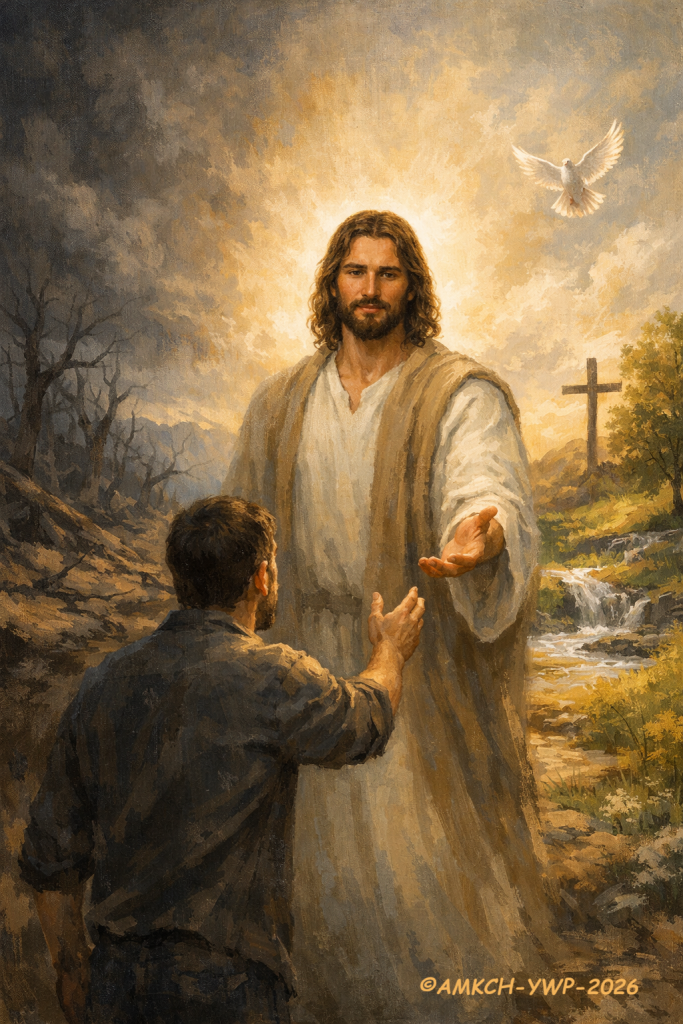
There is nothing more precious, nothing more foundational, to our Christian walk than the doctrine of salvation. It is not simply a teaching we learn and move past. It is the story that explains everything, from why the world groans to why hope still refuses to die. Salvation is the reason we breathe with purpose. It is the reason despair never has the final word. Yet many believers live their entire lives knowing the term without ever slowing down long enough to grasp the weight, the beauty, and the cost of what God has done.
Salvation is not a small thing. It is not a theological accessory. It is the very heartbeat of Scripture.
To understand salvation, we must first begin where God begins, in the Garden of Eden. Adam and Eve lived in perfect fellowship with God. There was no shame, no fear, no hiding. Creation itself was in harmony with its Creator. Scripture records God’s assessment of His completed work in Genesis 1:31: “God saw all that He had made, and it was very good. And there was evening, and there was morning, the sixth day.”
The Hebrew word translated “good” is tôv, meaning complete, whole, fully aligned with its intended purpose. This was not a casual compliment. God was declaring that creation functioned exactly as He designed it to function. Nothing was broken. Nothing was missing. Life flowed freely, and relationship with God was unguarded and whole.
That perfection, however, was fragile only in the sense that obedience mattered. When Adam and Eve chose to disobey God, everything fractured. Their sin was not simply eating forbidden fruit; it was choosing autonomy over trust, self over submission. In that moment, relationship with God was broken, and creation itself felt the impact.
This is what Scripture calls the fall.
The Greek word for sin is hamartia, meaning to miss the mark. Humanity had strayed from God’s design for life, fellowship, and purpose. This was no small error; the consequence was severe. Death entered the human story, not just physical death, but spiritual death, a separation from the God who is the source of all life. Humanity was cut off from the One they were made to know, and the harmony of creation began to unravel.
We can read Paul’s explanation to this reality in Romans 6:23: “For the wages of sin is death, but the gift of God is eternal life in Christ Jesus our Lord.”
The word “wages” matters here. Wages are earned, a natural consequence of one’s actions. Death was not an arbitrary punishment handed down in anger; it was the inevitable result of turning away from life itself. This separation affected everything: relationships fractured, creation groaned under the weight of human rebellion, and humanity became enslaved to sin, powerless to restore what had been broken.
Left to ourselves, there was no solution. The law could reveal sin, but it could not remove it. It was never given as a ladder for humanity to climb back to God. Instead, it functioned as a mirror, reflecting God’s holiness while simultaneously exposing how far we had fallen. The law could name sin, define sin, even show its seriousness, but it could not heal the human heart. It could diagnose the disease, but it could not cure it.
Romans 3:20 shows this to us: “Therefore no one will be declared righteous in God’s sight by the works of the law; rather, through the law we become conscious of our sin.”
The law revealed God’s righteous standard, but it also proved that no human being could meet it. Instead of producing life, it exposed death. The problem was never the law. The problem was the human heart, and without God’s intervention, humanity remained helpless.
Sacrifices, too, served a purpose, but they were never the final answer. The blood of animals could not erase sin. It could only cover it temporarily. Every sacrifice offered under the old covenant pointed forward, acting as a shadow of something greater yet to come. Each offering reminded the worshiper that sin still existed and that death was still required as payment.
The writer of Hebrews explains this in Hebrews 10:1: “The law is only a shadow of the good things that are coming, not the realities themselves. For this reason it can never, by the same sacrifices repeated endlessly year after year, make perfect those who draw near to worship.”
If sacrifices could have truly cleansed the conscience, they would have ceased. Instead, they were repeated again and again, year after year, a constant reminder that the debt of sin had not yet been paid. Hebrews makes it unmistakably clear in Hebrews 10:4: “It is impossible for the blood of bulls and goats to take away sins.”
This was not a failure in God’s design; it was preparation. The law and the sacrificial system functioned as tutors, teaching humanity that sin was not a surface issue. It was a heart issue. Only a perfect sacrifice could address it, and only God could provide that sacrifice.
Humanity was truly helpless. No amount of effort, repentance rituals, or religious discipline could undo the damage of the fall. The problem was not a lack of instruction; it was a lack of life. Dead hearts cannot resurrect themselves. That is why salvation had to come from God Himself.
The name Jesus carries the entire story of salvation within it. In Greek, His name is Iēsous. It comes from the Hebrew Yehoshua, meaning Yahweh saves. His name is not symbolic; it is declarative. From the very beginning, God announced His rescue plan.
Jesus did not come merely as a moral teacher or wise philosopher. Many have tried to reduce Him to that because it feels safer. A teacher can be admired without being obeyed. A philosopher can be quoted without being surrendered to. But Jesus does not allow Himself to be placed in that category. He did not come to offer opinions about life; He came to be life.
To understand this, think of it this way: a man has a son. That son is as the man, he is the same in essence, the same in nature, the same in character, though distinct in person. The son reflects the father fully. In the same way, Yeshua is God. He is not a separate God or merely a divine agent. He is fully God, sharing the same nature and essence as the Father, yet distinct as the Son.
Jesus came as God in human form. He did not stop being God to become a man. He took on humanity without surrendering His divine nature. John states this plainly in John 1:14: “The Word became flesh and made His dwelling among us. We have seen His glory, the glory of the one and only Son, who came from the Father, full of grace and truth.”
This matters deeply for salvation. Only God is holy, only God is sinless, and only God has the authority to deal with sin at its root. If Jesus were merely a man, even a good man, His obedience would have benefited only Himself. But He is God in human form, and every act of His life carries eternal weight.
Jesus lived the life humanity failed to live. From Adam forward, every human being fell short of God’s standard. Sin was not just something people did; it was something that ruled them, a power that bound hearts and clouded minds. Into that broken world, Jesus entered fully, facing the same temptations, enduring the same pressures, yet without ever yielding.
The writer reminds us in Hebrews 4:15: “For we do not have a high priest who is unable to empathize with our weaknesses, but we have one who has been tempted in every way, just as we are, yet He did not sin.”
Yeshua’s obedience was not theoretical or abstract. It was lived, moment by moment, under real pressure, in a fallen and struggling world. Every heartbeat, every choice, every word and thought reflected perfect submission to the Father. He did not obey selectively, picking what was convenient; He obeyed completely, perfectly, and on our behalf.
This is what the writers of The Bible meant when they said, He fulfilled the law. The law demanded perfect obedience, not partial obedience, not sincere effort, but perfection. Jesus did not lower that standard. He met it. He satisfied every requirement of the law, morally and spiritually. He obeyed God not only in outward actions, but in motive, thought, and desire.
Before any of this happened, Jesus Himself explained it all in Matthew 5:17: “Do not think that I have come to abolish the Law or the Prophets; I have not come to abolish them but to fulfill them.”
To fulfill the law means to bring it to its intended completion. Jesus did not loosen its demands to make salvation easier. He satisfied its demands completely on behalf of humanity. Every command, every requirement, every expectation was fully met. Where Adam failed, Jesus succeeded. Where Israel failed, Jesus remained faithful. Where humanity rebelled, Jesus submitted, showing perfect obedience not only in action but in heart and will. This is why His obedience matters just as much as His death. Salvation is not only about sin being removed; it is about righteousness being provided. Humanity did not only need forgiveness; humanity needed a perfect righteousness to stand before a holy God. Jesus supplies both. Through His obedient life, He provides righteousness; through His sacrificial death, He removes sin.
Paul shows this connection in Romans 5:19: “For just as through the disobedience of the one man the many were made sinners, so also through the obedience of the one man the many will be made righteous.”
Jesus did not simply die for us; He lived for us as well. Every act of obedience, every choice of submission, every moment of faithfulness was lived on behalf of those who could not live that way themselves. His life was not only a model to follow; it was lived in our place, offering Himself for humanity. He did not die merely as a victim of injustice. He took upon Himself the full penalty of sin, every sin, past, present, and future, and bore its weight completely.
Paul describes this divine exchange in 2 Corinthians 5:21: “God made Him who had no sin to be sin for us, so that in Him we might become the righteousness of God.” This is the heart of salvation: the sinless Son of God taking the sin of the world upon Himself so that sinners might receive a righteousness they could never earn. Justice was satisfied. Love was poured out. The cross stands as the meeting place of God’s holiness and God’s mercy, where judgment and grace intersect in perfect harmony.
The resurrection sealed everything. Death could not hold Him, sin lost its authority, and salvation was accomplished, not in theory, but in history, in reality, in the events of time itself.
Yet salvation is not automatically applied to everyone. It is offered freely, but it must be not only accepted, but truly received. Paul makes this clear in Ephesians 2:8–9: “For it is by grace you have been saved, through faith, and this is not from yourselves, it is the gift of God, not by works, so that no one can boast.”
Grace is God’s unearned favor, freely given. Faith is trusting wholly in what Christ has already accomplished, believing that His obedience and sacrifice are sufficient. Salvation is not the result of human effort, morality, or religious performance; it is a gift to be received through trust in Him.
But receiving salvation is only the beginning. The moment of belief opens the door to a deeper work in our lives is called sanctification. To be sanctified is to be set apart, to be gradually shaped into the likeness of Christ. God begins this work immediately, patiently refining our hearts, renewing our minds, and shaping our character, turning the gift of salvation into a living, transforming reality.
At salvation, our standing before God changes instantly. Scripture calls this justification. God declares us righteous, not because of our actions, but because of Christ’s finished work. This is positional sanctification. In God’s sight, we are holy because we are in Christ. Yet our daily experience tells us that transformation is still unfolding. Thoughts, habits, attitudes, and reactions do not change overnight. This is where the Holy Spirit works patiently and faithfully. Sanctification is not self-improvement. It is transformation.
Paul describes this process in Romans 12:2: “Do not conform to the pattern of this world, but be transformed by the renewing of your mind. Then you will be able to test and approve what God’s will is, His good, pleasing and perfect will.”
The word translated “transformed” comes from metamorphoō, meaning a complete change in form. God reshapes how we think, how we respond, and how we live. As this transformation unfolds, fruit becomes visible. These fruits are in Galatians 5:22–23: “But the fruit of the Spirit is love, joy, peace, patience, kindness, goodness, faithfulness, gentleness and self-control. Against such things there is no law.”
These qualities are not produced through striving. They are not the result of trying harder, being disciplined, or forcing ourselves to act holy. They are the evidence of the Holy Spirit at work within us, quietly reshaping hearts, refining desires, and guiding thoughts. Growth takes time because transformation is not instant; it is often invisible at first. Patience appears when we don’t react in anger; kindness speaks when the world would be harsh; joy surfaces even in suffering. Each small choice, each surrendered moment, is proof that God is working in ways we cannot always see. Sanctification is a lifelong journey, like a tree stretching slowly toward the sun, or gold being refined inch by inch in the fire. Every moment counts, every step matters, and God is faithfully doing His work in us.
There will be failures along the way, moments when we stumble, when our hearts falter, when our choices fall short. There will be times of conviction, gentle correction, and even sharp reminders that we are still learning to walk in God’s ways. Yet salvation is not fragile; it does not depend on our perfection. God does not abandon what He begins. Paul reassures believers in Philippians 1:6: “Being confident of this, that He who began a good work in you will carry it on to completion until the day of Christ Jesus.”
That completion is glorification. One day, when Christ returns, every struggle, every stumble, every tear will be redeemed. Our bodies will be transformed, freed from weakness and decay. Sin and death, the forces that have pursued humanity from the beginning, will be removed completely. Fellowship with God will be restored fully, as it was always meant to be, in unbroken harmony and joy. The journey may be long and sometimes painful, but every step, every moment of growth, is leading to that perfect day when we will see Him face to face.
Salvation is total rescue from sin and death, the moment when God steps in and pulls us from the consequences we could never escape on our own. Sanctification is restoration in progress, the patient work of God shaping our hearts, renewing our minds, and teaching us to live in His ways day by day. Glorification is the final fulfillment, the perfect completion of all He has begun, when our bodies, our hearts, and our spirits will be fully aligned with His glory.
This is not shallow hope. It is solid ground, firm beneath our feet, even when the path feels uncertain or the journey long. God saves when we are powerless, sustains when we are weak, and completes what He starts with absolute faithfulness. Every step we take, every trial, every moment of obedience, rests not on our own strength, but on His unchanging, unshakable faithfulness. We are held, guided, and perfected by the One who cannot fail, and this is the glorious promise at the heart of our salvation.
✝️✝️✝️✝️✝️
Father, I come to You as I am. I’ve failed. I’ve missed the mark. I’ve tried and fallen short. I need You. Thank You for Yeshua, for living the life I could not live, for dying the death I deserved, and for rising to give me real life. I open my heart to you. I receive you fully, trusting that your obedience and sacrifice are enough for me. Holy Spirit, come in. Change me from the inside. Teach me, guide me, and help me walk with You. Thank You that salvation is real, that You are working in me, and that one day You will make me fully like Christ. I surrender everything to You, Father, and I believe You will finish what You began. In Yeshua’s name, Amen, Amen.
✝️✝️✝️✝️✝️
If you liked this message, please leave a positive comment. I would love to hear from you!
image done by my chatgpt at my direction.
.