Sometimes when we read the Word slowly, something quiet rises out of the text and asks us to stop for a moment. It is not always a loud revelation. Sometimes it is just a question that refuses to go away. Scripture has a way of doing that. The Spirit gently presses on a detail, and suddenly a passage we have read many times before begins to unfold in a deeper way. This happened to my husband and me as we were reading this morning.
That is how this particular question begins.
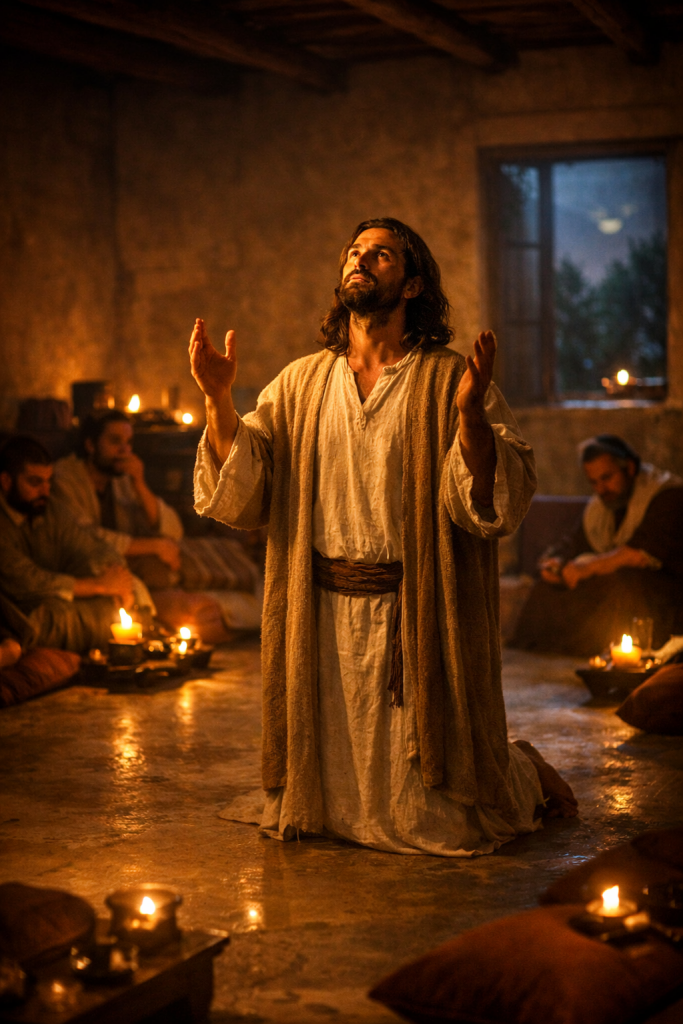
On the night before the cross, Yeshua lifts His eyes toward heaven and begins to pray. The prayer is recorded in John 17, and it is one of the most intimate moments preserved in the Scriptures. The disciples are present, but the prayer is not directed toward them. Yeshua is speaking to the One who sent Him.
John 17:1
“Father, the hour has come. Glorify Your Son, that the Son may glorify You.”
The entire prayer carries the tone of a Son speaking to His Father with deep trust and purpose. He speaks of the work He has finished, the people entrusted to Him, and the unity that will hold them together after He returns to the Father.
Then, in the middle of the prayer, a phrase appears that is both tender and revealing.
John 17:11
“Holy Father, keep through Your name those whom You have given Me, that they may be one as We are one.”
In the Greek text the words translated “Holy Father” are hagie pater. The meaning is straightforward: Set-apart Father. Yeshua is addressing God directly. This is not a title being assigned to a person. It is an expression of reverence spoken to the One who alone holds that position.
When we search the Scriptures carefully, something interesting appears. That phrase occurs only here. The Son speaks it to the Father in prayer, acknowledging the sacred uniqueness of the One who sent Him.
Now place that moment beside something Yeshua said earlier in His ministry.
In Matthew 23, Yeshua is confronting a pattern that had developed among certain religious leaders. They had begun to surround themselves with honor and titles that elevated them above the people. Recognition had become more important than humility.
Yeshua describes what He sees.
Matthew 23:5–7
“They do all their works to be seen by men… they love the place of honor at feasts, the best seats in the synagogues, greetings in the marketplaces, and to be called by men, ‘Rabbi, Rabbi.’”
The problem was not leadership itself. Teaching and guidance have always existed among God’s people. The problem was the desire to be lifted above others through titles that created spiritual status.
So Yeshua speaks directly into that situation.
Matthew 23:9
“And call no man your father upon the earth, for One is your Father, the One in heaven.”
The words are clear, but they must be understood in the context in which they were spoken. Yeshua is not abolishing family language. The Scriptures obviously speak of earthly fathers and mothers. Instead, He is correcting the elevation of human leaders into positions that belong uniquely to God.
The verses that follow reveal His reasoning.
Matthew 23:11–12
“The greatest among you shall be your servant. Whoever exalts himself will be humbled, and whoever humbles himself will be exalted.”
The Kingdom of God operates in the opposite direction from human systems. Religion often builds ladders of rank, titles, and recognition. The Kingdom moves downward through humility, service, and care for others.
To understand the depth of what Yeshua is protecting, it helps to step back into the earlier Scriptures. The idea of God as Father did not begin with the apostles. It appears long before in the Torah and continues through the prophets.
Moses reminds Israel of their relationship with the One who formed them.
Deuteronomy 32:6
“Is He not your Father, who bought you? Has He not made you and established you?”
Here the language of fatherhood is connected with both creation and covenant. God is the One who brought the nation into existence and sustained it.
The prophets continue the same theme. Through Isaiah, the people acknowledge God’s role in shaping them.
Isaiah 64:8
“But now, O LORD, You are our Father; we are the clay, and You our potter.”
This image reveals something profound. A potter forms clay with intention and care. In the same way, God shapes His people according to His purposes.
Isaiah also speaks of God as the eternal Redeemer of His people.
Isaiah 63:16
“You, O LORD, are our Father; our Redeemer from everlasting is Your name.”
The prophet Malachi echoes the same truth when confronting division among the people.
Malachi 2:10
“Have we not all one Father? Has not one God created us?”
These passages reveal a consistent pattern. Throughout the Scriptures, God is presented as the true Father over His people. He is their Creator, their Redeemer, and the One who sustains them.
When we arrive at the teachings of Yeshua, that same idea becomes even clearer. In the Sermon on the Mount, when He teaches His disciples how to pray, the first words He gives them point directly back to that relationship.
Matthew 6:9
“Our Father in heaven, hallowed be Your name.”
Prayer begins by acknowledging who God is. The disciples are not told to approach a hierarchy of human authorities. They are invited to come directly before the Father.
Notice the two ideas placed side by side in that opening line: Father and hallowed. The Father is near, but His name is holy. He is relational, yet completely set apart.
The apostles later carry that same understanding forward. Paul writes to believers with deep reverence for the Father.
Ephesians 3:14–15
“I bow my knees to the Father… from whom every family in heaven and on earth is named.”
All fatherhood flows from Him. Every expression of care, protection, and guidance that we see among human fathers reflects something that began in God Himself.
When we see this thread running through the Scriptures, Yeshua’s words in Matthew 23 take on a deeper meaning. He was not merely correcting vocabulary. He was protecting the unique place of the Father in the lives of His people.
If human systems begin elevating leaders into positions that mirror the authority of God, something subtle begins to happen. People slowly shift their focus upward toward those leaders instead of upward toward the Father.
Yeshua would not allow that to take root among His followers. Instead, He continually brought them back to the simplicity of the Kingdom. There is one Father in heaven. There is one Messiah sent by the Father. And those who believe become brothers and sisters in a family formed by God Himself.
Leadership within that family is expressed through service. Shepherds care for the flock. Teachers explain the Word. But all of them stand under the same Father, never above the rest of the family.
This truth makes the prayer of Yeshua in John 17 even more powerful. On the night before the cross, with everything about to unfold, He lifts His eyes and speaks directly to the One who holds that sacred place.
“Holy Father…” The set-apart Father. The One from whom all life flows. And the request that follows reveals the heart of the Kingdom.
“That they may be one as We are one.”
Unity among believers does not grow from titles or religious hierarchy. It grows from the shared life that flows from the Father through the Son, to those who trust Him.
When believers draw near to the Father, they also draw near to one another. The closer the family comes to the Father, the stronger that unity becomes.
In the end, the message remains beautifully simple and deeply profound.
There is one Father in heaven.
And everyone who belongs to Him is family.
PART 2: When Titles Became Human
As the centuries passed after Yeshua’s ministry, the church grew larger and more organized. Communities spread across vast regions, and leaders emerged to guide them. In those early generations, bishops, elders, and overseers carried responsibility, but they were described simply as shepherds and servants; never elevated with sacred titles. Leadership was about care and example, not recognition.
Over time, however, as the church became centralized, certain offices gained prominence. The bishop of Rome gradually assumed greater influence, and honorific language began to appear. By roughly the sixth through ninth centuries, the title “Holy Father” began to be applied formally to the catholic pope. The word “pope” comes from the Greek pappas, meaning father. Originally a term for fathers or elders in general, it eventually became reserved exclusively for the bishop of Rome as the office became more “powerful”.
Today, official communications from the Vatican, statements from the United States Conference of Catholic Bishops, and even entries in the Catholic Encyclopedia consistently address the pope as Holy Father. Announcements, audiences, and papal letters begin with the phrase:
“His Holiness, the Holy Father, the Pope…”
Placed alongside the words of Yeshua, the contrast is unmistakable. What the Son of God spoke upward to God alone, “Holy Father”, was now being applied to a human leader. This was precisely the kind of elevation He had warned against. Human honor and titles began to obscure the simplicity of the Kingdom and the singular place of the true Father in heaven.
Yet even as history unfolded this way, the principle of the Kingdom remained unchanged. Leadership is essential, but it is measured not by titles or honor, but by humility and service. Just as Yeshua washed the feet of His disciples, leaders are called to serve those entrusted to them. The greatest among believers is the one who kneels, the one who lifts up others, the one who reflects the care and example of the Messiah rather than the authority of a human office.
This historical perspective does not diminish faith. It clarifies it. It shows why Scripture consistently redirects hearts toward God alone. The Father remains unique, set apart, holy. Every expression of guidance, protection, or teaching from human hands flows from Him, not from a title or position. Believers continue to be called into one family, bound together through the life of the Father, the Son, and the Spirit.
Even as traditions and human structures arose, the truth stands unshaken: one Father in heaven, one Messiah, one family. The rest, titles, offices, human honor, cannot replace the intimacy, unity, and service that define The Kingdom of God.
PRAYER (Spirit-Led, in English from the original Greek text of John 17)
Father, set-apart One, I bow before You in awe and thanksgiving. Keep those You have entrusted to Your Son through Your name, that they may be united as You and Your Son are united. Guard their hearts, renew their minds, and let them walk in the light of Your truth. Protect them from the snares of pride and the distractions of earthly honors. Let them serve one another in humility and love, reflecting the example of Your Son, who came not to be served but to serve. May all who call upon You in faith recognize that You alone are Father, Creator, and Sustainer, and may they draw close to one another in the unity that flows from Your Spirit. In Yeshua’s Holy name, Amen Amen.
✝️ ✝️ ✝️ ✝️ ✝️
©AMKCH-YWP-2026
✝️ ✝️ ✝️ ✝️ ✝️
If this message blessed you, please leave a comment. I would love to hear from you.
image done by chatgpt at my direction.
✝️ ✝️ ✝️ ✝️ ✝️
.
.