: A Tale of Two Cities, Not Dickens, Just History
✝️
I’m not sure why I’m writing this. It just came to my mind… maybe God wanted me to explain to those who don’t understand… I don’t know… it’s all God. THAT I do know. Someone must have been doing some serious thinking about this topic. So, with God’s help, and a very little help from AI in my research, here is your answer.
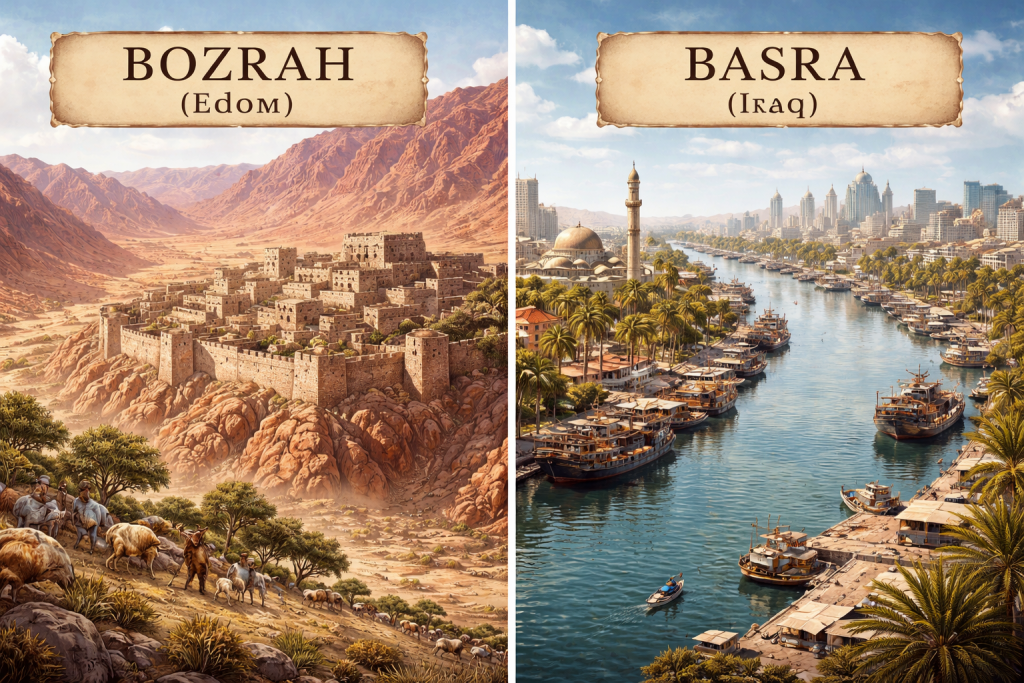
Some people hear ‘Bozrah’ and immediately think of the modern city of Basra in Iraq. (This is where the confusion usually starts, because the names sound similar, not because the places are related.) But that is not it. These are two very different places with very different histories. The ancient Bozrah was in Edom, in what is now southern Jordan, known in Scripture as a center of Edomite civilization. The Hebrew word Bozrah (בֹּצְרָה, Boṣrah) literally means “sheepfold,” which hints at the pastoral life of the Edomites, who were shepherds and herders of the rugged, rocky land. Basra, Iraq, by contrast, is a major port city on the Shatt al-Arab near the Persian Gulf, founded much later in the 7th century CE during the early Islamic period, famous for trade and culture, and it does not appear in the Scriptures.
Though the names sound similar, Bozrah and Basra occupy distinct places in history, geography, and significance, one biblical, the other medieval and modern. Understanding the difference helps us keep Scripture and history straight.
Bozrah in Edom appears several times in Scripture, often as a symbol of judgment and conquest. Prophets like Isaiah and Jeremiah refer to it in the context of God’s dealings with Edom, highlighting its fortified strength and eventual downfall. For example, in Isaiah 34:6–8, God’s judgment is described over Edom: “The sword of the Lord is filled with blood…for the Lord has a sacrifice in Bozrah.” Similarly, Jeremiah 49:13–22 describes Bozrah’s fall, showing that no fortress, no matter how strong, can withstand God’s sovereignty. In the Hebrew, words like ruach (ר֫וּחַ) for “wind/spirit” and nephesh (נֶפֶשׁ) for “life/soul” emphasize God’s living power over nations and people, reminding us that His judgment is not abstract, it touches real hearts and lives.
Bozrah’s geography and environment shaped its people. Edomites were shepherds, miners, and warriors of the desert cliffs, which made their pride and independence notable in contrast to Israel. The fall of Bozrah becomes a vivid picture of God’s sovereignty: even the mightiest, most fortified places are under His authority. Recognizing that Bozrah is in Edom, not Iraq, keeps us anchored in Scripture and in God’s unfolding plan of redemption.
Studying Bozrah gives us more than a historical fact, it teaches us about God’s justice, His power over nations, and His mercy toward those who turn to Him. Names can sound alike across centuries and languages, but context, the time, the people, the purpose, is what matters. When we see Bozrah in the Bible, we are looking at Edom, a land with its own story in God’s redemptive plan, not a medieval port city like Basra in Iraq (which belongs to a completely different historical era and world entirely separate from the biblical narrative).
When we step back, Bozrah is more than just a dot on a map. Its story shows us God’s sovereignty and His justice: no human pride, no walls, no armies, no matter how strong, can stand against His hand. The Hebrew Bozrah, “sheepfold” (boṣrah), reminds us that God’s people are watched over, protected, and led, and that even strongholds meant to intimidate are under His authority.
Yet, God’s justice is never without mercy. For those who turn to Him, there is refuge, as we see in Psalm 34:18, “The Lord is near to the brokenhearted and saves the crushed in spirit (nephesh, נֶפֶשׁ),” and in Joel 2:32, “Everyone who calls on the name of the Lord shall be saved.” Isaiah 30:18 reminds us that “the Lord waits to be gracious to you, and therefore He exalts Himself to show mercy to you.” And Nahum 1:7 calls Him “a stronghold in the day of trouble; He knows those who take refuge in Him.”
The history behind Bozrah (בֹּצְרָה, boṣrah) teaches vigilance and humility: we see pride humbled, strength shown as powerless before God. The fall of Bozrah vividly illustrates Isaiah 34:2, “For the Lord is enraged against all the nations, and furious against all their host; He has devoted them to destruction, He has given them over to slaughter,” and Jeremiah 49:13–22 recounts how even fortified cities, mighty in human eyes, cannot withstand His sovereignty. The writer of Proverbs 16:18 reminds us that“ Pride goes before destruction, and a haughty spirit before a fall,” and Psalm 33:10–11 declares that “The Lord brings the counsel of the nations to nothing; He frustrates the plans of the peoples. The counsel of the Lord stands forever.”
And yet, His redemptive plan moves forward. Understanding Bozrah in its true Edomite context, not confusing it with Basra in Iraq, helps us read Scripture with clarity and recognize His purposes in history. As Genesis 12:3 shows, God’s plan of redemption through Abraham includes the surrounding nations, and Romans 11:25–27 reminds us that His sovereignty works even through those outside Israel. Isaiah 55:8–11 tells us that His ways and thoughts are higher than ours, and Psalm 78:42–44 illustrates how He weaves events, nations, and hearts into His story of redemption.
Bozrah (בֹּצְרָה, boṣrah) becomes a lens through which we marvel at the way God moves in history, uses geography, culture, and human pride, and yet unfolds mercy and justice perfectly within His eternal plan. The Spirit (ruach, ר֫וּחַ) moves through these events, touching every nephesh (נֶפֶשׁ) and reminding us of God’s living presence and authority.
Every fortress that falls, every proud nation humbled, every stronghold under His judgment points to Him. Bozrah still speaks today: calling us to humility, calling us to awe, and reminding us that God’s hand guides history with perfect justice and mercy.
✝️ ✝️ ✝️ ✝️ ✝️
Prayer
Father God,
We thank You for Your wisdom and Your Word. Help us to see Your justice and mercy clearly, and guide us to pray for the people of Bozrah and Basra, that every heart may find refuge in You. Help us learn vigilance and humility from their stories, recognizing that human pride is powerless before You, yet those who turn to You discover safety and hope. Move in the hearts of all people, teaching us to marvel at how You work in history, in communities, and in lives, bringing Your redemptive plan to fulfillment. Guide our prayers and our actions, and teach us to live our lives to reflect Your justice, mercy, and love. In Yeshua’s Holy Name, Amen.
✝️ ✝️ ✝️ ✝️ ✝️
If this message blessed you, please leave a comment. I would love to hear from you.
© 2024 AMKCH
AI-assisted images created with DALL‑E 3
✝️ ✝️ ✝️ ✝️ ✝️
.
.