Jesus said something that has always fascinated me. When the Pharisees wanted Him to make His disciples stop praising God, Jesus answered them, “I tell you, if they keep quiet, the stones will cry out,” Luke 19:40.
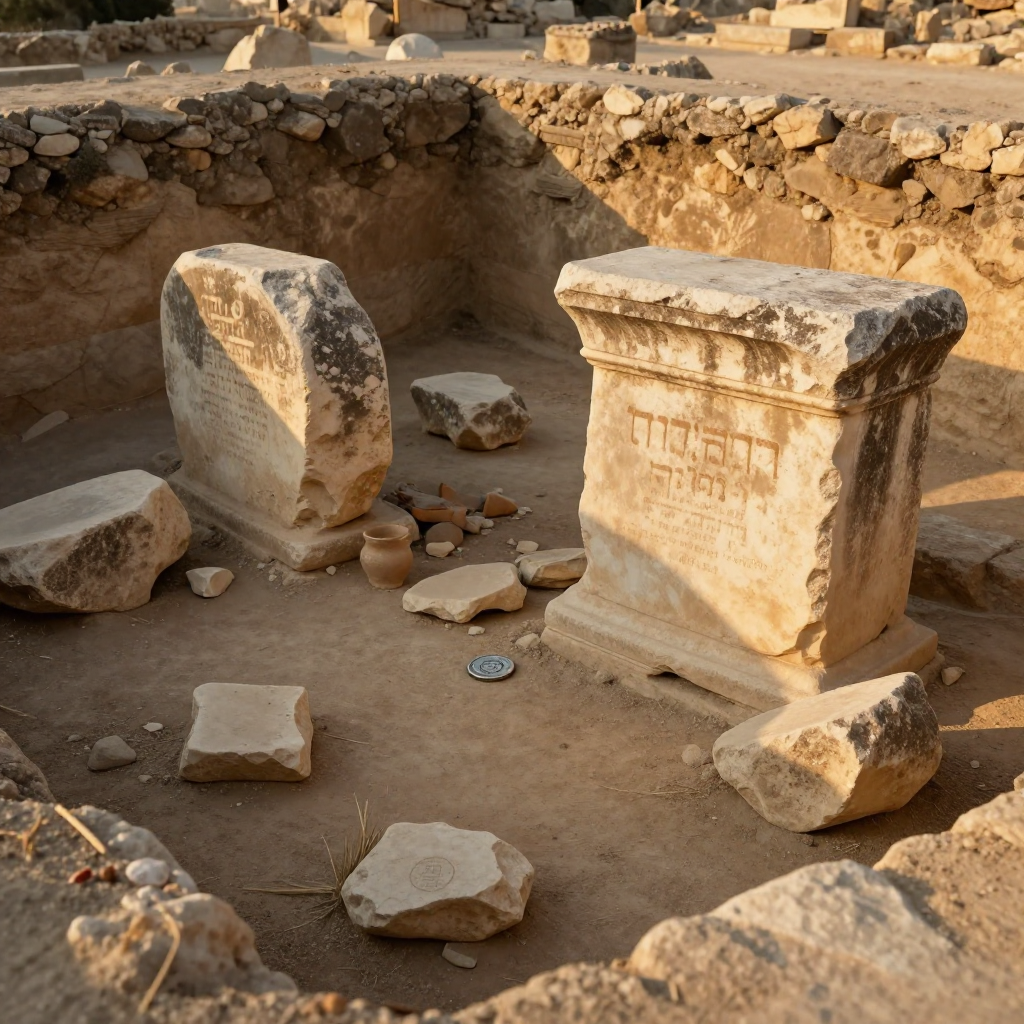
I have thought about that many times. What would it look like if the stones actually did cry out? No, I’m not talking about rocks suddenly growing mouths and starting to preach. I’m talking about what happens when archaeologists uncover the things that have been buried for centuries and those very things begin telling us about the people, places and events of the world recorded in Scripture.
And let me tell you something right from the beginning. I believe Jesus Christ is exactly who He said He is. I believe Yeshua walked this earth. I believe He healed the sick, opened blind eyes, made the lame walk, cast out demons, raised the dead, calmed the storm and performed every miracle recorded in Scripture. I don’t believe those things just because archaeology has convinced me to believe them. I believe them because I believe Him.
And I’ve seen Him work in my own life. I’ve seen things happen that I know HAD to be only by the hand of God. So when I read about the miracles of Jesus, I’m not sitting here wondering whether miracles are possible. I already know they are. I serve a living God. I’ve experienced His faithfulness myself.
What archaeology does for me is something different. It lets me look at the physical world in which these things happened and say, “Look at this!” Because sometimes the stones have been sitting there all along.
Take Nazareth for example.
The Gospel tells us that Jesus grew up in Nazareth, Matthew 2:23. And for a long time, people who wanted to cast doubt on the New Testament could point out that Nazareth wasn’t the sort of place that appeared prominently in the writings of the “great” ancient historians. But archaeology doesn’t care whether a town was famous enough to make it into somebody’s history book. Archaeology doesn’t care about opinions. If people lived there, they left things behind. We all have done that.
Archaeologists have uncovered remains at Nazareth showing that it was a Jewish settlement during the late Hellenistic and Early Roman periods. Excavations have uncovered domestic remains, pottery and other evidence belonging to the period in which Jesus lived there. The Israel Antiquities Authority has published archaeological work documenting this settlement. So there it is.
Nazareth was not a fictional town invented long after Jesus. There really was a Jewish community there during His lifetime.
Does that particular house belong to Jesus? No. We don’t have a stone sitting there with His name carved into it. But that’s not what I need. I don’t need an archaeological sign saying, “Jesus slept here,” to know that Nazareth existed. The ground itself has already answered that question.
And then we get to Jerusalem.
John tells us about a pool called Bethesda and gives us a detail that seems almost strangely specific. He says the pool had five porticoes,John 5:2. That’s the kind of detail that can make you wonder why the writer bothered to tell us that. But archaeological work on the pool complex has shown that there really was a large pool arrangement with the kind of five-portico configuration John describes.
And this is where I have to smile a little. Because somebody wrote that down two thousand years ago, and now they’re digging around in Jerusalem finding the exact thing he was talking about!
Then John tells us about another pool, the Pool of Siloam, where Jesus sent the man who had been blind to wash, John 9:7. The pool was not some imaginary feature added to make the story sound impressive. Archaeologists uncovered the ancient Pool of Siloam in Jerusalem, dating it to the Second Temple period.
And, yes, I do believe the miracle happened.
I don’t believe the man merely walked down there, washed his eyes and happened to get better because of some unexplained coincidence. I believe Jesus healed him.
The archaeology doesn’t perform the miracle again for us. It does something else. It puts our feet on the ground where the account says these things really happened. And that matters. Because my faith isn’t afraid of the ground. My faith isn’t afraid of archaeology. My faith isn’t afraid of somebody digging. If somebody uncovers a first-century house at Nazareth, wonderful. If somebody finds an ancient pool in Jerusalem, wonderful. If somebody finds an inscription with the name of a Roman governor mentioned in the Gospel, well, now you’ve really got my attention.
And that’s exactly what happened with Pontius Pilate.
For a long time, Pilate was simply a name we knew from the New Testament and from ancient historical writings. Then an inscription bearing the name of Pontius Pilate was discovered at Caesarea. It is a first-century limestone inscription identifying him as prefect of Judea. Pontius Pilate was not a character somebody invented for the Gospel story. His name is literally there on a stone.
And when I read the Gospel accounts of Jesus standing before Pilate, I know I’m reading about a real Roman official who actually governed Judea during the period in which Jesus was crucified.
And then we come to the crucifixion.
This one gets particularly interesting because archaeology has found physical evidence of crucifixion from the very time and place we’re talking about. The remains of a first-century Jewish man commonly known as Yehohanan were discovered with an iron nail passing through his heel bone. The remains provide direct archaeological evidence that crucifixion by nailing was actually carried out in Judea during the period of Roman rule.
Again, I don’t need that skeleton to prove that Jesus was crucified. Scripture already tells me that He was. And Jesus Himself gave me a vision that showed His torture.
But when somebody says, “Well, perhaps crucifixion in the way described in the New Testament isn’t historically realistic,” archaeology has something to say about that.
Yes, it was. The Romans really did crucify people. They really did use nails. And there is an actual first-century heel bone with the nail still there.
The stones are talking again.
And then there is the Shroud of Turin.
Now this one really gets my attention, because we’re talking about a piece of linen that bears the faint front-and-back image of a man who appears to have been beaten, scourged and crucified. The Shroud has been studied over and over again, and there is still a tremendous amount of discussion about exactly what it is and where it came from.
But here’s what I find so compelling about it. The image isn’t just the image of somebody who died. The man on the cloth appears to have wounds consistent with crucifixion, including marks associated with the wrists and feet, and there are blood-like stains on the cloth. The whole thing looks like the aftermath of a crucifixion.
And I know what you’re probably thinking. “Are you saying that’s Jesus?” YES. As a matter of fact, I am. I’m also saying that many Christians believe it is the burial cloth of Jesus, and I can certainly understand why. When you put the details together with the Gospel accounts of His crucifixion, it gets your attention.
There has been a great deal of scientific testing done on the Shroud. In 1988, three laboratories conducted radiocarbon testing on certain samples from the cloth, and the results were published in Nature. Those tests gave a date range of AD 1260 to 1390. That sounds like the end of the discussion, doesn’t it?
Except it wasn’t.
Researchers have continued examining the Shroud and questioning whether the sample used for the 1988 dating was representative of the main body of the cloth. There has been disagreement over the sample itself, the statistical results and the possibility of contamination or differences in the sampled area. And this isn’t some little argument that disappeared years ago. Scientists are still studying those original samples and the dating question.
A 2026 study examined fragments from the very samples used in the 1988 radiocarbon testing and reported that the fragments examined were consistent with the main body of the Shroud and showed no evidence of contamination. The researchers also acknowledged that the radiocarbon dating remains a subject of ongoing debate.
So what do we do with that? We don’t pretend the controversy doesn’t exist. We also don’t throw the whole thing away because one test produced a result we don’t like. We keep looking.
And that’s what I love about this whole subject. The more people look at these ancient things, the more questions they find. Sometimes the answer is immediate. Sometimes it takes another study, another excavation, another piece of evidence.
And sometimes the stone, or the cloth, makes us stop and say, “Wait a minute. What’s going on here?”
I don’t need the Shroud to make me believe that Jesus was crucified. Scripture already told me that. I don’t need it to make me believe He was beaten, scourged, nailed to a cross and wrapped in linen after His death. I believe the Gospel accounts. Why? Because He showed me. And I read it in His Word.
But when I look at an ancient piece of linen carrying the image of a crucified man, I can’t just shrug my shoulders and walk away. I want to know more. Because sometimes the evidence we uncover doesn’t answer every question for us. Sometimes it simply makes us look closer.
And then there is another piece of evidence I find especially important because it concerns James.
Josephus, the first-century Jewish historian, wrote about the execution of James and identified him as “the brother of Jesus, who was called Christ.” The authenticity of this passage has been examined extensively, and the overwhelming majority of scholars regard the passage as authentic. There are still scholars who challenge it, and I don’t have to hide that disagreement. But the evidence for the passage is substantial. Now think about what that means. James wasn’t just some name that appeared in a Christian book hundreds of years later. A first-century Jewish historian was writing about James and connected him directly with Jesus.
And then something else came to light that makes the James story even more fascinating.
There is an ancient limestone burial box known as the James Ossuary. An ossuary is a bone box used in Jewish burial practices during this period. This particular box bears an Aramaic inscription that reads, in translation, “James, son of Joseph, brother of Jesus.”
Now, this is where the story gets really interesting.
The ossuary was acquired by an Israeli collector named Oded Golan in the 1970s. According to accounts of the discovery, he initially regarded it simply as an old limestone bone box. The inscription was not understood for many years. Eventually, Golan showed the box to André Lemaire, a scholar of ancient Semitic languages, and Lemaire recognized the enormous significance of what the inscription appeared to say.
Think about that for a minute. Someone had this ancient stone box for years and didn’t even realize what was written on it. Then someone else, who could read the ancient language, looked at those scratches in the stone and realized that they might be saying, “James, son of Joseph, brother of Jesus.”
Now, I need to be careful here, because I don’t want to tell you something is settled when it isn’t. The ossuary itself is an ancient first-century burial box. The controversy concerns whether the entire inscription is ancient or whether part of it was added later. The Israel Antiquities Authority’s scientific committee concluded in 2003 that the “brother of Jesus” portion was a modern forgery, and scientific studies were published supporting that conclusion. Other scholars and later scientific analyses have argued the opposite, presenting evidence that the inscription and its patina are ancient. The question has therefore remained disputed.
And in 2012, after a lengthy trial, Oded Golan was acquitted of the forgery charge concerning the James ossuary. That acquittal did not establish scientifically that the inscription was genuine, but it is important because the court did not find that the prosecution had proved Golan had forged it.
So I am not going to stand here and tell you that archaeology has definitively proven that this particular box contained the bones of James. It hasn’t. We don’t have a scientific chain of custody connecting human remains to James the brother of Jesus. I truly wish we had though! But what we do have is an ancient ossuary bearing an inscription that says “James, son of Joseph, brother of Jesus”, along with a major scholarly debate over whether that inscription is ancient.
And honestly, even with that controversy, I find the whole story fascinating.
Because Josephus gives us James, the brother of Jesus, in the first century. Paul gives us James, the brother of Jesus, in his earliest Christian writings. And then an ancient burial box appears bearing a name combination that fits James, son of Joseph, brother of Jesus. That does not make the disputed inscription a settled fact, but it certainly gives us something worth examining.
And James wasn’t the only apostle whose existence is anchored in very early evidence. Paul wrote that after his conversion he went to Jerusalem and met Cephas, whom we know as Peter, and James, Galatians 1:18-19. Paul wasn’t writing centuries after the apostles were gone. He knew these men. And when Paul wrote about the resurrection, he said that he had received and passed on the tradition that Christ died for our sins, was buried, was raised and appeared to Cephas, the Twelve, James and others,1 Corinthians 15:3-8.
There is a great deal of discussion among scholars about the exact form and dating of the tradition that Paul is repeating, but there is no question that this resurrection proclamation belongs to the earliest period of Christianity. One Cambridge study specifically examines the pre-Paul character of the formula in this passage.
And there is another archaeological discovery from this same world that I find so interesting because it brings us back to the people surrounding Jesus during His final days.
In 1990, a burial cave was uncovered in Jerusalem’s Peace Forest, and archaeologists found twelve ossuaries inside. One of the most ornate bore the Aramaic inscription “Joseph son of Caiaphas.” Josephus, writing in the first century, refers to the high priest Joseph who was called Caiaphas, and the New Testament identifies Caiaphas as the high priest involved in Jesus’ trial. The archaeological discovery does not tell us everything that happened in that trial, of course, but it gives us a first-century burial box bearing the name of the Caiaphas family known from the historical record.
And that is another moment when I look at the stone and think, “There you are.”
We have Pilate. We have the Caiaphas family. We have the physical evidence for Roman crucifixion. We have Nazareth. We have Jerusalem. We have the pools of Bethesda and Siloam. We have James in Josephus. We have Peter and James in Paul’s own first-century writings. We have the earliest proclamation of the resurrection.
And this is where my faith comes right into the middle of the story. Because I believe Jesus Christ really rose from the dead. Not symbolically. Not merely in the hearts of His disciples.
He rose.
The tomb was empty because the Son of God conquered death. That’s not something I’m waiting for archaeology to give me permission to believe.
But when I find that the earliest Christian proclamation already centered on the death, burial, resurrection and appearances of Jesus, and that Peter and James are right there in that earliest testimony, I don’t shrug and say, “Well, that’s interesting.” I look at it and say, “Of course. That’s what the apostles were preaching.”
And then there is something else I find intriguing. Even the enemies of Christianity knew that Jesus was associated with extraordinary works.
The second-century critic Celsus, whose arguments against Christianity were preserved by Origen, did not simply dismiss the reports about Jesus’ extraordinary works as though nobody had ever heard such stories. His argument was that Jesus’ works should be explained as magic rather than divine power. Now, obviously, I don’t accept Celsus’ explanation. I believe those works were miracles. I believe Jesus healed because He is the Son of God. But notice what is happening. The argument had moved to a completely different question. The issue was not simply, “Did Christians, centuries later, invent stories about Jesus doing amazing things?” Jesus’ extraordinary works were already part of the controversy surrounding Him. And that makes perfect sense when I read the Gospels.
The people who saw what Jesus did had to decide what they believed about Him. Was He merely a teacher? Was He a prophet? Was He doing these things by some evil power, as the pharisees and scribes accusedd Him of? Or was He exactly who He claimed to be? The religious leaders in His own day were confronted with the same Jesus I am confronted with when I open the Gospels.
But I KNOW MY answer.
He is Lord. He is the Christ. He is the Son of God. He is the One who came in the flesh, died for our sins, rose again and is alive today.
That’s why this whole thing about the stones is so exciting to me. I’m not digging through the dirt trying to manufacture faith. I’m already a believer. I’m digging through the dirt and finding that the world described in the Bible keeps showing up. Nazareth was there. Jerusalem was there. Bethesda was there. Siloam was there. Pontius Pilate was there. The Caiaphas family was there. James was there. Peter was there. Paul was there. Crucifixion was there. His Resurrection WAS there!
And the earliest followers of Jesus were proclaiming His resurrection right at the beginning of the “Christian movement.”
And then there are all those other archaeological discoveries that keep filling in the world around them: first-century Jewish villages, synagogues, roads, homes, ritual baths, burial places, coins, inscriptions and the physical remains of the culture in which Jesus and His disciples lived.
I don’t need every artifact to have Jesus’ name on it. Why would I? I don’t expect to find a stone that says, “Jesus stood here at three o’clock on Tuesday.” That’s not how archaeology works. What I expect is exactly what we’re finding: evidence of the world in which He lived. And then I open Scripture and find that the people, places, customs and events described there belong to that same world.
That’s when I start thinking about what Jesus said. “If they keep quiet, the stones will cry out,” Luke 19:40. Maybe that’s exactly what we’re watching happen.
The stones aren’t replacing Scripture. They aren’t replacing faith. They aren’t replacing the testimony of the apostles. They’re simply giving us another witness.
And I believe the greatest witness isn’t buried underneath Jerusalem at all.
He’s alive.
That’s the part I never want us to lose while we’re looking at all these fascinating archaeological discoveries.
Jesus Christ is not merely somebody we are trying to prove existed. He did exist. He did live. He did die. He rose again. He is alive. And He is still working to bring in His Sheep.
I’ve seen Him work in my own life. I’ve seen Him answer prayer. I’ve seen Him do things that I could not do and that no human being could do for me. I know what I have experienced with my own eyes, and I know whom I have trusted.
So when I hear people say that miracles cannot happen because they haven’t seen one, I don’t have to argue with them. I can simply say, “Well, I’ve seen Him.” And I believe what I have seen. I believe what Scripture tells me. I believe the testimony of those who walked with Him. And now, when archaeologists uncover another stone from the world of Jesus, I can’t help but wonder what that stone is going to tell us next. Because Jesus said the stones would cry out.
And sometimes, when another piece of that ancient world comes out of the ground, it sure seems like they are.
✝️✝️✝️✝️✝️
Prayer:
Father, I thank You that Your truth does not depend on whether people choose to believe it. You are God, and what You have spoken is true. I thank You for giving me the desire to search, to learn, and to discover the things You have allowed us to uncover from the ancient world. When I look at the stones, the ruins, the inscriptions, and all the evidence left behind, help me remember that these are not merely pieces of history. They are reminders of a world in which Your Word came to life.
Lord Jesus, I believe You. I believe You walked this earth, that You performed the miracles recorded in Scripture, that You willingly gave Your life for me, that You died, were buried, and rose again. I believe You are alive today, and I thank You that my faith rests in You, not in the opinions of men. Let every discovery I encounter draw my attention back to You rather than becoming an end in itself.
Give me wisdom and discernment as I examine what has been uncovered. Help me recognize truth, question what needs to be questioned, and never be afraid of honest evidence. Let me see these ancient stones with eyes of wonder, remembering Your words that if Your people kept quiet, the stones themselves would cry out. And Father, may I never forget that the greatest testimony is not buried in the ground. It is Jesus Christ, my Lord and Savior, who was dead and is alive forevermore. Amen.
✝️✝️✝️✝️✝️
Don’t take my word for it. Like the Bereans in Acts 17:11, search the Scriptures daily to see whether these things are so. Open your Bible, study God’s Word for yourself, and ask the Holy Spirit to guide you into all truth. Don’t simply accept my conclusions. If what I’ve written agrees with Scripture, hold fast to it. If it doesn’t, let God’s Word be your final authority.
If you liked this message, please leave a positive comment. I would love to hear from you!
© AMKCH 2026
Picture was done by imagefree.net at my direction. This is not a real scene.
✝️✝️✝️✝️✝️
.