
Sometimes when I read a book, whether good or not so good, I might brush over long paragraphs to get past the “boring parts”, like descriptions. Sometimes those descriptions can take up whole pages! As I was reading God’s Word this morning, I thought about that. We cannot study God’s Word by just brushing over the paragraphs because they may be boring.
Paul tells us to “Study to shew yourself approved unto God, a workman that need not to be ashamed, rightly dividing the word of truth,” 2 Timothy 2:15.
We often hear this verse used as an encouragement to study the Bible, and certainly it is that. But if we are going to take the verse seriously, we should not rush past its own words. Paul does not just tell Timothy to acquire information. The Greek spoudazō carries the sense of being diligent, earnest, and making every effort, while orthotomeō, translated “rightly dividing,” means handling something correctly and accurately. Paul is talking about the kind of carefulness that produces a workman who has no reason to be ashamed before God. The goal is not to become impressive before other people. The goal is to be approved unto God and to handle the word of truth accurately.
That means we need to learn how to listen to Scripture rather than merely recognize it. There is a great difference between reading words on a page and actually paying attention to what those words are saying. We can become so familiar with a passage that we no longer see it. We remember what we were taught about it, what our favorite commentator said about it, what our church taught about it, or what we have heard preached for years, and then we read the passage through that conclusion. At that point, we may sincerely believe that we are reading Scripture when we are actually reading our understanding of Scripture, into Scripture.
That is a dangerous habit because an interpretation can become so familiar that we stop recognizing it as an interpretation. Once a particular explanation has been repeated often enough, people can begin saying, “The Bible says…” when what they really mean is, “This is what someone concluded the Bible means.” Those are not the same statement. A conclusion may be correct, but it must still be distinguished from the words upon which the conclusion is based. If we are going to study to show ourselves approved unto God, we have to be willing to examine the foundation of our conclusions instead of merely defending the conclusions themselves.
This is why the details count. Every word may not carry the same weight in every passage, but we cannot know which words matter until we have actually paid attention to them. A noun can establish a category. A pronoun can establish who is being discussed. A possessive can establish a relationship. A conjunction can connect two thoughts, or show that they are being contrasted. A singular or plural can matter. A word describing a person can matter. A word identifying a relationship can matter. Even a word that seems insignificant at first glance can become important when we discover that our interpretation depends upon it.
Genesis 25 gives us an excellent example because the passage is easy to read quickly and just as easy to make say more than it actually says. Genesis 25:1 says, “Then again Abraham took a wife, and her name was Keturah.” The Hebrew word there is ’ishshah, a word meaning woman or wife. The passage does not introduce Keturah as Abraham’s concubine; it identifies her as his wife.
Then Genesis names Keturah’s sons. “And she bare him Zimran, and Jokshan, and Medan, and Midian, and Ishbak, and Shuah,” Genesis 25:2. The passage continues by giving some information about their descendants. Jokshan fathered Sheba and Dedan, and Midian’s sons are named. Then the writer deliberately gathers those descendants together by saying, “All these were the children of Keturah,” Genesis 25:3–4.

Now we arrive at verses 5 and 6. “And Abraham gave all that he had unto Isaac,” Genesis 25:5. Then comes the statement that has caused us to stop and listen carefully: “But unto the sons of the concubines, which Abraham had, Abraham gave gifts, and sent them away from Isaac his son, while he yet lived, eastward, unto the east country,” Genesis 25:6. The Hebrew phrase translated “the sons of the concubines” contains the plural ha-pilagshim, “the concubines.” The verse says that Abraham gave gifts to those sons and sent them away from Isaac.
Then comes the temptation to read faster than the text.
Keturah’s six sons have just been named. Verse 6 mentions “the sons of the concubines.” It is very easy to make the two statements identical in our minds and then say, “Abraham sent Keturah’s sons away.” But stop and ask the question that careful Bible study requires us to ask: Where does Genesis actually say that?
It does not say, “the sons of Keturah.” It does not say, “Keturah’s sons.” It does not identify the sons of the concubines by name. It does not explicitly say that Keturah was one of those concubines. In fact, immediately before this statement, the text has explicitly called her Abraham’s wife. Therefore, if we identify Keturah’s six sons with the unnamed “sons of the concubines,” we have made an inference. We may investigate whether there is evidence for that inference, but we must not disguise the inference as though Genesis itself had made the identification.
That distinction is the very lesson.
We are not saying that no one may ever conclude that Keturah’s sons were included. We are saying something much more basic: the conclusion must remain a conclusion unless the text gives us evidence that establishes it. If someone teaches, “Abraham sent Keturah’s sons away,” the proper question is not whether that teaching is popular, ancient, or plausible. The proper question is, “Where does the text say that?”
There is another detail that should make us even more careful. Ishmael had already been sent away from Abraham’s household in a completely different event. Sarah told Abraham to cast out Hagar and Ishmael, and God told Abraham to listen to Sarah concerning the matter, Genesis 21:10–13. Genesis then tells us that Hagar and Ishmael departed and that Ishmael grew up in the wilderness, Genesis 21:14–21. Therefore, when we reach Genesis 25, we should not casually combine Ishmael’s earlier departure with the action described in verse 6. Scripture gives us the account of Ishmael’s departure separately.
Genesis 25 then gives us another remarkable detail. After the statement about the sons of the concubines being sent away, the chapter records Abraham’s death and says, “And his sons Isaac and Ishmael buried him,” Genesis 25:9. The text then proceeds to give a detailed account of Ishmael’s twelve sons and identifies them as twelve princes according to their tribes, Genesis 25:12–16. It tells us where Ishmael’s descendants settled, Genesis 25:18. Notice what the writer does: when he wants to identify a man’s sons, he identifies them. When he wants to identify descendants, he identifies them. When he wants to tell us where people settled, he tells us. That should make us cautious about supplying information where the text itself has chosen not to supply it.
The point is not that every unanswered question has some hidden answer waiting for us to discover. Sometimes the biblical writer simply does not tell us. We should be comfortable with that. There is humility in saying, “The text does not tell us.” We do not honor Scripture by filling its silences with our certainty. We honor Scripture by respecting both what it says and what it leaves unsaid.
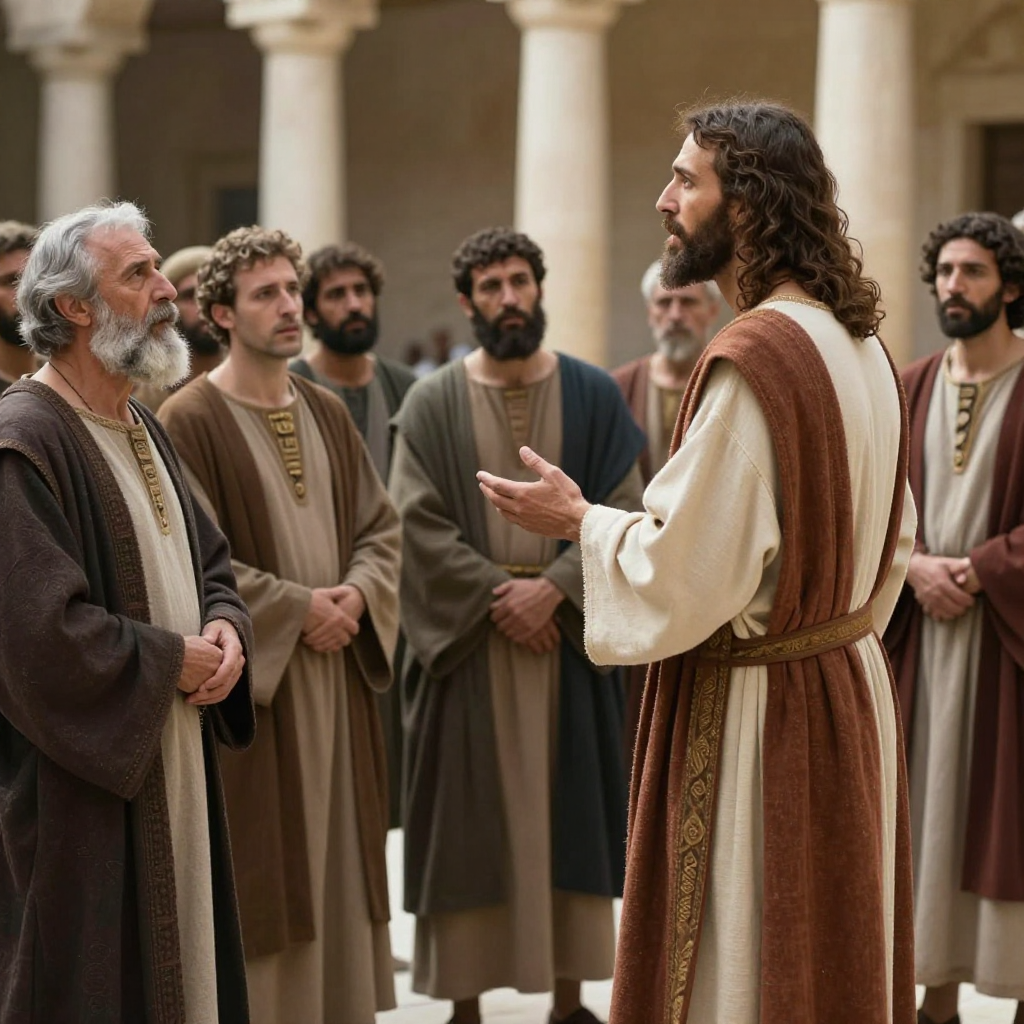
This principle is especially important because Scripture itself demonstrates that words matter. Jesus did not treat biblical wording as disposable. When the Sadducees questioned Him concerning the resurrection, He appealed to the wording of God’s statement to Moses: “I am the God of Abraham, and the God of Isaac, and the God of Jacob,” Matthew 22:32; Exodus 3:6. Jesus’ argument depended upon the statement as it was given. He did not brush over the wording because the general idea was already familiar. He listened to what God actually said and reasoned from it.
Paul likewise demonstrates the importance of wording when he discusses the promise made to Abraham and his “seed,” Galatians 3:16. His argument draws attention to the singular form of the word rather than treating “seed” as though the grammatical form were irrelevant. Whatever questions we may ask about Paul’s use of that passage, one thing is unmistakable: the wording mattered to the argument.
This is not merely a technique for proving doctrines. It is a posture toward Scripture. We are saying, in effect, “God has spoken, therefore I will pay attention.” If we believe that the Scriptures are worth studying, then we should care about what is actually written. We should not be embarrassed to slow down over a word. We should not dismiss a distinction simply because it interferes with an interpretation we have inherited. We should not assume that a passage says something because we have heard it said a thousand times.
There is also a warning in Scripture about the difference between truth and human talk. Paul tells Timothy to avoid “profane and vain babblings,” because such talk will increase ungodliness, 2 Timothy 2:16. He then gives examples of men who had “erred concerning the truth,” 2 Timothy 2:17–18. That immediately follows the instruction to be a workman approved unto God who rightly handles the word of truth. The placement is significant. Careful handling of truth and careless handling of words are not presented as equally harmless approaches.

This is why studying Scripture should involve more than just collecting verses that support what we already think. We should be willing to investigate the words that seem inconvenient. We should examine the surrounding verses rather than extracting one sentence or word from a paragraph. We should distinguish the people whom the text distinguishes. We should notice when the writer names someone and when the writer does not. We should notice whether a statement is explicit or whether we have supplied a connection ourselves. We should examine the original Hebrew, Aramaic, or Greek when a linguistic question actually matters. And when we find that our previous understanding rested on an assumption rather than an explicit statement, we should be willing to change our understanding.
That is not weakness. That is what being teachable means.
The danger of inherited interpretation is not that everything handed down to us is wrong. Much of it may be right. The danger is that we can become so accustomed to an interpretation that we stop testing it for truth. A person can arrive at a correct conclusion for the wrong reason. Another person can arrive at a mistaken conclusion while sincerely believing that he is merely repeating what Scripture says. Neither sincerity nor familiarity substitutes for examination. Someone once told me “Sincerity is no guarantee for Truth”. I live by that rule.
So when someone tells us, “The Bible says…” we should stop and listen carefully enough to ask ourselves,“Does the Bible actually say that, or is that what someone has concluded from what they read in the Bible?”That question is not disrespectful. It is precisely the kind of question a serious student of Scripture ought to ask.
And we should ask it of ourselves.
When we say, “The Bible says,” can we show where it says it? When we say, “Therefore,” can we explain why the conclusion follows? When we say, “This person is included,” can we identify the words that establish the inclusion? When we say, “These two statements are referring to the same people,” can we demonstrate that connection rather than merely assuming it? When we say, “This is what the passage means,” have we first established what the passage actually says?
The discipline is simple, although it is not always easy: separate the text from the interpretation.
First, listen to what is actually written.
✝️✝️✝️✝️✝️
Prayer:
Father, I praise You because You are the God of truth, wisdom, and understanding. Your Word is precious because You have spoken, and I worship You for giving us the ability to seek You, hear You, and learn from You. You are faithful, righteous, and worthy of all honor and praise.
Father, help me to study Your Word with diligence and humility. Teach me to listen carefully to every word You have given, to notice the details, and to distinguish what You have actually said from what I may have thought You said. Keep me from accepting an interpretation just because someone else taught it to me. Give me the courage to examine everything honestly and the humility to change my understanding when Your Word shows me that I am wrong.
Help me to handle Your Word truthfully, never adding to it and never taking away from it. When I know what You have said, help me to believe it. When I am making a conclusion, help me to know when it is my own understanding and not what You have actually said. And when Your Word does not tell me something, give me the humility to say, “I do not know.”
Above all, Father, let my desire be to be approved by You, not by people. Teach me to listen before I speak, to study before I conclude, and to seek Your truth above every tradition or human explanation. May I always remember that Your Word deserves my careful attention.
In Jesus’ name, amen.
✝️✝️✝️✝️✝️
Don’t take my word for it. Like the Bereans in Acts 17:11, search the Scriptures daily to see whether these things are so. Open your Bible, study God’s Word for yourself, and ask the Holy Spirit to guide you into all truth. Don’t simply accept my conclusions. If what I’ve written agrees with Scripture, hold fast to it. If it doesn’t, let God’s Word be your final authority.
If you liked this message, please leave a positive comment. I would love to hear from you!
© AMKCH 2026
image done by imagefree.net at my direction.
If any of these people looks like you or someone you know, that is purely coincidental. They are not.
✝️✝️✝️✝️✝️
.