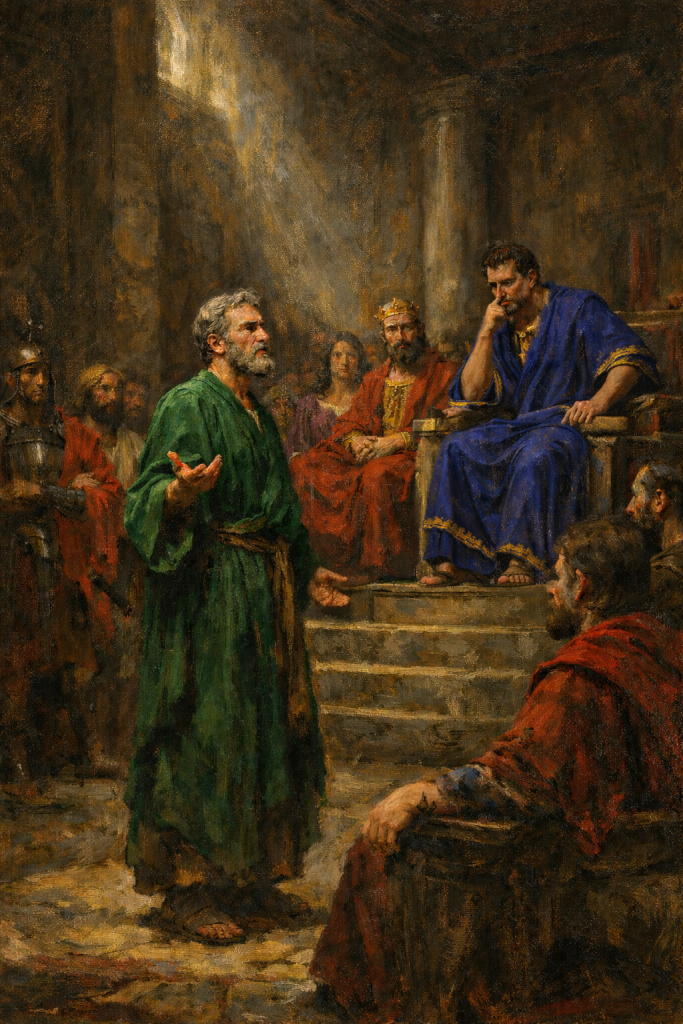
Paul’s Kind Of “Crazy”
They called him crazy. Not as an insult tossed around by enemies on the street, but as a conclusion reached by educated men in positions of authority. Paul stood before governors and kings, men trained to weigh evidence and assess credibility, and they decided something was wrong with him. He spoke about resurrection as if it were settled fact. He talked about a crucified man as though He ruled the world. He described encounters with God as if they were more real than stone walls and Roman law. And that was too much.
Festus finally said what everyone in the room was thinking:
“You are out of your mind, Paul. Your great learning is driving you insane.” Acts 26:24
Festus was not ignorant. He was not hostile to learning. He was responding to what sounded, to him, like the breakdown of reason: too much obsession with invisible realities, too much confidence in things that could not be verified by Roman standards. Resurrection of the dead was not courage; it was madness.
Paul did not panic. He did not soften his words. He did not apologize for how his faith sounded. He answered calmly, almost gently:
“I am not out of my mind, most excellent Festus. I am speaking words of truth and sober judgment.” Acts 26:25
He was not claiming to be smarter than Festus. He was saying that wisdom itself had been misdefined. The issue was not his sanity, but whose definition of truth was being used.
Scripture is very careful about foolishness. It does not treat it lightly, and it does not define it the way people do:
“The fool says in his heart, ‘There is no God.’” Psalm 14:1
The Hebrew word translated fool is nābāl morally corrupt, spiritually senseless, willfully hardened. This is not about IQ, education, or sophistication. A nābāl resists God even when He has made Himself plain. Creation testifies. Conscience bears witness. Truth is available. And
That matters, because Paul knew that category. Before Damascus, he did not believe in Yeshua. He did not misunderstand Him. He completely rejected Him. He denied that Yeshua was the Messiah. He believed Jesus was a false teacher whose followers were dangerous to Israel’s faithfulness. Paul did not think he was wrong. He thought he was righteous.
He said so himself later:
“I persecuted the church of God violently and tried to destroy it.” Galatians 1:13
Paul was not confused. He was convinced. He had training, authority, and Scripture memorized. His zeal was real. His conscience was clear. And he was wrong. That is important, because sincerity does not equal truth. Religious passion does not guarantee alignment with God.
That is why Damascus was not a simple change of opinion. It was a collision with reality. Paul was not searching for Messiah; he was traveling with orders to arrest believers, enforcing what he believed was obedience to God. And then God stopped him:
“As he was approaching Damascus, suddenly a light from heaven flashed around him. He fell to the ground and heard a voice saying to him, ‘Saul, Saul, why are you persecuting Me?’ He said, ‘Who are You, Lord?’ And He said, ‘I am Jesus, whom you are persecuting.’” Acts 9:3–5
That moment stripped Paul of every assumption he carried. Jesus was alive. Jesus was exalted. Jesus identified Himself completely with His people: to touch them was to touch Him. Paul learned, in an instant, that his confidence had placed him on the wrong side of God. That is where Paul stopped being a nābāl.
From that point forward, Paul no longer denied God. He began obeying Him. But obedience brought a new accusation. The world now used a different word: mōros—foolish, absurd by human judgment. Paul understood the difference, and he never confused them. That is why he could write without embarrassment:
“We are fools for Christ’s sake.” 1 Corinthians 4:10
He was not admitting error. He was describing how faithfulness appears to those who measure reality by power, success, and control. When obedience does not fit the world’s system, the world labels it irrational.
Paul explains why:
“The word of the cross is foolishness to those who are perishing, but to us who are being saved it is the power of God.” 1 Corinthians 1:18
The word foolishness here is mōria—madness, nonsense, absurdity. To the perishing, the cross makes no sense. A Messiah who dies looks defeated. Weakness looks like failure. Suffering looks pointless. But Paul had learned that the world defines victory wrong.
That is why he could say:
“God chose the foolish things of the world to shame the wise.” 1 Corinthians 1:27
God does not argue with human wisdom. He exposes it by bypassing it. He works through what the world discards. Paul understood that once God redefined wisdom for him, everything he once trusted had to be released—including his credentials.
Paul listed them openly: lineage, training, reputation, discipline. Then he said something radical:
“I consider everything a loss because of the surpassing worth of knowing Christ Jesus my Lord.” Philippians 3:8
The word loss is zēmia—damage, injury, harm. Paul did not say his past was harmless. He said clinging to it would pull him back into self-reliance. Human wisdom cannot slowly evolve into God’s wisdom—it must be surrendered.
That is why Paul talked about wisdom differently. He used sophia—wisdom, but not academic brilliance or philosophical argument. He called it a mystērion—truth revealed by God, not discovered by human effort:
“We speak God’s wisdom in a mystery, the hidden wisdom God ordained before the ages for our glory.” 1 Corinthians 2:7
This wisdom does not impress crowds. It does not protect reputation. It often looks ineffective until God acts. It requires trust instead of control.
That explains something Paul said that unsettles people:
“If we are out of our minds, it is for God.” 2 Corinthians 5:13
The phrase out of our minds comes from existēmi—to be beside oneself, overwhelmed, carried beyond normal limits. Devotion to God can look excessive. Obedience does not always fit within social comfort zones. Faith can appear unbalanced to those who do not share its foundation. Paul accepted this.
He did not hide his scars. He listed them plainly—beatings, imprisonments, hunger, exposure, sleepless nights. Then he said:
“If I must boast, I will boast of the things that show my weakness.” 2 Corinthians 11:30
Why? Because weakness strips away illusion:
“When I am weak, then I am strong.” 2 Corinthians 12:10
This is not poetry; it is lived reality. Strength, in Paul’s life, was no longer self-sufficiency. It was dependence on God’s power. That is why Paul did not fear being called mōros. He refused to live as a nābāl.
When the world calls believers naïve or simple for trusting Scripture, that is mōros. But when God Himself is denied, truth is suppressed, and hearts harden, that is nābāl. Paul drew the line, and it remains today.
Paul’s life demonstrates the difference. Faithfulness may look foolish to human eyes, but it is wisdom revealed to those aligned with the Spirit. Rejection of God’s truth is moral corruption, no matter how rational or learned the person appears.
To live like Paul is to accept misunderstanding. To follow Spirit-led wisdom is to accept criticism, mockery, and rejection. Being called foolish by the world does not make one a nābāl. Only rejection of God makes a person fall into that category.
Paul’s scars are his credentials. His weakness is his strength. His willingness to appear absurd is the path to God’s power. In every insult, misunderstanding, and hardship, he models Spirit-led clarity.
At the end of all things, it will not be those celebrated by the world who are exalted, but those willing to look foolish yet remain faithful. Titles, applause, influence—temporary. Faithful obedience—eternal.
Paul could laugh, speak boldly, suffer patiently, and die unshaken. He knew that being mōros in the eyes of men was no threat. Being nābāl in the eyes of God was the only danger worth fearing.
This is the line we are called to walk. When the world calls you simple, when family mocks your faith, when friends cannot understand why you obey God over man, remember Paul. He saw the difference, lived it, obeyed, suffered, and thrived. Not by worldly standards, but by the Spirit of God.
Obedience may look absurd, impractical, or even dangerous. But it is the path of life. It is the path of faith. It is the path Paul walked—and the Spirit calls each believer to walk today.
If you liked this message please leave a positive comment! I would love to hear from you.
Image done by my chatgpt at my direction.
.
.