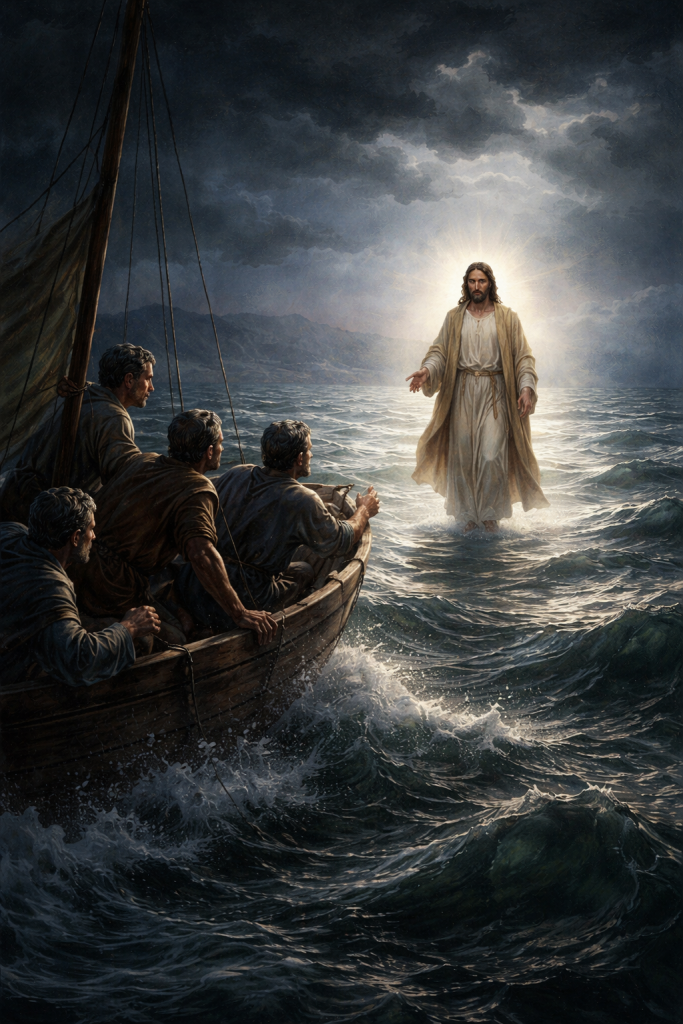
After Jesus (Adonai Yeshua) had fed the five thousand with just five loaves and two fish, a crowd had gathered in astonishment, amazed at what they had witnessed. They were satisfied, yes, their immediate hunger addressed, but their hearts and minds were unsettled. Miracles impress, but they do not always teach. Many in the crowd began to fixate on what they had seen, the bread multiplied and the abundance, and they considered taking Him by force to make Him king (John 6:15). Their focus was immediate relief, not the eternal purpose of His ministry. They were blind to the spiritual reality unfolding before them, seeing only the surface of what God was doing.
Jesus, perceiving the thoughts of their hearts, knew this was not the path He had come to walk. He withdrew from the crowd, ascending the mountain alone to pray. This was not a retreat born of fear or hesitation. It was communion, alignment, and preparation. Before authority is displayed over wind and waves, Jesus positions Himself in the presence of the Father. He does not allow human expectation to dictate His steps, nor does He allow the awe of miracles to divert His purpose. This quiet, solitary moment of prayer is as crucial to the story as any public miracle. It is the grounding for everything that follows.
While Jesus remained on the mountain, He sent His disciples ahead across the Sea of Galilee. Evening fell. Darkness settled. The disciples obeyed, stepping into the boat, moving forward in faith, though Jesus had not yet come to them (John 6:17). The darkness they faced was more than simply nightfall. The Greek word skotia carries the sense of obscurity, uncertainty, even a hiddenness of understanding. They were obeying, yet they could not see Him. They had faith, but not sight. This is often the way of obedience, it asks us to move even when clarity is absent.
As they rowed, the sea rose against them. A strong wind blew, and the waters became rough (John 6:18). The Greek word anemos indicates a violent, forceful wind, pressing against their progress. These were experienced fishermen, men who knew the waters, yet even experience cannot make a storm manageable when obedience leads you into resistance. They rowed for hours, and by the time Jesus arrived, they had gone only three or four miles (John 6:19). This is a reminder that human effort, even diligent, faithful effort, can be exhausted and still feel insufficient.
Mark’s Gospel adds an important detail: Jesus saw them straining at the oars (Mark 6:48). The Greek word basanizō describes torment, deep distress, and the grinding effort of human labor. YHWH is not indifferent to our struggle. Distance does not hinder our God’s vision. Darkness cannot conceal our efforts from Him. Psalm 33:18 reminds us, “Behold, the eye of YHWH is on those who fear Him, on those who hope in His steadfast love.” Even when the way is unclear, the effort is observed and valued.
Then, in the middle of the night, something extraordinary happens. Jesus comes to them, walking on the sea (John 6:19). The sea is never neutral in Scripture. In Jewish thought, it represents chaos, danger, and unpredictability. Genesis 1:2 describes the waters covered by darkness before God brings order. Psalm 77:19 speaks of God making His path through the waters. Job 9:8 says God alone treads upon the waves. The Hebrew verb darakh, to tread or march with authority, signals dominion. When Jesus steps onto the water, He is revealing identity, not merely performing a spectacular act. Chaos bends before its Creator.
The disciples’ immediate reaction is terror. They think He is a ghost. Fear misinterprets revelation when identity is unclear. But then Jesus speaks, and His voice slices through the uncertainty: “It is I; do not be afraid” John 6:20. The Greek egō eimi is profound. I AM. This echoes God’s self-revelation to Moses in Exodus 3:14, ehyeh asher ehyeh, I will be what I will be. Eternal, self-existent, present. The One who sent them into the storm is the One who walks over it, standing unshaken. Identity replaces fear. Presence replaces uncertainty.
Notice carefully: the storm does not immediately stop. The wind does not cease. Fear is transformed by recognition, not circumstance. Faith comes by hearing Romans 10:17, by recognition of the Word made flesh. The disciples’ labor does not vanish, they are still exhausted, but the presence of Jesus brings a shift that is far more profound than mere physical relief.
John tells us they willingly received Him into the boat (John 6:21). Presence must be received. Jesus does not impose Himself; He invites. And then, the miracle that can easily be overlooked: immediately, the boat reaches the shore where they were going. The Greek word eutheōs means instantly, without delay. Hours of rowing, struggle, and fatigue end in a single, transformative moment. Time and effort bend under His authority.
Psalm 107:29–30describes a parallel divine action: “He stilled the storm to a whisper; the waves of the sea were hushed. Then they were glad because of the calm, and He brought them to their desired haven” . The Hebrew chephets implies delight, God’s intended pleasure. God does not simply rescue; He completes the journey He has begun.
The disciples’ labor had value, yet it did not achieve completion. Only when Jesus entered the boat did their efforts bear fruit. This illustrates a central spiritual truth: diligence matters, but dependence matters more. Zechariah 4:6 reminds us that it is not by might nor by power, but by God’s Spirit. Faithful effort is honored, but divine presence brings completion.
There is a further lesson about peace. Jesus did not calm the storm before walking on the water. He did not still the wind before stepping into the boat. Peace is found in presence, not circumstances. Psalm 46:1 says, “God is our refuge and strength, a very present help in trouble.” The Hebrew me’od nimtsa means exceedingly found. He is not distant. He meets us where we are.
Faith does not always remove the storm. Faith is often recognizing Jesus in the boat and trusting that His presence brings transformation. Isaiah 43:2 says, “When you pass through the waters, I will be with you.” Through, not around. The water itself does not vanish, but guidance, protection, and purpose arrive in the midst of difficulty.
Timing, too, is divine. Jesus came in the fourth watch of the night, the hour just before dawn, when strength is nearly gone and hope is thin. Habakkuk 2:3 assures us that vision waits for its appointed time; it will not delay beyond the moment intended. What seems late to us is perfect in God’s plan.
Even creation acknowledges His authority. Water cannot naturally support human weight, and gravity pulls down without exception. Yet Colossians 1:16–17 tells us all things were created through Him, and in Him all things hold together. Nature is sustained by the Creator’s word. When He steps on the water, it is not suspended; it responds.
For the disciples, this was transformative. Adonai, Yeshua was no longer simply teacher or miracle worker. He was the I AM, eternal, sovereign, and present. Storm revelation deepens faith, preparing hearts to recognize God in ways that endure beyond the immediate miracle.
For us, this story meets the rhythms of our daily lives. We know what it is to row against resistance. Financial strain. Health struggles. Broken relationships. Emotional exhaustion. Obedience that seems unrewarded. Darkness that lingers longer than expected. Yet this passage reassures us: Jesus sees, Jesus comes, Jesus speaks. When received into our circumstances, arrival is no longer in question.
We may not know how long the rowing will last. But we know who rules the sea. And that knowledge steadies the soul.
✝️✝️✝️✝️✝️
Adonai, Yeshua, You who walked upon the waters and calmed the hearts of Your disciples, come now into the storms of my life. When the wind howls, when the waves rise, and when darkness hides the path ahead, remind me that You are near, watching, knowing, and guiding. Teach me to trust not in my strength or understanding, but in Your presence, for when You enter the boat of my life, everything changes.
I invite You, Adonai, into the struggles I cannot control, the fears that grip my heart, and the uncertainties that weigh me down. Speak Your words of life: “It is I; do not be afraid,” and let them echo in my soul, bringing courage where doubt lingers and peace where chaos rages.
Even when I cannot see the shore, help me to row in faith, knowing that Your timing is perfect, Your purpose unwavering, and Your love unending. May I recognize Your hand in every wave, Your guidance in every gust of wind, and Your glory in every trial. And when You bring me to the place You have prepared, may I rejoice, not only in the calm, but in the knowledge that You were with me through the storm.
Lord, make my heart like the disciples’, alert to Your presence, open to Your authority, and steadfast in faith. I surrender my fears, my efforts, and my understanding to You, trusting that You are the I AM, the eternal One, the Lord of life and all creation. Let Your peace reign in me today, tomorrow, and forever. Amen and Amen.