The TRUE Story of Perpetua and Felicity
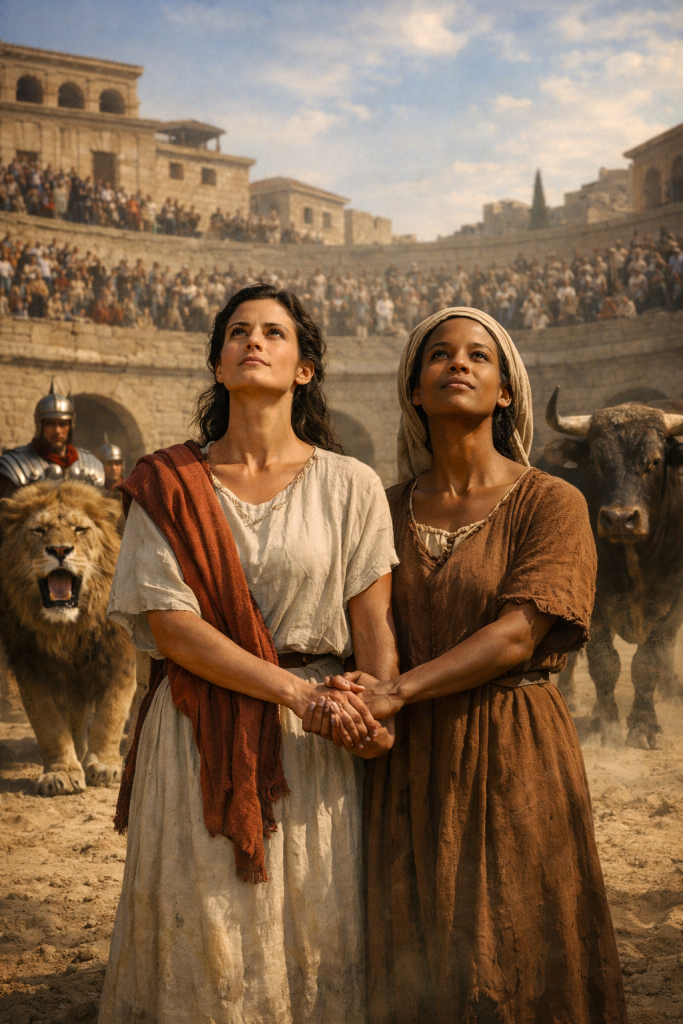
Perpetua was a young woman of noble birth, raised amidst the opulence of Carthage, a bustling Roman province in North Africa. Her family’s wealth was evident in their fine clothing, the many servants who attended them, and their grand home at the city’s heart. Carthage was a crossroads of culture, Roman power, and local tradition, a city alive with commerce, politics, and religion. Yet in the midst of such worldly abundance, Perpetua’s nephesh, her whole soul, hungered for something eternal. She longed for a truth that would not fade, a peace that would surpass the pleasures and comforts of her noble life. As Scripture instructs: “Seek first the kingdom of God and His righteousness, and all these things will be added to you” (Matthew 6:33). It was this pull toward God that shaped the course of her life, guiding her toward the One who is the ultimate source of peace and joy.
Her journey to faith was not without struggle. Perpetua knew the allure of the world, her roles as daughter, wife, and mother carried social expectations and familial duties. Yet she encountered Jesus Christ, known to her as Yeshua HaMashiach, and her heart was captured. Secretly, she studied the Scriptures, met with other believers, and discovered a love unlike any she had known. The joy she felt in her heart, a deep ruach of spirit, was unshakable, surpassing the fleeting satisfactions of her social status. Isaiah promises, “You will keep in perfect peace him whose mind is steadfast, because he trusts in You” (Isaiah 26:3), and this was the peace that Perpetua carried, even in the midst of the trials yet to come.
The cost of this faith became starkly clear in 203 AD. Roman Emperor Septimius Severus had forbidden conversions to Christianity, fearing the rapid spread of a faith that challenged imperial authority. Perpetua was arrested along with others in Carthage. Her father, a man torn between love and fear, pleaded with her to renounce Christ. He even offered the life of her infant son as a reason to recant, hoping she would return to safety. But Perpetua’s khesed, steadfast devotion, was immovable. She had undergone baptism, immersed in the cleansing waters of mikveh, and she knew that following Christ was the only path to eternal life (Romans 6:3-4). Her heart was already surrendered, her spirit set upon the eternal.
Within the prison, Perpetua encountered Felicity, a young slave who shared her faith. Felicity’s life had been one of oppression, years spent under the burdens of servitude, yet she had found hope in Christ. Even in chains, her ruach burned with perseverance. Like Perpetua, she was expecting a child, and the uncertainty of survival weighed upon her. Yet she endured with courage, her spirit strengthened by the knowledge that God’s promise was sure: “The Lord is my shepherd, I lack nothing… He restores my soul” (Psalm 23:1-3). Together, the two women became sisters in faith, praying, encouraging one another, and holding fast to the words of Jesus: “Blessed are those who are persecuted because of righteousness, for theirs is the kingdom of heaven” (Matthew 5:10).
Their days in prison were harsh. The air was thick, the walls damp, and the iron chains clanked with every movement. Guards mocked them, yet their spirits remained unbroken. Perpetua began experiencing vivid visions, glimpses of the heavenly realm where she saw herself standing before God’s throne, radiant and free. She was assured of the eternal reward awaiting her, echoing Christ’s promise: “Be faithful, even to the point of death, and I will give you the crown of life” (Revelation 2:10). These visions nourished her nephesh, giving courage that could not be quenched, even under the shadow of impending death.
Felicity gave birth while imprisoned, her child a fleeting joy in the midst of suffering. Scripture had reminded her, “For our light and momentary troubles are achieving for us an eternal glory that far outweighs them all” (2 Corinthians 4:17). Her ruach embraced the joy and pain together, trusting God to care for her newborn as He counts every hair on our heads (Luke 12:7). Both women faced the trial ahead with hearts united in prayer and courage, their friendship a tangible reflection of God’s steadfast love, khesed, which binds the faithful in every circumstance.
The Roman proconsul summoned them, and the courtroom brimmed with spectators. Perpetua’s father again implored her to sacrifice to the Roman gods. She responded with unwavering conviction: “I cannot. I have made my choice,” echoing Joshua’s declaration: “But as for me and my house, we will serve the Lord” (Joshua 24:15). The women were sentenced to death by wild beasts in the arena. In the days that followed, they found peace in Christ’s presence: “Never will I leave you; never will I forsake you” (Hebrews 13:5). Their nephesh ruach was fortified, hearts anchored in the eternal promises, walking courageously into the reality of suffering, yet sustained by God’s love.
The arena of Carthage was packed, the sun harsh on dust-strewn ground. Perpetua and Felicity stood side by side, fearless, embodying the eternal hope: “The Lord is my light and my salvation, whom shall I fear?” (Psalm 27:1). Wild animals were unleashed; a massive cow charged. The women fell, rose again, their courage undiminished, reflecting Christ’s victory over death (1 Corinthians 15:55-57) and His warning: “Do not be afraid of those who kill the body but cannot kill the soul” (Matthew 10:28). The soldiers finished the execution swiftly, yet their khesed, their steadfast love for God, remained undefeated. Perpetua and Felicity’s spirits ascended to eternity, fulfilling Paul’s words: “To live is Christ and to die is gain” (Philippians 1:21).
Their blood became a seed of faith across the Roman world. The courage of a noblewoman and a slave together demonstrated that true strength is found not in social standing but in the love of God. Their martyrdom inspired countless others to stand firm. Their story, a living sermon, echoes the promise: “Let us not become weary in doing good, for at the proper time we will reap a harvest if we do not give up” (Galatians 6:9). Faith rooted in God’s love endures even when earthly powers seem overwhelming.
Even today, their example calls us to unwavering trust. The courage of Perpetua and Felicity reminds us that faith is not merely intellectual assent but complete trust in Christ, permeating our nephesh and ruach. Life’s trials, though lesser in intensity than theirs, are opportunities to cling to God’s promises. Jesus, who walked with them, walks with us: “I am with you always, to the very end of the age” (Matthew 28:20). He strengthens the weary, restores the faint, and offers peace that surpasses understanding (Philippians 4:7).
Jesus’ sacrifice is the foundation of our hope. He endured suffering, offering life to the undeserving (Hebrews 12:2), and through Him, we can stand firm. Our love for Him, like that of Perpetua and Felicity, is not based on our merit but on His boundless grace (Romans 5:8). Nothing can separate us from this love (Romans 8:38-39). The daily struggles of life, whether pain, disappointment, or fear, are met with the assurance that His ruach upholds us, and our nephesh rests in His unchanging care.
We are called to embody their example, living as witnesses of Christ’s love in a world that often resists His ways. Our lives are His instruments, showing others the khesed we have received. When we face trials or approach death, we do so with hope, knowing the victory is already secured in Him (John 16:33). Perpetua and Felicity remind us that courage is born not of human strength but of the unwavering presence of God. In their footsteps, we can live boldly, love deeply, and trust completely.
May the story of Perpetua and Felicity encourage us as we walk our own paths of faith. Their martyrdom was not the end but the beginning of countless testimonies, a spark that ignited courage across centuries. In and for Yeshua HaMashiach, we are called to face trials, to embrace God’s love, and to shine as lights in a darkened world, secure in the promise that His love is greater than anything this earth can offer.
Heavenly Father, YHWH, Creator of all, we come before You in awe of Your steadfast love and mercy. We thank You for the example of Perpetua and Felicity, who stood firm in faith even in the face of death. Lord, their courage reminds us that Your love is greater than any fear, any trial, any earthly power.
Strengthen our nephesh and uplift our ruach, that we may stand unwavering in the truth of Your Word. Help us to trust You in every trial, to cling to Your promises, and to love You with all our hearts, as they did. May their example ignite in us a fire of faith that cannot be extinguished, a witness of Your khesed that shines in our homes, our communities, and our hearts.
Protect us, Father, from doubt and fear. Remind us daily that You are with us, guiding, sustaining, and comforting. Let us walk boldly in the path of righteousness, honoring Your name in life and in every challenge we face. And when our journey draws us close to the shadows of death or loss, may we, like Perpetua and Felicity, find peace in Your eternal embrace, rejoicing in the hope of Your Kingdom.
In and for Yeshua HaMashiach, we pray, Amen and Amen.
If you were blessed by this message, please leave a comment! I would love to hear from you.
©️ AMKCH 2025
image done by my chatgpt at my direction. If any of these people looks like you or someone you know, that is purely coincidental. They are not.
.
.