My side of the story.
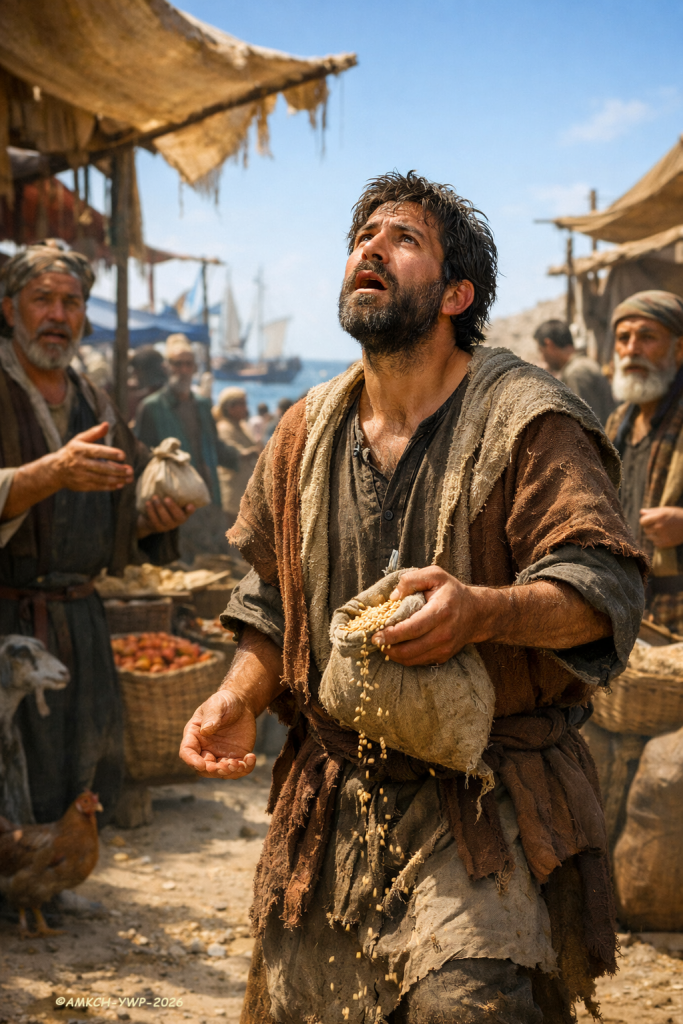
I was arguing with a merchant when God spoke.
The man had shorted me on barley. Not by much, but enough that it mattered. I held the sack open, running the grain through my fingers, counting by feel the way my father taught me. The merchant crossed his arms and smirked like he always did when he thought he’d won.
“That’s a full measure,” he said. “You prophets think rules don’t apply to you.”
“I’m not a prophet,” I snapped. “And this is light.”
People were watching. I hated that. I hated being looked at like I was supposed to be something better, calmer, holier. I just wanted what was fair. The argument heated. Voices rose. Then the world shifted.
“Jonah.”
The sound cut through everything. The market noise dulled, like I’d gone underwater. The merchant kept talking, unaware I wasn’t there anymore.
“Get up. Go to the great city of Nineveh and cry out against it, because its wickedness has come up before Me.”
Nineveh.
I knew Nineveh. Everyone did. Why would God ask me to go to these people? To give them a chance? A chance they didn’t deserve? The people of Nineveh were wicked, violent, and cruel. They were known for their brutality, tearing down nations and leaving no room for mercy. I had heard the stories, seen the destruction they caused, and I couldn’t imagine walking into that city to preach a message of repentance. My stomach clenched Grain spilled into the dirt. Someone cursed behind me. I didn’t care. Their caravans bullied their way through smaller towns. Their soldiers humiliated kings. Their leaders crushed the poor and called it order. I had heard survivors speak in whispers about what they did for sport.
God’s command hung heavy in my chest. I couldn’t understand it. These were the enemies of my people, and I wanted nothing more than to see them destroyed, not saved. There was no love in my heart for Nineveh, only anger, resentment, and fear. You want me to walk into that? You actually want me to speak?
I knew what I had to do. I turned away. I didn’t answer. I left the market with people shouting after me, barley forgotten, argument unfinished. I walked fast, then faster, like motion itself could drown out God.
By the time I reached the port, my decision had hardened into rebellion. I boarded the first ship I could find, sailing to Tarshish, as far away from Nineveh as I could get. That city lay in the opposite direction of Nineveh, and that was reason enough. If I could escape, if I could outrun God’s command, then I could be free from this burden. Maybe God would find someone else, someone who could go there without hesitation, someone who wasn’t so filled with bitterness. I paid the fare without looking at the captain. He eyed me like I was trouble.
“Running from someone?” he asked.
“Something like that,” I muttered.
But God didn’t let me run forever.
Below deck smelled of fish and fear. I wedged myself between crates and lay down, pressing my face into my arm. If I slept, maybe God would wait. Maybe He would choose someone else. I slept.
“What kind of man sleeps through that?” one sailor yelled.
I woke to the ship screaming. Wood cracked. Men shouted. Water poured in faster than they could bail it. I climbed the ladder and was slapped by wind so hard it stole my breath.
The storm came for me instead. It came on suddenly, a violent tempest that tossed the ship back and forth. The sailors were terrified, throwing cargo overboard in a desperate attempt to save the ship. They cast lots to find the cause of their misfortune, and when the lot fell on me, I knew what had happened. It was my fault. I was running from God, and He had found me.
Another grabbed me. “Pray! Pray to your god!”
I knew they didn’t want to throw me overboard, but the storm wasn’t relenting. They begged me to pray to my God, but deep down, I knew the only way to stop the storm was for me to accept my fate.
“What did you do?” they demanded.
“I ran,” I confessed to the sailors, “I am a Hebrew, and I worship the Lord, the God of heaven, who made the sea and the dry land.”
They were horrified. I could see it in their eyes. Their fear sharpened into anger. “Then fix it!”
“There’s only one way. Throw me into the sea,” I said. “It’s the only way.”
They didn’t want to do it. They argued. They prayed. They cursed me. When they finally threw me overboard, the water closed over my head like judgment.
Then came mercy I did not want.
The fish swallowed me whole. Darkness crushed in. It was all-consuming. The stench burned my throat. I screamed until there was no air left, then sobbed, then prayed words I barely meant. The walls felt as if they were closing in around me, each breath a struggle against the thick, suffocating air. Three long days felt like I was dying in pieces. Here I was trapped in a prison of my own making. The stillness was deafening, a silence broken only by the sound of my racing thoughts and the rhythmic pounding of my heart. I argued with God until my voice was gone. I accused Him of cruelty. I accused Him of mercy. I remembered Scripture like it was a lifeline and hated myself for needing it. My prayers were my only escape, whispers of repentance and plea for mercy, yet even they seemed to fade into the dark void, swallowed by the depths of the sea. The pressure of it all, the isolation, the guilt, the regret, pressed in on me from all sides, leaving me with nothing but the bitter taste of my own rebellion.
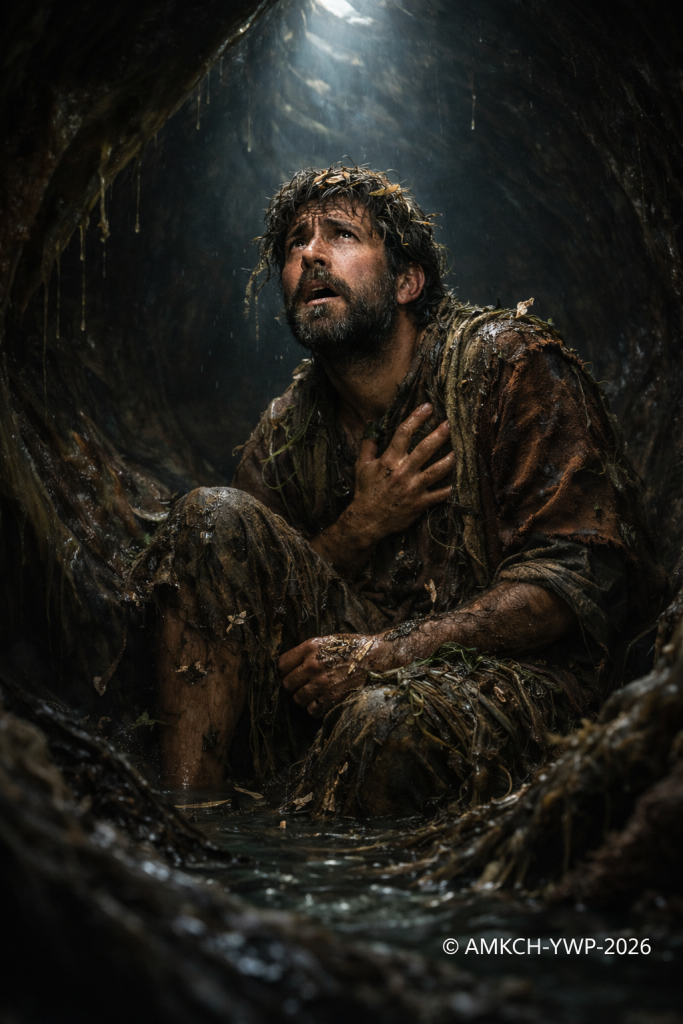
I had tried to flee from God, but I couldn’t escape. His mercy followed me into the depths, reminding me of everything I had run from.
In that dark place, I finally understood. I had been shown mercy when I didn’t deserve it. I had been given a second chance, even when I had turned my back on God. And now, God was calling me to extend that same mercy to the people of Nineveh.
I prayed, confessing my rebellion and asking for God’s forgiveness. “When my life was ebbing away, I remembered you, Lord, and my prayer rose to you, to your holy temple. I will sacrifice to you with a song of thanksgiving, and I will fulfill what I have promised.”
God heard me, His ears, always attentive to the cries of the broken. In that moment, I felt the weight of His gaze upon me, piercing through the darkness and the silence. With a single command, He ordered the fish to release me from its suffocating grip. The great creature, at the bidding of the Almighty, thrust me onto dry land as though I were nothing more than a discarded scrap. The sand beneath me felt foreign, like a reminder of the world I had abandoned, and yet, as I lay there, gasping for breath, I knew without a doubt what was required of me next.
When the fish expelled me onto land, I lay there shaking, covered in filth and shame.
“Get up,” God said again. “Go to Nineveh.”
This time I walked.
I went to Nineveh, not because I wanted to, but because I had to. It wasn’t a choice, it was a command. I’d tried to flee before, running as far as I could, but the will of God always found me. And now here I was, in the middle of this great, sinful city, proclaiming a message I never wanted to speak: “Forty days, and Nineveh will be overthrown!”
The city rose before me like a wound. Its walls were massive. Its gates crowded. Guards watched me like prey. Inside, I saw it immediately. The cruelty wasn’t hidden. A soldier shoved an old man aside for walking too slow. Merchants cheated openly. A child cried while his mother was dragged away for a debt she could never repay. People laughed. No one intervened.
My hands shook.
I opened my mouth and yelled.
“Forty days!” I shouted. “Forty days and this city will be overturned!”
The words felt strange in my mouth, like I was betraying everything I thought I knew about justice. These people—this city—were known for their cruelty, their wickedness. I had no love for them. I couldn’t stand the thought of them being spared. But I had no choice but to speak.
People stopped. Some laughed. Others cursed.
“Who is this?” someone sneered.
I kept going. I yelled until my throat burned. I pointed at their violence. I named their sins. I told them their power meant nothing to the God who sent me.
I walked through the streets, and as I spoke, I saw the reactions. At first, I thought they would mock me, ignore me, or even punish me. But to my shock, it didn’t go that way. The people—each and every one of them—believed the message. The mighty king, sitting on his throne, was the first to respond. He rose from his seat, tore his robes, and put on sackcloth, humbling himself before God. The rest of the city followed suit. They fasted. They put on sackcloth. From the greatest to the least, they turned away from their wickedness!
A group of men surrounded me. One shoved my chest. “Say that again.”
“I will,” I said, voice cracking. “Because it’s true.”
Fear spread faster than mockery. Someone ran. Another fell to his knees. Whispers turned to shouts. Shouts turned to wailing. Word reached the palace. The king came down from his throne, not in pride but terror. He tore his robe. He ordered fasting. He commanded repentance.
The city broke.
People wept in the streets. They returned stolen goods. They begged forgiveness. Even the animals were denied food as if creation itself joined the mourning.
I stood there, stunned. I had expected destruction, fire, and wrath. But instead, I saw repentance. I saw a city broken, a people acknowledging their sins. It was as if God’s message had cut through the hardness of their hearts, and they had responded. There was no arrogance, no denial, only a deep, urgent desire to change.
And then I waited. I waited for the inevitable… fire and brimstone. But it never came.
I left the city and climbed a hill, heart pounding with anger I couldn’t explain. God had done it. He had spared them.
Instead, God’s mercy came. He saw their repentance, their willingness to turn from their evil ways, and He forgave them. I couldn’t understand it. How could God extend mercy to such a wicked city? How could He forgive them after everything they had done?
I went outside the city, climbed a hill, and found a spot where I could sit and watch, hoping for something that would never come. I wanted to see the destruction, to witness the fire and the chaos that I thought were deserved. I wanted to see the wrath of God poured out on those people, who, in my eyes, had lived in sin for too long. I couldn’t shake the feeling that Nineveh had to be punished. So, I waited. I waited as the sun beat down, and the stillness of the air seemed to mock my own restless heart.
In the quiet of that hill, I wrestled with my emotions. Anger simmered beneath the surface—anger at the Ninevites, but also at God. How could He forgive them? After all they had done? Didn’t they deserve what had been promised? And yet, here I was, watching, unable to move, even as the city continued to stand. It was like I was in limbo, caught between my own narrow understanding of justice and God’s boundless mercy.
I wanted to be distant from them, detached from the whole situation, because my heart was not at peace. The people of Nineveh had repented, yes, but I couldn’t understand how that could change everything. They had been so wicked, so violent. Why should they be spared? Why should they not face the same wrath that had been promised? My heart was still hardened, still holding on to the idea that their sins were too great to be erased in an instant.
I went outside the city, climbed a hill, and found a spot where I could sit and watch, hoping for something that would never come. I wanted to see the destruction, to witness the fire and the chaos that I thought were deserved. I wanted to see the wrath of God poured out on those people, who, in my eyes, had lived in sin for too long. I couldn’t shake the feeling that Nineveh had to be punished. So, I waited. I waited as the sun beat down, and the stillness of the air seemed to mock my own restless heart.
I wanted to be distant from them, detached from the whole situation, because my heart was not at peace. The people of Nineveh had repented, yes, but I couldn’t understand how that could change everything. They had been so wicked, so violent. Why should they be spared? Why should they not face the same wrath that had been promised? My heart was still hardened, still holding on to the idea that their sins were too great to be erased in an instant.
In the quiet of that hill, I wrestled with my emotions. Anger simmered beneath the surface—anger at the Ninevites, but also at God. How could He forgive them? After all they had done? Didn’t they deserve what had been promised? And yet, here I was, watching, unable to move, even as the city continued to stand. It was like I was in limbo, caught between my own narrow understanding of justice and God’s boundless mercy.
But then, just as I was sinking deeper into my resentment, I felt a stirring. It was subtle at first, a quiet whisper in my heart, but unmistakable. God didn’t leave me alone in my anger. He didn’t let me sit there, fuming and clinging to my bitterness. It was as if He was telling me, “You can’t keep your heart closed like this.” The discomfort grew stronger, and the weight of my emotions began to shift. God wasn’t going to allow me to wallow in my frustration. He wasn’t going to leave me with just my limited understanding of justice. He was going to show me something I had refused to see.
Then He started talking to me.
I hadn’t asked for it, yet in that moment, I felt a small sense of comfort. It was a brief reprieve, but a welcome one, as I sat there on the hill, still waiting, still fuming, still clinging to my frustration with Nineveh’s survival. The scorching sun had been unbearable, and for just a moment, the plant was a reminder that God, in some small way, was watching over me.
But the next morning, something changed. I woke to find that the plant had withered. The leaves had shriveled and the stem was dead. I could feel the scorching heat again, but this time, there was no shade to protect me. It was as if my small comfort had been taken away in an instant, and I found myself angry once more, more irritated than ever. My mind, already clouded with resentment, now felt a fresh sting of loss, something so small, yet I felt its absence keenly. In the heat of the moment, the death of the plant seemed to mirror my own frustration, my own sense of unfairness. Why should I be left without this comfort? Why should I be left to endure the heat when I had been given relief, only to have it ripped away?
“This is unfair!” I yelled. “That plant mattered to me!”
(image to come)
And then, in that stillness, God spoke to me, “You have been concerned about this plant,” He said.
It was as if He was drawing my attention to something I hadn’t fully grasped. I had been so consumed by my own discomfort, so fixated on my own small loss, that I hadn’t even stopped to think about the nature of the plant itself. I hadn’t tended to it, nurtured it, or given it life. It had simply appeared, given to me as a small gift, and just as quickly, it had vanished. And yet, I was deeply upset by its loss.
His voice wasn’t loud, but it carried a weight that made me stop in my tracks. “Though you did not tend it or make it grow. It sprang up overnight and died overnight.”
“They’re monsters!” I shouted back. “They deserved destruction!”
“And you deserved the sea,” He replied.
I went silent.
The truth settled like dust after a storm. I had lived because of mercy. They lived because of mercy. I had hated it until I needed it.
The city stood. God’s mercy stood with it.
And I stood there, small, exposed, and finally honest before Him.
Then God’s words cut deeper, piercing through my self-centered thinking. “And should I not have concern for the great city of Nineveh, in which there are more than a hundred and twenty thousand people who cannot tell their right hand from their left, and also many animals?”
His words were gentle, yet convicting. In that moment, I saw the full weight of my own narrow perspective. I had cared more for the plant—something so fleeting, so temporary—than for the lives of the people in Nineveh. A hundred and twenty thousand souls, many of whom were lost and didn’t even know their right from their left. I had been so caught up in my anger and my sense of justice that I had failed to see the bigger picture. God’s concern wasn’t just for one fleeting plant, it was for the whole city, for every lost soul, for the creatures of the land, for everything He had created.
In that moment, it became clear: I had been blind to the very mercy I had just witnessed in Nineveh. God’s heart wasn’t small. It wasn’t limited to a single moment of discomfort or a single, withered plant. His heart was as vast as the city of Nineveh, and even greater.
I sat there, stunned. God had shown me the depth of His mercy. I had been so consumed with my own feelings of justice and vengeance that I couldn’t see what He was doing. The people of Nineveh had repented, and God had shown them mercy—not because they deserved it, but because He is merciful.
I had learned the hardest lesson of all: mercy isn’t something I can control. It never was. From the moment God called me to Nineveh, I fought against Him—not just against His command, but against the very nature of who He is. I ran, thinking I could outrun His purpose, only to be swallowed by the very mercy I despised.
Nineveh deserved destruction. Their wickedness was undeniable, their cruelty infamous. I was ready—eager, even—to witness their downfall, to see the justice they had earned finally fall upon them. But justice was not God’s final word. Mercy was.
When they repented, God relented. And I, though I had spoken His warning, could not rejoice in His forgiveness. I sat outside the city, seething, my heart heavier than the scorching sun that beat down on me. He gave me a vine for shade, and I welcomed it—only to mourn when He took it away. And then He asked me,“Do you have a right to be angry?”
I had no answer. My rage crumbled under the weight of His question. Here I was, grieving a plant that lived and died in a day, yet unmoved by the salvation of thousands. My heart had been small, but God’s mercy had never been.
This wasn’t about me. It was never about my understanding of who deserved grace. It was about a God whose compassion stretches beyond human limits, whose mercy is bigger than my anger, my hatred, my sense of justice. I had wanted Nineveh’s destruction, but God had wanted their redemption.
And in the end, His mercy stood firm. Unshaken by my resentment. Undeterred by my protests. A mercy that belongs to Him alone. ✝️✝️✝️✝️✝️
I hope this message blessed you. If so, please leave a comment. I look forward to hearing from you.
Note:The Ninevites are believed to come from the descendants of Noah’s son Shem, specifically through Asshur. The Bible in Genesis 10:11 states, “From that land he [Nimrod] went to Assyria, where he built Nineveh, Rehoboth Ir, Calah, and Resen, which is between Nineveh and Calah—which is the great city.” This suggests a connection between Asshur, a son of Shem, and the founding of Nineveh. Some believe Nimrod, a descendant of Ham, may have played a role in its early history, but traditionally, the Assyrians, including the Ninevites, are traced back to Asshur. This places them among the Semitic peoples.
Images were done by my ChatGPT at my direction
Both teaching and images are © AMKCH YWP 2026
.
.