Fellowship in the Fire
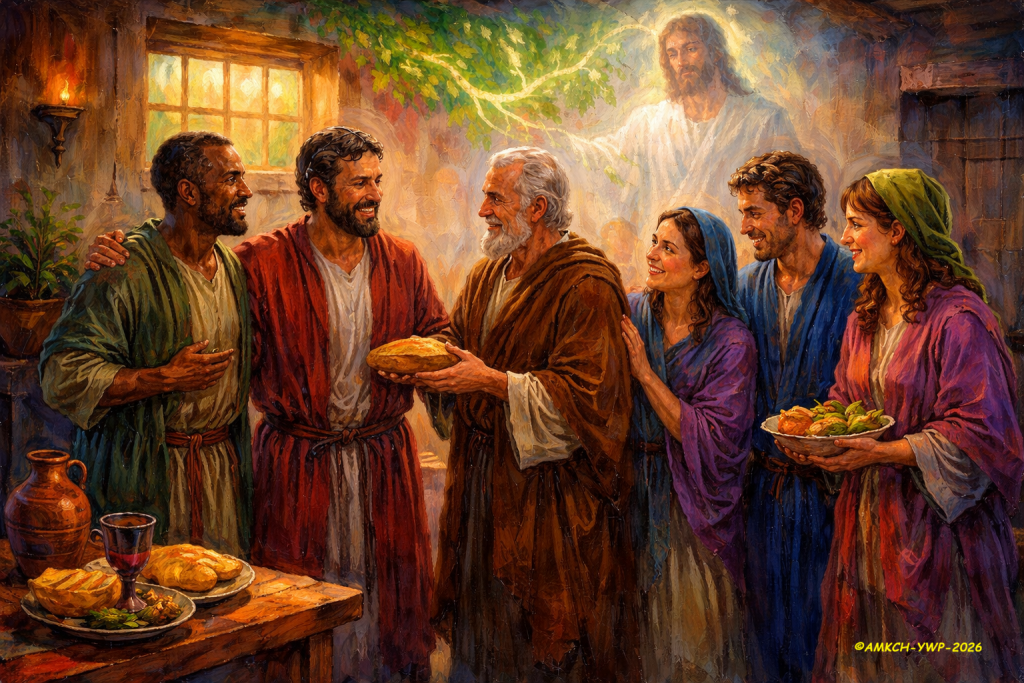
When we look at the early church, one of the most beautiful and demanding realities we encounter in Scripture is Κοινωνία (koinōnía) meaning shared life, participation, partnership. It is often translated as fellowship or communion, but those English words are too small if we imagine potlucks, meetings, or friendly gatherings. Κοινωνία is not casual and it is not optional. It speaks of people bound together by something stronger than preference, comfort, or personality. It is a shared life shaped by God Himself. It is partnership in what He is doing in the world.
Κοινωνία means lives braided together around Christ. It means hearts, resources, suffering, joy, mission, and responsibility are no longer private property. It is the kind of unity where personal identity is real, but no longer supreme, because a greater shared identity has taken precedence. In Christ, believers do not merely associate. They belong to one another because they belong to Him.
This reality becomes visible immediately in the life of the early church. Acts 2:42 tells us, “And they continued steadfastly in the apostles’ teaching and fellowship (κοινωνία), and in the breaking of bread, and in prayers.” This is not a schedule of activities. It is a description of a life reordered by the Spirit. Their response to the outpouring of the Holy Spirit was not individual spirituality but shared existence. Doctrine was not abstract information. It became the framework for how they lived together.
They did not merely listen to teaching. They inhabited it. The apostles’ words shaped how they treated one another, how they spent their money, how they bore pain, and how they celebrated grace. Κοινωνία meant that joy and suffering were no longer faced alone. Faith was not lived in isolation but embodied in community. The gospel was not something they believed privately. It was something they practiced together.
This shared life naturally expressed itself in action. Acts 2:44–45 describes believers holding things in common, selling possessions, and distributing as needs arose. This was not charity driven by guilt. It was the natural outflow of belonging. When lives are genuinely shared, need becomes personal. Another believer’s lack is no longer someone else’s problem. It touches the whole body.
This is why breaking bread mattered so deeply. Meals were not just rituals detached from life. They were moments where equality was practiced, barriers were lowered, and provision was remembered as coming from God. Prayer was not performance. It was shared dependence. In Christ, they had become a family, not by bloodline or culture, but by the blood of the Lamb. Romans 12:13 reminds us, “Contribute to the needs of the saints and seek to show hospitality.” Amen!
To understand the fullness of κοινωνία, it must be seen as responsibility as much as blessing. The early believers knew they were not simply enjoying community. They were stewarding something holy. They had been transformed by the gospel, and that transformation bound them together. Their fellowship reflected God’s own nature; His relational, faithful self-giving. This shared life carried a shared purpose. Philippians 1:5 speaks of their κοινωνία in the gospel, meaning partnership in its advance. Every believer mattered. Every life was part of the mission. Fellowship was not passive. It was active participation in God’s work, using gifts for the strengthening of the body and the reaching of the lost.
Because they belonged to one another, they bore one another’s burdens. Galatians 6:2 instructs, “Bear one another’s burdens, and so fulfill the law of Christ.” Because they shared identity, they shared cost. Caring for one believer meant caring for the body as a whole. This is why generosity was not heroic but normal. The life of Christ flowed through them together. 1 John 3:17 says, *”But if anyone has the world’s goods and sees his brother in need, yet closes his heart against him, how does God’s love abide in him?* This shows that fellowship is never theoretical. It is tested in practical, sacrificial love.
Paul later describes this shared identity clearly in 1 Corinthians 12:12–13: “For as the body is one, and has many members, and all the members of that one body, being many, are one body: so also is Christ. For by one Spirit we were all baptized into one body, whether Jews or Greeks, whether slaves or free, and we were all made to drink of one Spirit.” Differences remained, but divisions lost their power. Ethnicity, social status, and former boundaries no longer defined worth. All were brought into one living organism through the Spirit of God. This is the heart of κοινωνία. Not sameness, but unity. Not erasure, but belonging.
This fellowship carried weight. The early believers understood that shared life required shared faithfulness. They were accountable to one another because they were accountable to Christ. This is where κοινωνία leads us into deeper waters, because it cannot be separated from Κρίσις (krísis), meaning judgment, decisive reckoning.
At first, fellowship and judgment sound like strange companions. But Scripture binds them together. Κρίσις is not only about the end of time. It is God’s righteous confrontation with sin, disorder, and rebellion. It is His decisive action against what destroys life. It is not neutral, and it is not gentle. It is necessary.
The English word crisis captures something of this weight. A crisis is not a moment that feels hopeful or improving. It is a time when things are wrong, unstable, dangerous, and painful. It is when systems fail, lives unravel, and weakness is exposed. Crisis is what happens when brokenness can no longer be ignored. It is worse, not better. This is why Κρίσις matters. God does not pretend that brokenness is manageable. He judges it. He confronts it. He acts decisively against it. For those outside of Christ, this is terrifying. For those in Christ, it is salvation.
Jesus speaks plainly in John 12:31: “Now is the judgment (κρίσις) of this world: now shall the ruler of this world be cast out.” The cross was not only an act of love. It was an act of judgment. Sin, death, and the powers of darkness were exposed and defeated. Christ’s death and resurrection were the decisive reckoning that broke their authority.
When we enter into κοινωνία with Christ, we enter into the victory of His κρίσις. We are no longer judged as enemies but purified as children. Judgment does not disappear. Its purpose changes. It no longer condemns. It refines. This κρίσις continues to work in the lives of believers. It is not postponed entirely to the future. God’s judgment operates now through the Spirit. Conviction reveals what does not belong. Exposure brings what is hidden into the light. This is uncomfortable and often painful, because it touches our attachments, habits, and false securities. But it is not rejection. It is mercy.
God’s κρίσις removes dross. It burns away what destroys life. It reshapes us into the image of Christ. This judgment leads to life because it deals honestly with what is wrong. Crisis hurts because something is wrong. God’s judgment heals because He refuses to leave us there. This refining work happens within fellowship. We are not purified alone. Others see what we cannot. Others carry us when we are weak. Others speak truth when we are blind. James 5:16 reminds us, “Therefore confess your sins to one another and pray for one another, that you may be healed.” This is why κοινωνία matters. It is the place where God’s judgment becomes restorative rather than crushing.

As we live in fellowship with Christ and with one another, we participate in His victory. His κρίσις does not destroy us. It frees us. It restores our true identity. It teaches us how to live as people no longer ruled by fear or brokenness. Romans 12:10 encourages us, “Love one another with brotherly affection. Outdo one another in showing honor.” Fellowship calls us to active love, mutual support, and the courage to endure the refining fire together.
Paul reminds us in 1 Corinthians 1:9, “God is faithful, by whom you were called into the fellowship (κοινωνία) of His Son Jesus Christ our Lord.” This calling is not light. It is eternal. Fellowship is where God’s refining fire works. It is where crisis meets redemption. It is where judgment produces holiness.
In this shared life, we are continually shaped. Not by condemnation, but by truth. Not by fear, but by victory. The κοινωνία we experience with one another is the life of God flowing through His people. The κρίσις we experience within is His loving, transforming work that refuses to leave us broken. 1 Peter 4:8–10 reminds us, “Above all, keep loving one another earnestly, since love covers a multitude of sins. Show hospitality to one another without grumbling. As each has received a gift, use it to serve one another, as good stewards of God’s varied grace.”
That is fellowship in the fire. That is κοινωνία entwined with κρίσις. That is the call to bear one another’s burdens, to walk through crisis under God’s judgment, and to emerge sanctified, strengthened, and united in Christ. Amen
PRAYER:
Heavenly Father,
We come before You, grateful for the gift of shared life, for the mystery and beauty of κοινωνία. Thank You for binding us together in Christ, for making us not just individuals, but members of one body, part of Your family, connected in love, joy, and purpose. Teach us to carry one another’s burdens, to rejoice together, and to weep together, always reflecting the heart of Jesus in all we do.
Lord, we acknowledge Your κρίσις, Your righteous judgment. Help us to understand that it is not condemnation but refinement, a fire that purifies and shapes us into the image of Your Son. May we embrace Your correcting hand, allow it to uncover what is hidden, and trust Your mercy to restore and strengthen us. Let Your Spirit work in our hearts so that even in moments of crisis, we see Your victory and the power of Your presence guiding us through.
Father, we ask that our fellowship not be casual or superficial. Make it sacred, active, and life-giving. Let our lives interweave so that generosity, encouragement, and care flow naturally from one to another. Let us share not only our joys and resources but also our strength, wisdom, and faith. May our community be a living testimony of Your love, reflecting the unity and grace that You desire for Your people.
Keep us humble, teachable, and aware of one another. May Your presence in our fellowship bring healing where there is brokenness, courage where there is fear, and light where there is darkness. Let us walk together in Your Spirit, bound by the blood of Christ, strengthened by Your judgment that leads to life, and empowered to live boldly for Your glory.
We pray this in the name of our Lord Jesus Christ, our true Vine, our Redeemer, and our Friend. Amen.
✝️✝️✝️✝️✝️
If you liked this message, please leave a comment. I would love to hear from you!
Image was done by my chatgpt at my direction. If any of these people looks like you or someone you know, that is purely coincidental. They are not.
Both teaching and image are © AMKCH YWP 2026