Connection, and Responsibility
In the beginning, God created the heavens and the earth, and all that He made was perfect. Words carried meaning because creation itself responded to the Creator. Adam did not struggle to find the right words. His speech reflected truth, reality, and relationship. Genesis 1:1, In the beginning God created the heavens and the earth, shows that creation came forth through God’s Word. Everything Adam said resonated with life. There was no miscommunication, no confusion, no disconnect. Naming the animals was not a simple exercise in labeling; it was recognition of essence and purpose. Genesis 2:19, Whatever the man called each living creature, that was its name, reveals that language in Eden was participatory: speech and reality were in harmony. Adam understood creation, and creation understood Adam. God’s world was not only beautiful in design; it was beautiful in relationship, understanding, and communication. The first language Adam spoke was powerful, direct, and living. It reflected his communion with God, with creation, and with himself.
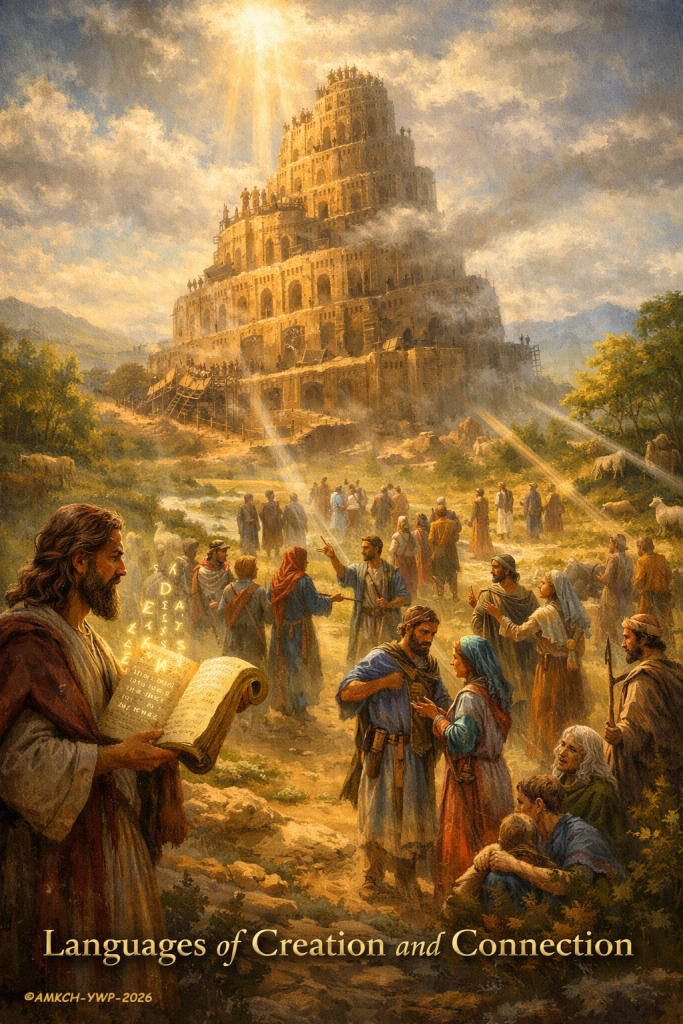
Then came choice, and with choice came rebellion. Humanity was given freedom, and freedom without humility became pride. The Tower of Babel illustrates the consequences of such rebellion. Genesis 11:1, The whole earth had one language and the same words, shows unity of speech, but Genesis 11:4, Let us make a name for ourselves, exposes pride. The Hebrew verb qarar means to seek fame or self-glory apart from God. People sought to reach the heavens themselves, grasp the power of God, and exalt their own name. Their hearts were hardened, their ambitions selfish, and they ignored God’s presence. Their language, which should have built community and understanding, became a weapon of arrogance.
God did not remain silent. Genesis 11:7, Come, let us go down and confuse their language, shows righteous intervention. The Hebrew balal means to mix, to disrupt, to scatter. Speech fractured because sin had fractured hearts. Those who once built together could no longer communicate. Their pride had blinded them to God, and God, in justice, prevented the escalation of destruction that unchecked ambition would bring. This was not mere “niceness.” It was holiness acting to preserve humanity from the consequences of sin.
Yet even in judgment, God’s wisdom shone. The scattering produced diversity. Different languages became a reflection of divine creativity. Each new tongue carried unique culture, memory, and worldview. Language was no longer only a tool for communication; it became identity, perspective, and a way of understanding reality. Acts 2:6, Each one heard them speaking in his own language, shows that God values diversity in purpose, but He also calls for unity in righteousness. The gift of language carries responsibility: just because we can communicate differently does not give us the right to deceive, oppress, or belittle one another.
Hebrew exemplifies this deeply. Words carry life and covenant. Shalom is not merely peace; it is wholeness, integrity, relational completeness. Numbers 6:26, The Lord lift up His countenance upon you and give you peace, speaks of restoration and protection. Chesed, covenant loyalty, steadfast love, acts with endurance even amid trials. Exodus 34:6, The Lord, merciful and gracious, abounding in steadfast love, shows that God’s goodness is active, persistent, and relational. Adam’s language reflected this order; Babel shows what happens when humans abandon it. Hebrew reminds us that every word carries moral weight. Misuse of language can separate communities and fracture faith.
Greek gave the apostles a language precise enough to carry the gospel into a complex world. Multiple words for love—agapē, selfless sacrificial love; philia, brotherly friendship; storgē, family devotion; eros, desire—helped believers understand God’s relational character. John 15:13, Greater love has no one than this, that someone lay down his life for his friends, is agapē in action. Faith is pistis, trust grounded in loyalty. Grace is charis, unearned favor that transforms behavior. Greek allowed precision, but humans could still distort it. Language carries power; when corrupted by pride, it separates rather than unites.
Latin preserved Scripture for centuries, becoming the Church’s guardian language. Its descendants—Spanish, French, Italian—carry structure and Christian legacy. Spanish expresses relational warmth, family, and community. Mandarin carries layered meaning, honoring respect and continuity. Arabic communicates devotion through rhythm and sound. English spreads Scripture widely, carrying history and evolving nuance. Every language reflects God’s order, but humans must wield it with humility. Misuse can divide, oppress, or distort truth.
Even today, language can reflect pride, greed, and selfishness. We judge others by accent, appearance, or tongue. We use words to wound, exclude, and belittle. James 3:5–6, The tongue is a small member, yet it boasts of great things. How great a forest is set ablaze by such a small fire! God reminds us that language carries moral weight. Every word, gesture, and sentence can build life or destroy it. Just because someone speaks differently does not give the right to mock, harm, or neglect them. God calls for care, compassion, and justice.
Sign language demonstrates God’s provision and justice. It shows that even those who cannot hear are not excluded from communication, understanding, or worship. Language is relational, living, and meant to connect. Revelation 7:9, A great multitude from every nation, tribe, people, and language standing before the throne, shows that diversity exists eternally, honored and redeemed in God’s presence. Humans are called to reflect that unity without erasing identity. Pride fractures; humility restores. Words honor God when they lift others, protect the weak, and teach truth.
God’s discipline is part of language’s purpose. Babel scattered those who would exalt themselves. Christ restores. John 17:23, That they may be one, just as You, Father, are in Me, and I in You, that they also may be in Us, demonstrates that unity comes through relationship with God, not forcing sameness. Redemption is relational. Speech becomes a tool for blessing, teaching, comforting, and connecting, not for asserting dominance. Language honors God when it communicates truth, encourages the weary, and uplifts the oppressed.
The modern world continues to test this gift. Social media, global communication, and cultural differences bring immense opportunity for understanding—but also danger for division. Pride, envy, and greed distort speech. When we twist words to dominate or belittle, we echo Babel. When we speak words of love, patience, and justice, we mirror God’s order. Proverbs 16:24, Pleasant words are a honeycomb, sweet to the soul and healing to the bones, shows that language can heal, guide, and comfort when aligned with God’s will.
Languages are living threads that weave through creation and culture. Hebrew, Greek, Latin, Spanish, Mandarin, Arabic, English, and sign language reveal human identity, history, and devotion. They reflect divine creativity, but they also reflect responsibility. We are called to speak truth, care for those who are marginalized, correct injustice, and honor God in communication. Words can bridge differences or widen them; the choice lies in our hearts. Pride scatters; humility restores. Selfishness wounds; love heals. God’s Word calls us to justice, care, and relational integrity, no matter the language we speak.
God’s Word instructs that every word matters. Colossians 4:6, Let your speech always be gracious, seasoned with salt, so that you may know how you ought to answer each person, reminds us that responsibility accompanies every utterance. Language can serve self-interest or God’s glory. It can tear down communities or build them up. It can divide nations or unite believers. The gift of speech carries eternal weight.
One day, all will stand before God, united not by uniformity but by faith, humility, and love. Every tongue, culture, and gesture will testify to His glory. Psalm 19:1, The heavens declare the glory of God; the skies proclaim the work of His hands, reminds us that creation itself communicates truth. Human language participates in that witness. The gift of speech is holy. Misused, it destroys; used rightly, it builds life. Pride scatters; humility restores. Selfishness wounds; love heals. God’s Word calls us to justice, care, and relational integrity, no matter the language we speak.
©️AMKCH-YWP-2026
Image done by my ChatGPT at my direction
Both teaching and image are © AMKCH YWP 2026