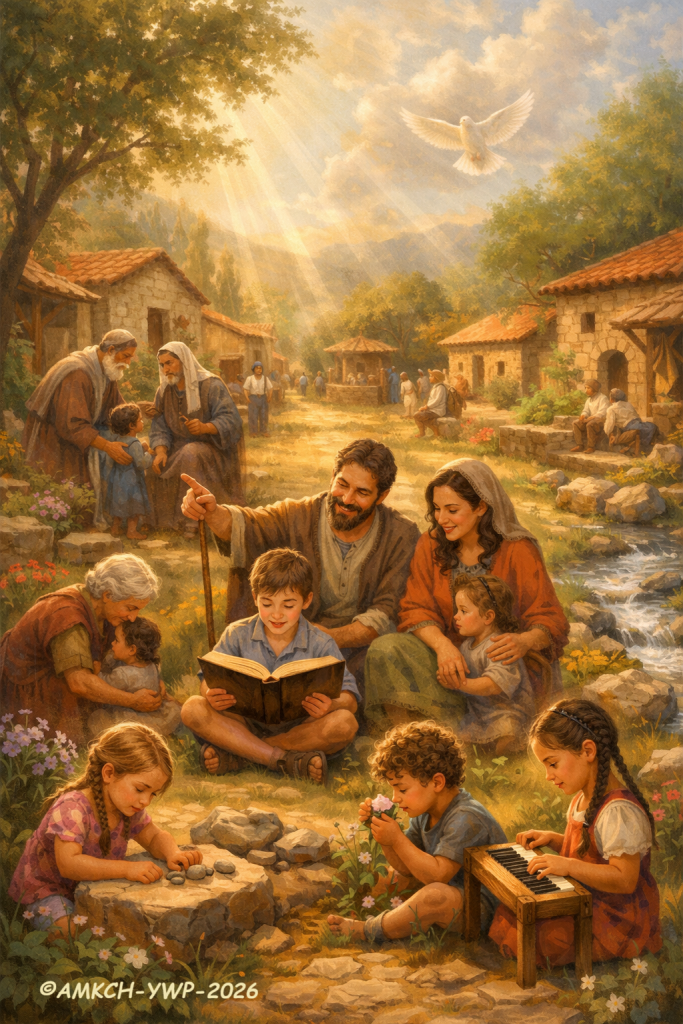
Raising children in the love of Christ is not merely a good idea; it is a sacred responsibility. It is a holy trust that God places upon the hearts of parents, a calling that reaches far beyond the routines of daily life or the practicalities of provision. From the very beginning, Scripture shows what covenant means, what family is intended to be, and how central love, wisdom, and obedience are to the shaping of life itself. Raising children is not separate from walking with God. It is a living, breathing part of that walk, woven into the rhythm of life, the shaping of relationships, and the worship of His holy name in every moment.
When God spoke to Adam and Eve and said, “Be fruitful and multiply and fill the earth” (Genesis 1:28), He was not merely issuing practical instructions. In Hebrew thought, multiplying was not only about numbers. It was about passing on His image and filling the earth with hearts that carry His likeness. Parenting, then, is about raising souls, not only caring for bodies. It is nurturing people who know God, reflect Him, and live in a way that honors His holiness. Parents are called to shepherd the hearts, minds, and spirits of their children in a manner that mirrors God’s own love for His creation.
Parenting in ancient times was never done in isolation. Children were part of the entire community. Elders, neighbors, and extended family members all participated in shaping the children’s character and understanding. It was not unusual for an elder or a neighbor to correct a child who had strayed or misbehaved. This correction was never offered out of pride or curiosity but out of genuine love and concern. Parents would then follow up with guidance of their own. In this way, the child was corrected twice, not to shame, but to shape character and instill understanding. There was unity, accountability, and a shared sense of responsibility. Children learned that love is strong enough to guide, tender enough to correct, and consistent enough to nurture righteousness. They saw firsthand what it means to be part of a community that loves God and one another.
In contrast, many of today’s settings have shifted this rhythm. Discipline is often seen as the parent’s sole responsibility. Cultural norms frequently discourage anyone outside the household from correcting a child. If a neighbor, or even a teacher, or elder offers guidance, it may be met with resistance or viewed as interference. Children rarely experience the broader community of faith actively participating in their moral formation. Without this shared responsibility, parents can feel isolated, and children may miss the reinforcement of godly living and loving correction that was once natural in growing up within a faith-centered community.
Parents are not only guides in character and faith but also in intellectual and academic formation. Ancient families understood this instinctively: the home was the child’s first classroom. Today, however, many families see academics as the teacher’s sole responsibility. Yet children who are introduced to reading, writing, and curiosity about the world long before formal schooling gain strong foundations that last a lifetime.
Some children, when guided early, achieve remarkable progress. My children, for example, were reading at a third-grade level by the age of three. They were curious about numbers, geography, and even the sciences, exploring and asking questions about the world around them. This early engagement did more than teach skills, it cultivated curiosity, discipline, and a lifelong love of learning. Such early experiences become the roots of a mind that seeks understanding, a heart that delights in knowledge, and a spirit that rejoices in God’s creation.
At the heart of raising children in God’s love is the Shema in Deuteronomy 6:4-7. The word Shema (שָׁמַע, shama) means hear, but it is far more than listening with the ears. It is hearing with the heart and responding in obedience. “Hear, O Israel: The Lord our God, the Lord is one. Love the Lord your God with all your heart and with all your soul and with all your strength.” Parents are commanded to impress these words upon their children. The Hebrew word for impress, שָׁנַן (shanan), means to sharpen, to instill something so deeply that it becomes a part of the person. Teaching children about God’s love is woven into everyday life: at breakfast, on walks, during bedtime, and in the rhythm of daily living. Truth takes root in these small, ordinary moments, growing steadily under God’s care.
Discipline is part of this journey, but it is always a form of loving correction, never harshness or cruelty. Proverbs 22:6 instructs, “Train up a child in the way he should go, and when he is old, he will not depart from it.” The Hebrew word חָנַךְ (chanak) means to dedicate or initiate. To train a child is to walk alongside them, to point out the path they were made to follow, and to help them trust it. Proverbs 3 reminds that the Lord disciplines the one He loves, as a father disciplines the child in whom he delights. Discipline is not rejection; it is a reflection of God’s delight. Parents mirror this love by guiding with compassion, correcting with wisdom, and never losing sight of a child’s value in God’s eyes.
Nothing speaks louder than example. Children may forget the words they hear, but they rarely forget what they see. Parents who live with integrity, pray with sincerity, treat others kindly, and love God openly are planting seeds that sink deep into a child’s spirit. That is why Deuteronomy 6 begins with the call for parents themselves to love God with all their heart. Children learn faith through witnessing it lived, through observing consistent love in action.
Paul echoed this in Ephesians 6:4, urging fathers not to provoke their children to anger but to bring them up in the training and instruction of the Lord. Even in a culture where fathers held complete authority, Paul called for gentleness. Strength and loving correction walk hand in hand, reflecting God’s heart. Firmness is never meant to intimidate; guidance is never meant to dominate.
Parenting is never meant to be done alone. The faith community carries part of this responsibility, just as it did in the days of Moses. Hebrews 10 reminds believers to encourage one another and not forsake meeting together. When children see other believers living out their faith, when they are welcomed into the broader family of Christ, they understand that faith is not merely personal but communal. The church becomes a living classroom where God’s love is taught, embodied, and passed on, reinforcing lessons from the home and strengthening the child’s understanding of His kingdom.
Through all of this, grace flows abundantly. No parent gets it right every time, yet God’s grace is sufficient. As 2 Corinthians 12:9 promises, His power is made perfect in weakness. When parents stumble, God’s Spirit reaches children in ways human effort cannot. He restores, strengthens, and nurtures in moments when human guidance is not enough.
God reminds repeatedly of the reality of correction and accountability. When wrongdoing goes uncorrected, hearts grow accustomed to it, slowly shaping habits that resist truth (Ecclesiastes 8:11). Even kindness and blessings alone cannot teach a child to do what is right if the heart is not open (Isaiah 26:10). Sometimes, despite the best efforts, stubborn hearts resist change (Jeremiah 5:3). God waits patiently, giving space to repent (Revelation 2:21). His correction is never harsh; it is a sign of belonging, for He disciplines those He loves (Hebrews 12:6). Parents are called to teach children while they are young, guiding with love so that lessons take root and flourish (Proverbs 22:6).
Raising children in the love of Christ is a sacred calling. The road is long, winding, and full of challenges, yet God walks beside parents every step. Living and teaching His truth, disciplining with love, modeling faith in the everyday, leaning on the community, and nurturing early learning allows children to grow into people who know, love, and follow Him. The love of Christ is the thread that weaves all these pieces together, correcting, nurturing, modeling, and persevering, planting eternal seeds in the lives of children, shaping them not just for this world but for the life to come.
PRAYER
Holy Father,
We ask that you would cause parents’ hearts to overflow with wisdom beyond their own understanding, patience that mirrors Your own, and courage to guide even when the path is difficult. Encourage their words and actions to teach with integrity, their corrections to be gentle yet firm, and their love to remain unwavering. Establish their lives as living examples of faith, kindness, and obedience to You.
Guide the community that surrounds these children to speak truth in love, offer discernment, and walk in unity with parents. Nurture the village to reflect Your heart, cultivating righteousness, accountability, and compassion. Help children to see Your kingdom reflected in the care, example, and devotion of all who guide them.
Open the minds of children to wonder, curiosity, and understanding. Strengthen their hearts with Your wisdom, enlighten their spirits to seek You, and allow Your seeds of knowledge and truth to flourish through every season. Protect them from harm and guide them firmly along the paths of righteousness and joy.
Release abundant grace where human weakness appears. Help the weary to rise, encourage the hesitant to move forward, and reveal that Your Spirit works beyond human effort. Let every correction, every lesson, every act of love carry the power of Your enduring presence and cultivate lives that honor You forever.
In the name of Jesus Christ, Shepherd, Teacher, and Redeemer,
Amen.
(image “Children”