Jerusalem was overflowing, pressed beyond its ordinary limits, the way it always became when the pilgrimage feasts arrived. The city didn’t just look crowded, it sounded crowded. Languages overlapped in the streets, accents bending familiar Hebrew into something foreign. Sandals scraped against stone, carts rattled through narrow ways, animals were guided carefully through alleys not built for this many bodies. The air was thick with the smell of baking bread, dust stirred up by feet, sweat under the hot sun.
It was the Feast of Weeks, the appointed time Israel had been counting toward since the offering of firstfruits of harvest, exactly as YHWH had commanded in Exodus 34:22 and detailed in Leviticus 23:15–21. Seven full weeks had been counted from the day after the Sabbath. Fifty days were complete.
The Torah called it חַג שָׁבֻעוֹת Chag Shavuot, the Feast of Weeks, tied to the wheat harvest and the presentation of the first yield back to God, as also told in Deuteronomy 16:9–12 and Numbers 28:26. It was a feast built around trust. The harvest had come in, not because Israel controlled the rain or the sun, but because YHWH had been faithful again. Each year, the people gathered to acknowledge that life, growth, and provision came from His hand alone.
That year, no one arriving in Jerusalem realized they were stepping into a day that would redefine what the presence of God looked like forever.
Fifty days earlier, just outside the city walls, Jesus of Nazareth had been crucified. Jerusalem had been crowded then too, swollen with Passover pilgrims, and the tension in the air had been thick. Rumors moved faster than people. Some followed Him through the streets as He carried the cross. Others stood back, watching from doorways and rooftops, unsure what to think or unwilling to be seen. There were voices shouting His name in accusation, others weeping openly, and still others silent, stunned by how quickly everything had turned. Some wondering why.
For His followers, the sound of the hammer striking iron into wood was unbearable. Each blow felt final, like hope itself was being nailed in place. They had believed the kingdom was near. They had believed redemption was unfolding before their eyes. Now they watched their teacher, the one who spoke with authority and healed with a touch, lifted up between heaven and earth, rejected by men and seemingly abandoned.
When He breathed His last, the weight of it settled in. His body was taken down before nightfall, handled with care but in haste. Wrapped, carried, laid in a borrowed tomb. A stone rolled into place. Sealed. Guarded. Everything about it spoke of endings. Sabbath came and went, and with it silence. No teachings. No miracles. No voice calling them to follow. Only grief, fear, and unanswered questions.
Then the third day came.
At first, it didn’t come with celebration. It came with confusion. An empty tomb. Grave clothes left behind. Women running with news that sounded impossible. Fear mixed with hope, hope restrained by disbelief. But soon He was standing among them. Alive. Speaking their names. Showing them His wrists and His side. Eating with them. The cross had not been the end! Death had not won! God had overturned what every eye had assumed was final.
What had looked like defeat was revealed as purpose. What had felt like loss became victory. And those days, heavy with grief and wonder, were still echoing through the hearts of His followers as they counted toward the fiftieth day, not yet knowing that something even greater was about to unfold.
God had raised Him from the dead!
For forty days after His resurrection, Jesus appeared to His disciples again and again. Luke tells us He presented Himself alive with many convincing proofs, speaking to them about the kingdom of God (Acts 1:3). He walked with them in familiar places. He ate with them. He let them touch the scars. He opened the Scriptures to them, showing how everything written about Him in the Law of Moses, the Prophets, and the Psalms had to be fulfilled (Luke 24:44–45). The pieces they had carried for years finally began to fit together.
Still, even with the Scriptures opened and the risen Messiah standing before them, there was something they did not yet understand.
Before He ascended, Jesus gave them instructions that sounded simple but carried weight. He told them not to leave Jerusalem, but to wait for the promise of the Father, the gift they had heard Him speak about, saying they would soon be baptized with the Holy Spirit (Acts 1:4–5). He told them they would receive power when the Holy Spirit came upon them, and that power would make them witnesses, beginning in Jerusalem and extending outward to Judea, Samaria, and to the ends of the earth (Acts 1:8).
Then He was taken up from their sight.
So they waited.
For ten days, they remained in the city, just as He said. They gathered together daily, praying, searching the Scriptures, steadying one another. About one hundred and twenty of them, men and women who had followed Jesus from the beginning, as Luke records in Acts 1:12–15. Waiting did not come easily as waiting never does. They knew God had spoken, but they did not know how the promise would arrive nor what it would demand of them.
Then the day came. The day the count was completed. The fiftieth day. The Feast of Weeks, called in Greek Πεντηκοστή Pentēkostē, meaning “fiftieth,” exactly as named in Acts 2:1.
They were all together in one place.
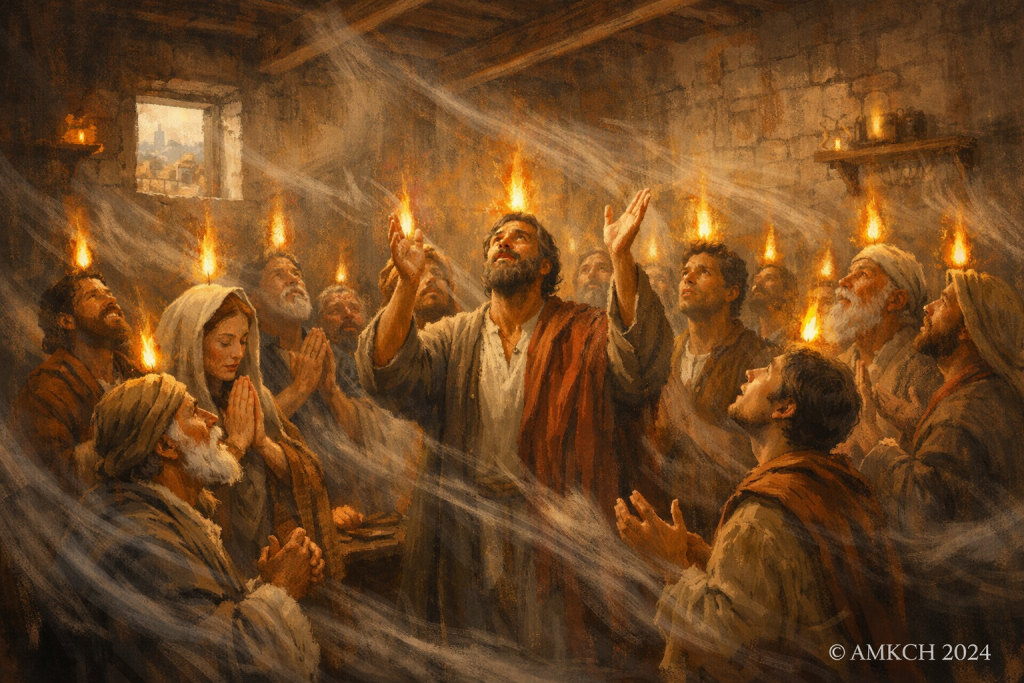
Without any kind of warning, a sound came from heaven. Luke describes it as a sound like a rushing mighty wind that filled the entire house where they were sitting (Acts 2:2). It was not a light breeze moving through open doors. The Greek word used is πνοή pnoē, a violent breath, a driving blast. The same life-filled idea carried in the Hebrew רוּחַ ruach, wind, breath, spirit. This was not weather. This was presence. The sound pressed in on them, filling the space completely.
Then they saw something else.
Tongues that looked like fire appeared, divided, and rested on each one of them (Acts 2:3). Fire that did not burn. Fire that did not consume. Fire that marked. Fire that came down not on stone or structure, but on people. Each one. Personally.
And they were all filled with the Holy Spirit (Acts 2:4). Not visited. Not brushed by. Filled.
Words poured out of them immediately, languages they had never learned forming clearly on their tongues as the Spirit enabled them. Outside, Jerusalem was already crowded with pilgrims from every nation under heaven who had come for the feast, just as Luke notes in Acts 2:5. When they heard the sound, they came together in confusion, because each one heard the disciples speaking in his own native language (Acts 2:6).
Parthians. Medes. Elamites. Residents of Mesopotamia, Judea, Cappadocia, Pontus, Asia, Egypt, Libya, Rome. Languages that Galilean fishermen should not have known. Yet they weren’t speaking nonsense. They were declaring the mighty works of God, exactly as Acts 2:11 says.
Some stood frozen, astonished, trying to make sense of what they were hearing. Others scoffed, saying they were full of wine, though it was only the third hour of the day (Acts 2:12–13). When God moves beyond expectation, mockery often becomes the quickest shield.
That’s when Peter stood up. This was the same Peter who had denied Jesus not long before. The same man who had once been afraid to be associated with Him. Now, standing with the eleven, he raised his voice and addressed the crowd (Acts 2:14). Fear no longer governed him. The breath that had filled the house had filled him too.
He told them plainly that what they were witnessing was not drunkenness. It was fulfillment. He explained that this moment had been spoken of long ago through the prophet Joel, quoting the words recorded in Acts 2:16–21, taken from Joel 2:28–32. God had said He would pour out His Spirit on all flesh. Sons and daughters. Young and old. Servants and free. No longer rare. No longer limited.
Then Peter did what the Spirit always does. He pointed to Jesus. He reminded them that Jesus of Nazareth had been attested by God through miracles, wonders, and signs done among them, things they themselves had seen (Acts 2:22). He did not soften the truth. He told them Jesus had been handed over and crucified. Yet even that had unfolded within God’s determined purpose. God raised Him up, loosing the pains of death, because it was not possible for death to hold Him (Acts 2:23–24).
Peter declared that Jesus had been exalted to the right hand of God and that what they were seeing and hearing was the direct result of Jesus pouring out the promised Holy Spirit (Acts 2:32–33).
The words struck their hearts. They were cut to the core and cried out, “What shall we do?” (Acts 2:37)
Peter answered clearly. Repent. Turn. Be baptized, every one of you, in the name of Jesus the Messiah for the forgiveness of sins, and you will receive the gift of the Holy Spirit (Acts 2:38). This promise, he said, was not confined to that moment. It was for them, for their children, and for all whom the Lord would call (Acts 2:39).
That day, about three thousand people received his word, were baptized, and were added to the number of believers (Acts 2:41).
On the feast that celebrated firstfruits, God gathered a harvest.
The Feast of Weeks had always been about acknowledging that provision comes from YHWH alone. And on that appointed day, God gave something greater than grain.
He gave His Spirit.
From that moment forward, the presence of God was no longer confined to a place, a structure, or a select few. He now dwelled within His people. And the city that day, loud with languages, questions, disbelief, and wonder, became the birthplace of a Spirit-filled people who would carry His name to the ends of the earth.
That day in Jerusalem did not belong only to the people who stood in those streets. It did not expire when the echoes of the crowd faded or when the apostles went their separate ways. What happened there was not a moment sealed in history. It was an opening.
Peter made that clear before the crowd ever dispersed. After proclaiming Jesus as risen and exalted, after calling them to repent and be baptized in His name, he said something that reached far beyond the sound of his own voice. He said the promise was for them, for their children, and for all who were far off, for everyone whom the Lord our God would call, just as Luke records in Acts 2:38–39.
That sentence carries weight. It stretches across generations.
The Holy Spirit did not come because the people earned Him. He came because Jesus had been crucified, raised, and exalted. The Spirit was given because the work was finished. The same pattern holds true now as it did then. Those who heard Peter that day were not told to achieve something extraordinary. They were told to turn. To repent. To believe. To be immersed into the name of Jesus the Messiah. And the promise followed obedience.
Receiving the Holy Spirit has never been about striving or emotion or perfect understanding. It has always begun with truth. With recognizing who Jesus is. With agreeing with God about sin and turning away from it. With trusting that forgiveness is real because the resurrection is real. Peter did not separate repentance from faith, or faith from obedience, or obedience from the gift. They belonged together.
What was true then is still true now.
Those who call on the name of the Lord will be saved, just as Joel said and Peter repeated in Acts 2:21. Those who turn to Jesus, who place their trust in Him as Lord and Messiah, are not left empty. God does not forgive and then withdraw. He forgives and then fills. The same Spirit who came with sound and fire came to dwell, to remain, to lead. The Holy Spirit is not given as a reward for spiritual maturity. He is given as the source of it.
He comes to those who believe, to those who yield, to those who ask, just as Jesus Himself promised before the cross. And when He comes, He does not come to make people impressive. He comes to make them alive. He teaches. He convicts. He strengthens. He bears witness to Jesus from within the human heart.
What began in Jerusalem did not stay there. It moved outward, just as Jesus said it would. It crossed borders, languages, and centuries. And it has not stopped moving.
The same God who filled a room with His breath still fills people who turn to His Son. The same Spirit who rested like fire on ordinary men and women still takes up residence in ordinary lives surrendered to Him. And the same promise spoken that day still stands, steady and unrevoked.
The presence of God is not distant. He is not unreachable. He is near to those who call on Him in truth.
And that, now as then, is where it begins.