“Behold, the dwelling of God is with humanity, and He will dwell with them.” Revelation 21:3.
From the very beginning the desire of God has been simple and profound: He wants to dwell with His people.
The story of Scripture is not primarily about buildings, kingdoms, or even religious systems. It is the story of a home that God intended to share with humanity, a dwelling where Creator and creation live together in unbroken fellowship. When we follow the narrative from Genesis to Revelation, we discover that the entire Bible reveals God rebuilding the house that was broken in the beginning.
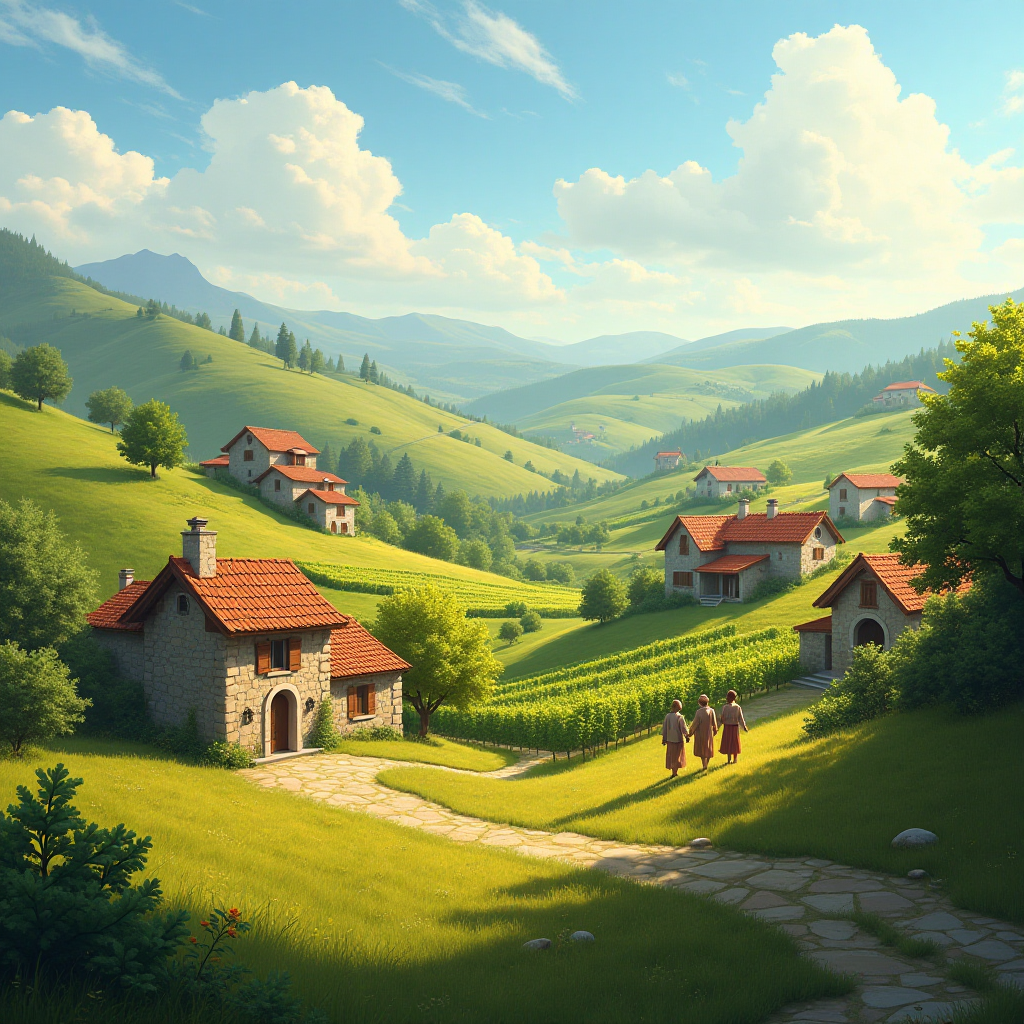
The story opens in a garden. Eden was more than a beautiful landscape or the first habitat for humanity. It functioned as the first dwelling place shared by God and the people made in His image. Scripture uses the Hebrew word בַּיִת bayit house, dwelling to describe a home or household. Eden can be understood as the first bayit of God with humanity, though it had no walls or roof like later structures. The open sky formed its covering, rivers flowed through it, and the presence of God filled the place with life. It was a living sanctuary where heaven and earth met naturally.
The creation of the first human reveals the intimacy of that original relationship.
Genesis 2:7 “Then the LORD God formed the man from the dust of the ground and breathed into his nostrils the breath of life, and the man became a living soul.”
The life given to humanity is closely connected to the Spirit of God Himself. The Hebrew word רוּחַ ruach spirit, breath, wind carries the idea of divine breath animating life. Humanity did not simply come into existence as another creature within creation. Humanity received life directly from God’s breath and lived within the atmosphere of His presence.
Within Eden there was harmony. Humanity walked with God. Creation functioned in balance. The garden was both home and sanctuary. The presence of God was not distant or hidden; it was experienced openly. This was the original dwelling God intended.
Yet the harmony of that house did not remain intact. When sin entered the world the relationship between humanity and God was fractured, and the dwelling that once united them was broken. Humanity was expelled from the garden, and the open fellowship that had existed there was lost.
Genesis 3:23–24 “Therefore the LORD God sent him out from the garden of Eden to work the ground from which he was taken. He drove out the man, and at the east of the garden he placed cherubim and a flaming sword to guard the way to the tree of life.”
The cherubim and the flaming sword guarding the entrance to Eden became a powerful symbol of separation. Humanity now lived outside the house that had once been shared with God. The broken relationship affected every part of life, bringing toil, sorrow, and mortality into the human experience. Yet even at that moment of exile the story of restoration had already begun.
God never abandoned His desire to dwell with His people. The rest of the biblical story reveals His steady work to rebuild what had been lost.
Centuries after Eden, when the descendants of Abraham were delivered from slavery in Egypt, God revealed a remarkable step toward restoring His dwelling among humanity. Through Moses He instructed the people to construct a sanctuary.
Exodus 25:8 “Let them make me a sanctuary, that I may dwell among them.”
The sanctuary described here was called the מִשְׁכָּן mishkan, dwelling place. Unlike the later temple in Jerusalem, the mishkan was not a permanent stone structure. It was a tent that could be assembled and disassembled as the people journeyed through the wilderness. Wherever Israel traveled, the dwelling of God traveled with them.
This tent was carefully designed with layers of sacred space. The outer courtyard was where sacrifices were offered. Inside the tent stood the Holy Place where priests ministered daily before the lampstand, the table of bread, and the altar of incense. Beyond a heavy veil stood the most sacred chamber, the קֹדֶשׁ הַקָּדָשִׁים Kodesh HaKodashim Most Holy Place. In that inner room rested the ark of the covenant, and upon it the כַּפֹּרֶת kapporet mercy seat where the presence of God appeared.
The design communicated something profound. God had returned to dwell among His people, yet a barrier still remained between humanity and the fullness of His presence. Only the high priest could enter the Most Holy Place, and even he entered only once each year with sacrificial blood. The house was being restored, but the separation that began in Eden had not yet been fully removed.
Generations later the temporary tent of the wilderness gave way to a permanent structure. Under King Solomon a magnificent temple rose in Jerusalem, constructed with stone, cedar, and gold. When the temple was dedicated something extraordinary happened that echoed the earlier presence of God in the tabernacle.
1 Kings 8:10–11 “When the priests came out of the Holy Place, the cloud filled the house of the LORD, so that the priests could not stand to minister because of the cloud, for the glory of the LORD filled the house of the LORD.”
The glory of God filled the temple so powerfully that the priests were unable to remain standing. The visible presence of God had once again filled a house prepared for Him. Yet even this magnificent temple pointed forward to something greater. The prophets began to speak of a future restoration that would reach beyond Jerusalem and even beyond the boundaries of the land.
Isaiah proclaimed a coming renewal not only of Israel but of creation itself.
Isaiah 65:17 “Behold, I create new heavens and a new earth; the former things shall not be remembered.”
This promise revealed that God’s ultimate dwelling with humanity would not simply restore a building. It would restore the entire created order. The broken house of creation would be renewed so that God and His people could live together again.
The arrival of Messiah marked the turning point in this story of restoration. The Gospel of John describes His coming in language that deliberately echoes the wilderness tabernacle.
John 1:14 “The Word became flesh and dwelt among us.”
The word translated “dwelt” comes from the Greek term σκηνόω skēnoō to dwell in a tent, to tabernacle. John’s choice of language points directly back to the mishkan. In other words, God had once again pitched His tent among humanity. The presence that once filled the tabernacle in the wilderness was now walking among people in the person of Messiah.
Wherever He went the reality of God’s kingdom became visible. The sick were healed, the oppressed were restored, and the broken were welcomed. People who had never entered the temple suddenly found themselves standing in the presence of God. Through Messiah the dwelling of God was moving once again among humanity.
Yet Messiah revealed that the restoration would go even further.
John 14:2–3 “In my Father’s house are many dwelling places… I go to prepare a place for you.”
The word translated “dwelling places” comes from the Greek word μονή, monē meaning abiding home. Messiah was speaking of a permanent dwelling prepared for those who belong to Him. The house of God would one day be filled with His people.
Before that dwelling could be completed, however, the barrier between humanity and God had to be removed. At the moment of Messiah’s death something dramatic occurred inside the temple in Jerusalem.
The veil that once guarded the entrance to the Most Holy Place was suddenly torn open. The separation that had existed since Eden was removed through the sacrifice of Messiah. Access to the presence of God was restored.
From that moment forward the dwelling of God would no longer be limited to a single structure of stone. The apostles began teaching that God was building a living house made of people.
Peter described believers with the imagery of stones shaped for construction.
1 Peter 2:5 “You also, as living stones, are being built up as a spiritual house.”
Each life becomes part of the structure God is building. This house is not constructed with brick or timber but with transformed lives joined together by faith. At the center of this house stands Messiah Himself.
Ephesians 2:19–20 “You are members of the household of God… Jesus Christ Himself being the chief cornerstone.”
The cornerstone, called ἀκρογωνιαῖος akrogōniaios translated cornerstone, determines the alignment of the entire building. Every wall in an ancient structure was measured from that stone. In the same way the life and teaching of Messiah establish the direction and foundation of the house God is building.
Scripture also explains that the work of each believer contributes to this house. Paul writes that what we build in this life will one day be revealed.
1 Corinthians 3:12–13 “If anyone builds on the foundation with gold, silver, precious stones, wood, hay, straw, each one’s work will become clear; for the Day will declare it, because it will be revealed by fire.”
This testing does not determine whether the foundation stands, because the foundation is Messiah. Rather, it reveals the quality of what has been built upon that foundation. Faith, love, and obedience endure. Empty works fade, are burnt away.
Paul also reveals that the restoration of God’s dwelling involves more than a spiritual structure. It includes the transformation of our own bodies. Our present bodies are described as temporary tents, echoing the language of the wilderness tabernacle.
2 Corinthians 5:1 “If our earthly house, this tent, is destroyed, we have a building from God, a house not made with hands.”
This promise points to the resurrection. The mortal body that returns to dust will be raised into something entirely new.
1 Corinthians 15:42–44 “The body is sown in corruption, it is raised in incorruption.”
The word used for incorruption is ἀφθαρσία aphtharsia, imperishable. The resurrection body will no longer decay or weaken. It will be suited for life within the renewed creation God is preparing.
Creation itself waits for that restoration.
Romans 8:19–21 “The creation waits with eager expectation for the revealing of the sons of God… because the creation itself also will be delivered from the bondage of corruption.”
The final vision of this restoration appears in the book of Revelation. John sees the holy city descending from heaven.
Revelation 21:2 “I saw the holy city, New Jerusalem, coming down out of heaven from God.”
Then comes the declaration that fulfills the entire story that began in Eden.
Revelation 21:3 “Behold, the dwelling place of God is with man, and He will dwell with them.”
John then notices something remarkable about that city.
Revelation 21:22 “I saw no temple in it, for the Lord God Almighty and the Lamb are its temple.”
The presence of God fills the entire city. The house that began as a garden becomes a world filled with divine glory. The light of that city does not come from the sun or the moon.

Revelation 21:23 “The glory of God illuminated it, and the Lamb is its light.”
The story that began with humanity walking with God in a garden ends with humanity dwelling with Him in a renewed creation. The eternal בַּיִת bayit, house of God stands complete. Heaven and earth are united, and the presence of God fills the world.
What was broken in Eden is finally restored. God dwells with His people, and His people dwell with Him forever.
Prayer for God’s Eternal House
Heavenly Lord, Maker of heaven and earth, we bow before You in awe of Your glory. From the Garden of Eden, where You walked with Adam and Eve, to the radiant New Jerusalem You have prepared, Your desire has always been to dwell with us, Your children, in unbroken fellowship.
We thank You for the covenant of restoration, for the tabernacle in the wilderness, the temple in Jerusalem, and the promise of Your eternal house, where Your presence fills every corner. May our hearts be living stones, shaped by faith, obedience, and love, being built into a spiritual house, a holy people offering lives acceptable to You through Jesus Christ.
Purify us through trials as fire refines gold. Align our lives with the foundation of Messiah, so that when we enter Your eternal dwelling, we shine with the beauty of righteousness, the peace of holiness, and the joy of eternal life. Let the New Earth, Your perfected creation, be our home, where spirit and matter converge in Your glory.
May the light of Your presence illuminate our hearts, our communities, and our works, as we walk in hope, worship, and steadfast faith, awaiting the day when heaven and earth unite in Your eternal house. In Jesus’ Holy Name, Amen Amen.
✝️ ✝️ ✝️ ✝️ ✝️
©AMKCH-YWP-2026
If this message blessed you, please leave a comment. I would love to hear from you.
image done by chatgpt at my direction.
✝️ ✝️ ✝️ ✝️ ✝️
.
.