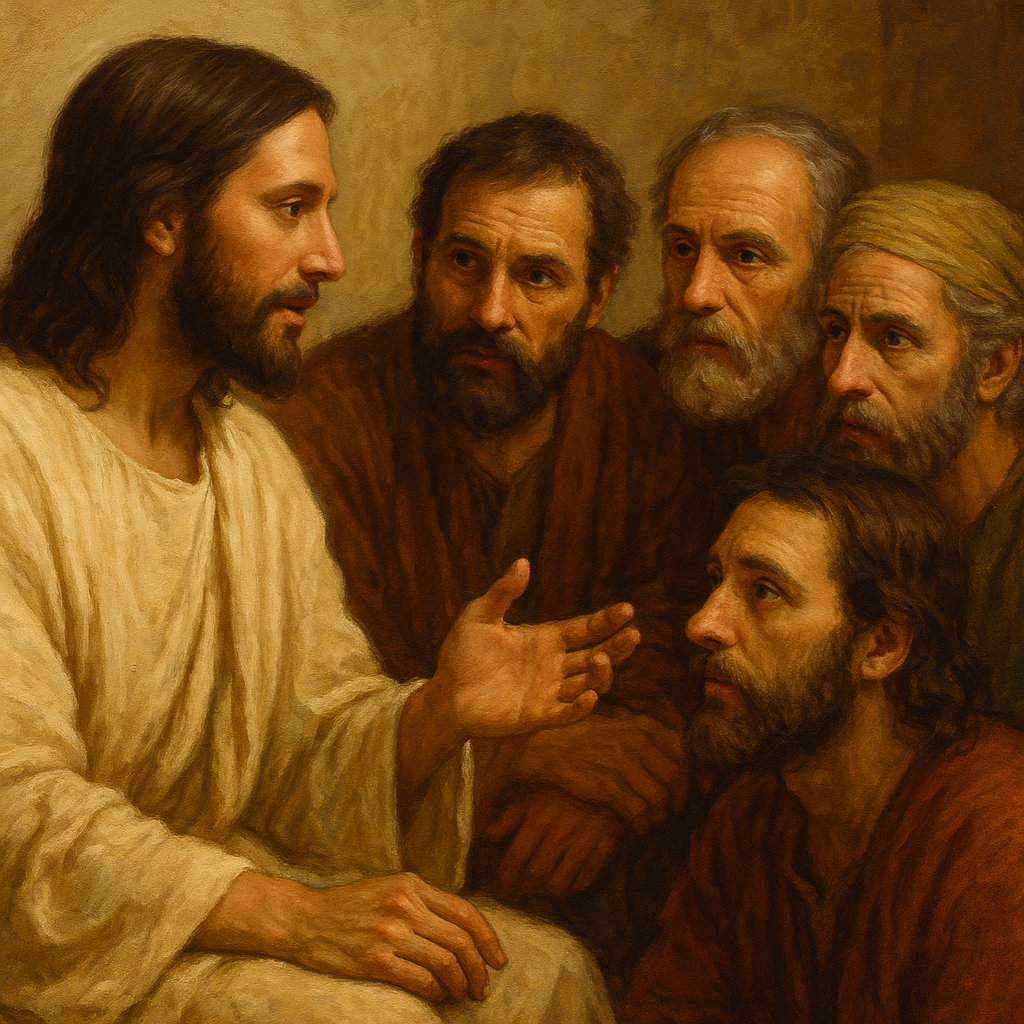
Before we turn our hearts to the words of the Gospel, it is vital to know the ones who wrote them. Matthew, Mark, Luke, and John were not distant authors hidden in libraries, they were men of flesh and spirit, walking the lands of Galilee and Judea, touching the shores of the Mediterranean, sitting in homes and marketplaces, and listening to the heartbeat of Yeshua Himself. Their lives were ordinary in some ways and extraordinary in others. They came from families, villages, and cultures shaped by Torah and the pressures of Roman rule. Each encountered Yeshua, each heard His call, and each chose a path that would forever change the way humanity understands the Kingdom of God.
This teaching will take you into their homes, their families, their languages, and their hearts. We will see where they lived, who they were related to, how they met Yeshua, and how the Spirit guided their words into the Gospels we hold sacred today. Along the way, Hebrew and Greek words will illuminate the depth of their writings, and Scripture will shine in bold/italics, bringing both clarity and life to the message.
To understand the Gospel fully, one must understand the storytellers. Let us walk beside them, and let the Spirit open our eyes to the men behind the words, that we may know not just what Yeshua said, but how He was seen, heard, and lived through the eyes of those He called.
Matthew ✝️✝️✝️✝️✝️
Matthew, known in Hebrew as Matthew (“Gift of YHWH”), was born in Galilee, likely near Capernaum, a hub of trade and daily bustle where the lake met the mountains and the Mediterranean breezes carried the scent of fish, fresh bread, and distant markets. His family was Jewish, steeped in Torah, possibly connected to Levitical or priestly lines. From an early age, Matthew would have recited Psalms in Hebrew, studied the laws, and participated in festivals, Passover (Pesach), Shavuot, and Sukkot, learning the rhythms of Jewish life, prayer, and communal gathering. Each festival carried stories of deliverance, covenant, and God’s presence, embedding in him an understanding of God’s faithfulness and expectation.
Yet, Matthew chose a path that placed him at odds with community respect: he became a tax collector, a role both lucrative and socially isolating, working under Roman authority. The tax booth was not merely a workplace, it was a crossroads of cultures, a place where Galileans, Greeks, Romans, merchants, and travelers converged. Coins stamped with Caesar’s face changed hands under his scrutiny, contracts were tallied, debts reconciled, and arguments mediated. Matthew’s keen mind, trained in arithmetic, negotiation, and observation, was sharpened daily in this environment. The marketplace was a stage of human interaction, human weakness, ambition, and need, all unfolding before him.
His family likely wrestled with his choices. Perhaps they questioned his ethics, worried about his reputation, or feared his isolation among Jews who despised collaborators. But divine purpose has a way of breaking human expectation. In Matthew 9:9 we read: And as Yeshua passed by, He saw a man named Matthew sitting at the tax booth, and said to him, “Follow Me.” And he rose and followed Him. Imagine the scene: Matthew’s hands full of coins, the marketplace alive with voices, carts rattling over stone, and Roman soldiers marching past, yet the calm, penetrating voice of the Messiah reached him. In that moment, a man who counted coins began to count nothing but the call of God.
Matthew’s response demonstrates immediate obedience, leaving behind livelihood, social approval, and the security of familiarity. His heart, once divided between profit and Torah, now turned wholly toward Yeshua. The transformation was both spiritual and practical: from a meticulous record-keeper of taxes, he became a meticulous chronicler of the Messiah’s life.
His Gospel, written in Greek yet structured with Semitic thought, emphasizes fulfillment (plērōma) of Hebrew prophecy and the arrival of the kingdom (basileia) of God. Matthew traces Yeshua’s genealogy (Matthew 1:1-17) from Abraham through David, reminding the reader that the Messiah emerges from God’s covenantal promise, rooted in the history and hope of Israel. Hebrew words such as nephesh (life/soul) and ruach (spirit) punctuate his writing, showing his attention to the spiritual reality beneath human action. His audience, primarily Jewish, would recognize the precision of these words, linking prophecy to present reality.
Matthew’s teaching goes beyond law. The Sermon on the Mount ( Matthew 5-7) elevates Torah into a life of Spirit-led righteousness, demonstrating that obedience to God involves heart, not mere compliance. His use of ekklesia in Matthew 16:18 signals the formation of a community, a body of believers bound not by ethnicity or status but by allegiance to Yeshua. Every coin he counted, every merchant he observed, every Sabbath he attended, all became instruments through which he learned and later taught about God’s kingdom.
Culturally, Matthew lived under Roman occupation. Taxes, political tension, and occasional unrest shaped daily life in Galilee. Roads carried soldiers, traders, and travelers, while marketplaces were centers of negotiation, rumor, and news. Within this context, Matthew’s call to follow Yeshua represents a radical reorientation: obedience to God superseding both social standing and material comfort. His family, though possibly troubled by his choice, became part of a new household, the disciples and early believers who witnessed miracles, heard teachings, and shared in the Spirit-led mission of the Messiah.
Even the structure of Matthew’s Gospel reflects his former life: precise, organized, attentive to detail, and deeply conscious of covenantal history. Repeated phrases like “that it might be fulfilled” connect Yeshua’s words and deeds to Hebrew prophecy, showing that God’s plan unfolds with intentional precision. Matthew’s attention to the Jewish festivals, feasts, and Temple observances demonstrates not only knowledge of Torah but lived experience of it, now reframed through the lens of Messiahship.
Spiritually, Matthew’s life teaches that divine calling can penetrate ordinary life. A man counting coins can become a man counting the words of the Messiah. Obedience, faith, and the willingness to leave worldly security placed him directly into God’s eternal plan. Every family meal, festival, market encounter, and synagogue gathering became a backdrop for God’s intervention, showing that even the seemingly mundane is fertile ground for the Spirit’s work.
Matthew’s perspective is further enriched by Hebrew thought: nephesh underscores the soul’s hunger for God, ruach conveys the Spirit’s movement in life and decision, and Torah represents covenantal guidance that is lived, not merely read. These words carry more than literal meaning, they resonate with spiritual reality, cultural expectation, and the heartbeat of Israel, making Matthew a bridge between prophecy and fulfillment, law and grace, the historical and the eternal.
Mark ✝️✝️✝️✝️✝️
Mark, or Mordechai, was raised in Jerusalem, likely connected to Barnabas and the early church. His mother’s house may have served as a gathering place for believers, a safe home where the teachings of Messiah were discussed. Mark was not one of the twelve, but his proximity to Peter and the apostles allowed him to observe Yeshua’s ministry closely.
Jerusalem in Mark’s youth was a vibrant city, full of pilgrims, merchants, Temple worshippers, and Roman oversight. He would have witnessed festivals, crowds, and debates among Pharisees and Sadducees. He grew familiar with the smells of incense in the Temple, the clamor of animal sacrifices, and the tensions between Roman soldiers and Jewish citizens. These observations developed a keen eye for human emotion and divine activity.
Mark’s Gospel is brisk, using euthus (“immediately”) to propel the narrative. In Mark 1:10, And immediately, coming up out of the water, He saw the heavens torn open and the Spirit descending like a dove upon Him, we see his style of urgency. The Servant nature of Yeshua is central; Mark 10:45 reminds us: For even the Son of Man did not come to be served, but to serve, and to give His life as a ransom for many. Words like doulos (servant), kyrios (Lord), and martys (witness) repeat, reflecting his thematic focus on service and testimony.
Mark likely met Yeshua indirectly, absorbing ministry through disciples and traveling with Peter. His youth and energy shine through the rapid narrative. His writing style balances Jewish expectation with Hellenistic literary clarity, and his family home would have been a hub for early believers, shaping his understanding of communal worship, discussion, and prayer. He observed the human side of miracles, the awe, fear, and sometimes misunderstanding of the crowds, capturing it vividly in his concise, moving prose.
Culturally, Mark’s audience included Jews and Gentiles familiar with Greek language and Roman authority. His descriptions reflect the vibrancy of Jerusalem life, the tension of Roman occupation, and the faithfulness of the early believers. Spiritually, Mark teaches attentiveness, obedience, and courage, witnessing and recording faithfully even when one’s place is not in the inner circle, but on the edges, observing and learning from those closest to the Messiah.
Luke ✝️✝️✝️✝️✝️
Luke, known as Loukas, was a Gentile physician from Antioch or Tarsus, trained in observation, precision, and care. His upbringing included Greek education, exposure to multiple languages, and possibly affluence that allowed study and travel. Though not Jewish, he devoted himself to understanding the Hebrew Scriptures and Yeshua’s life.
Luke traveled with Paul, witnessing the spread of the Gospel to Jewish and Gentile communities. He interviewed eyewitnesses, including Mary, mother of Yeshua, and gathered details from a physician’s perspective: ages, locations, and social dynamics. His Gospel emphasizes salvation (sōtēria), the Spirit (pneuma), and love (agapē). Luke 1:3-4 says: It seemed good also to me, having had perfect understanding of all things from the very first, to write an orderly account for you, most excellent Theophilus, that you may know the certainty of the things you have been taught.
Luke focuses on inclusivity, highlighting women, Gentiles, the poor, and the marginalized. He brings social and cultural context to every story, like the Good Samaritan or the healing of the sick, emphasizing God’s compassion. His medical training allowed him to record with clarity, while spiritual reflection infused the narrative with theological depth. He also authored Acts, detailing the Spirit’s work in spreading the Gospel to the ends of the earth.
John ✝️✝️✝️✝️✝️
John, or Yochanan, was the son of Zebedee and Salome, raised by the Sea of Galilee with his brother James. His family’s fishing trade provided moderate wealth and early exposure to labor, Jewish tradition, and festival life. He was among the first disciples called, part of the inner circle, and witness to the Messiah’s most intimate moments.
John 1:35-37 records: The next day John was again standing with two of his disciples, and he looked at Yeshua as He walked and said, “Behold, the Lamb of God!” And the two disciples heard him speak and followed Yeshua. John’s Gospel emphasizes eternal life (zōē aionios), light (phōs), and love (agapē). He portrays Yeshua as the Logos, the pre-existent Word (John 1:1-3): In the beginning was the Word, and the Word was with God, and the Word was God. All things were made through Him, and without Him was not anything made that was made.
John’s life by the Sea of Galilee, his work in the fishing trade, and close companionship with Peter and James allowed him to witness miracles, teaching, and the crucifixion in detail. His writing emphasizes relational faith: the Messiah as bread of life (John 6:35), light of the world (John 8:12), and resurrection and the life (John 11:25). His Gospel balances narrative, theological reflection, and Spirit-guided insight.
After walking closely with Yeshua, John faced later exile on the island of Patmos during Roman persecution. There, Yeshua appeared to him in visions, giving him revelations of the Church, the end times, and God’s eternal victory, recorded in the book of Revelation. John is the beloved disciple, fully trusted by Yeshua to convey God’s ultimate plan. His life, from Galilee to Patmos, shows devotion, love, observation, and faithful witness.
✝️✝️✝️✝️✝️
Together, these four men provide a complete view of Yeshua’s life. Matthew gives prophecy fulfillment and Jewish structure; Mark, immediacy and action; Luke, compassion, inclusivity, and careful historical detail; John, relational intimacy and theological depth. Families, languages, culture, and personal experience shaped their writings. Hebrew words like nephesh, ruach, and Torah, and Greek words like basileia, pneuma, and agapē, carry nuance, culture, and revelation across time.
Their lives teach obedience, courage, and faith. From Matthew’s tax booth to Mark’s Jerusalem home, Luke’s careful travels, and John’s Galilean intimacy, the Spirit worked through ordinary people to preserve the Word. The Gospels call us into participation: to witness, love, obey, and live in the Kingdom today.
The Baptism of Jesus
Matthew 3:13-17
Mark 1:9-11
Luke 3:21-22
John 1:29-34 (John’s account is more focused on John the Baptist’s testimony rather than a direct narrative of the baptism itself.)
The Temptation of Jesus in the Wilderness
Matthew 4:1-11
Mark 1:12-13 (brief, not as detailed as Matthew’s account)
Luke 4:1-13
The Feeding of the 5,000
Matthew 14:13-21
Mark 6:30-44
Luke 9:10-17
John 6:1-14 (John includes more conversation between Jesus and his disciples.)
The Transfiguration of Jesus
Matthew 17:1-9
Mark 9:2-8
Luke 9:28-36
The Crucifixion and Resurrection of Jesus
Matthew 27-28
Mark 15-16
Luke 23-24
John 18-20
(While the core events are the same, the details and emphasis vary, such as the dialogue on the cross or the specific resurrection appearances.)
The Parable of the Sower
Matthew 13:1-23
Mark 4:1-20
Luke 8:4-15
The Calling of the First Disciples
Matthew 4:18-22
Mark 1:16-20
Luke 5:1-11
John 1:35-51 (John’s account differs significantly, with a more detailed introduction to Jesus’ interaction with Andrew and Peter.)
The Lord’s Supper (The Last Supper)
Matthew 26:17-30
Mark 14:12-26
Luke 22:7-23
John 13:1-30 (John’s account doesn’t have the institution of the Eucharist, but instead focuses on Jesus washing the disciples’ feet.)
Heavenly Father, Creator of all, we come before You with hearts open and minds ready. Thank You for the gift of Matthew, Mark, Luke, and John, who walked with Yeshua, witnessed His life, and preserved His Word for all generations.
Lord, help us to see not just their writings but their hearts, their obedience, their courage, and their love for You. May the Hebrew words like nephesh and ruach, the Greek words like basileia, pneuma, and agapē, speak to us with clarity and revelation. May Your Spirit guide us as it guided them, opening our eyes to the depth of Your Kingdom and the life of the Messiah.
Father, teach us to follow with faith like Matthew, to serve with immediacy like Mark, to observe with compassion like Luke, and to love with intimacy like John. May we carry the lessons of their lives into our own, witnessing Your truth, walking in obedience, and reflecting Your light in every word and deed.
Bless this teaching, O Lord, that it may touch hearts, inspire discipleship, and draw all who read it closer to Yeshua, the Logos, the Word, and the eternal King. Let it be a lamp to guide, a mirror to reflect, and a call to live fully in Your Kingdom.
We ask this in the name of Your Son, Yeshua, our Savior and Messiah. Amen.
If you enjoyed this message, please leave a positive comment! I look forward to hearing from you!
Images are done by chatgpt as per my instructions.