Looking Back, But Moving Forward: Trusting God in the Midst of Our Battles
1 Samuel 17. We’re dropped into an area full of hills and valleys. The Israelis are at war with the Philistines, in the Valley of Elah. Two armies are on opposite hills, facing each other, but the battle isn’t starting. It’s like a standoff, where both sides are waiting, and in the midst of it all, there’s a giant, a literal giant, named Goliath. This guy is HUGE! The description of him is something that stands out immediately.
Goliath’s height is given in the text as “six cubits and a span,” which, according to some translations, is about 9 feet 9 inches, and to others 13 feet! It’s hard to even fathom someone that tall. And when we think of giants, while giants might sound mythological, ancient texts and historical records do explain about people of extraordinary height. Goliath’s size alone would have struck fear into anyone who saw him. It’s as if we’re looking at someone who represents the impossible, like the seemingly impossible problems in our own lives that can feel as massive as a giant.
Dr. Jordan Peterson, a psychologist and author, talks about the importance of confronting the chaos in our lives, pointing out that facing the “dragon” of our fears is a necessary part of personal growth. Goliath is that dragon, a tangible force that looms in front of us, demanding our attention and our fears. We all face these “giants” in life, whether they are failures, insecurities, or things from our past that continue to haunt us. They stand there, daring us to do something about it. And like the Israelis, we often feel too small, too weak, or too trivial to stand against them.
But Goliath is not just tall, his armor is described in detail. He’s wearing a bronze helmet, a coat of mail that weighs 5,000 shekels (about 125 pounds), and his legs are covered in bronze armor as well. It’s amazing that he could even walk with wearing all that weight! He even has a spear with a head that weighs 600 shekels (about 15 pounds), that’s heavy. You can see how this is meant to be intimidating. He’s a walking fortress, and everything about him screams power. He’s not just any warrior; he’s the one they’ve sent out to challenge Israel.
And here’s the thing about Goliath: He comes out, day after day, for forty days (doesn’t that number sound very familiar? But more on that in another message). Forty days of intimidation. Forty days of taunting the Israelis, mocking them, challenging them, saying, “Choose a man to come down and fight me.” It’s important to notice that, during this time, no one from Israel steps forward. And we can’t blame them. They’re looking at this giant and thinking, “Who could possibly defeat him?”
But then enters David, stage right, a young shepherd boy, I’d say about 17-18 years of age perhaps. David isn’t even there to fight. He’s just bringing food to his brothers, who are soldiers in the Israelite army. But when he hears Goliath’s taunts, it totally doesn’t sit right with him. He’s filled with righteous anger. Why? Because Goliath is not just insulting Israel; he’s insulting the God of Israel. And for David, that’s crossing the line. You don’t mock God, and you don’t defy God’s army and get away with it. It just ain’t happenin’; not so long as he’s there!
Now, when David offers to fight Goliath, his brothers get really ticked. They see him as just a kid, and they think he’s being reckless, wanting to show off… as young men at that age tend to do. But David isn’t rattled by their criticism. His faith isn’t shaken by his brothers’ words nor by the magnitude of the situation. He knows that God has been with him before. He recounts how, as a shepherd, He defended his flock from lions and bears. And if God was with him then, why wouldn’t God be with him now?
This is key. David’s confidence is not in his own strength. He’s not out there thinking he can do this on his own. David looked back at what God had already done in his life, and that gave him the courage to trust Him again. How often do we forget the times God has already carried us through, and instead focus on the size of our problems? David says, “The Lord who delivered me from the paw of the lion and the paw of the bear will deliver me from the hand of this Philistine.” (1 Samuel 17:37). It’s a beautiful example of how we can build our faith by looking at how God has shown up in our past, even in small things, and trusting that He will show up in bigger things.
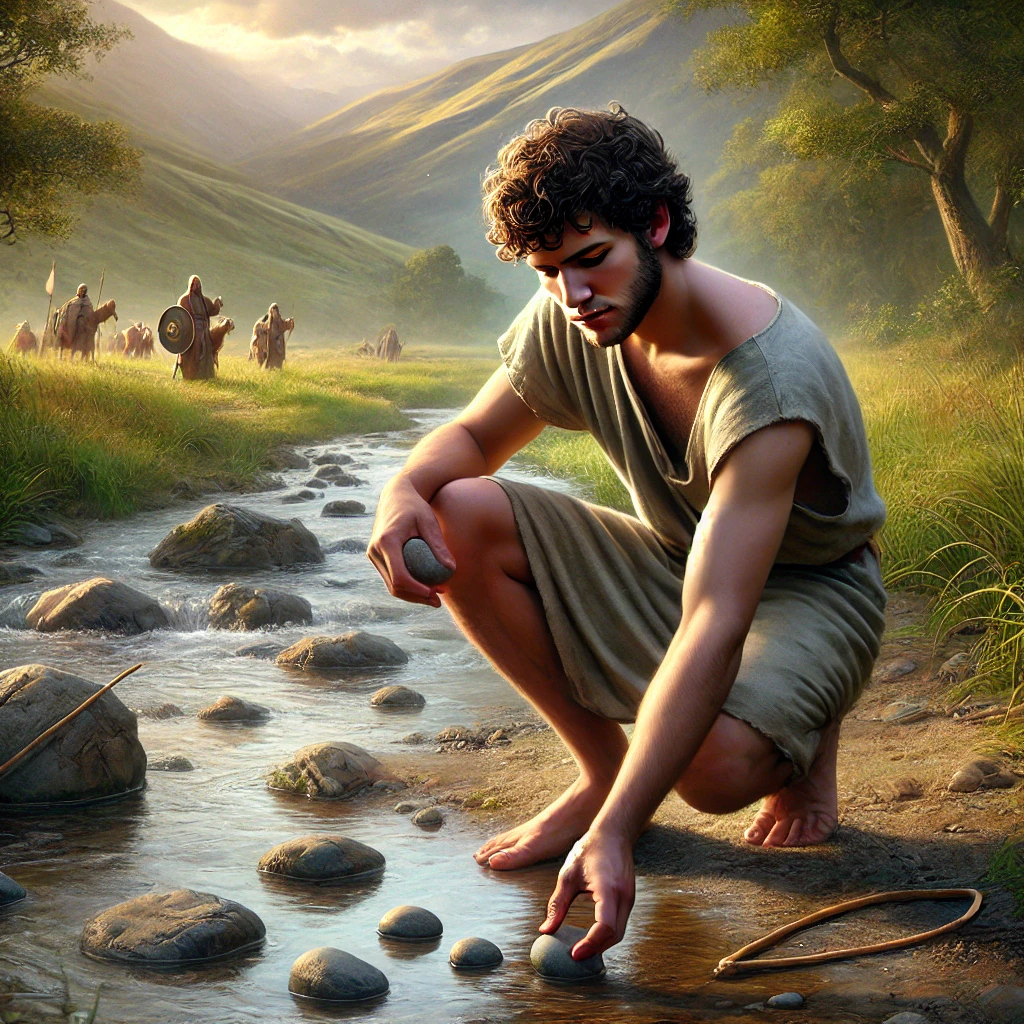
So, David goes to King Saul and insists that he’s the one who should face Goliath. Saul, who is the king, tries to put his armor on David, but David doesn’t feel comfortable with it. It’s too big and awkward. This is another important moment. David isn’t trying to fight Goliath the way everyone else would. He’s not using the tools of the world or relying on their methods of battle. He’s going with what he knows: a sling, five smooth stones, and his faith in God.
This is where something profound happens that hits the mark beyond the biblical narrative. When David refuses to wear Saul’s armor, he’s essentially saying, “I’m not going to try to do this someone else’s way, with someone else’s power.” This moment of independence and trust in God reminds me of the idea that Peterson talks about when he says, “You need to be yourself, and you need to be that honestly. And part of that honesty is knowing what you’re capable of and trusting it.” David trusts what he knows and steps into battle with the tools that have worked for him in the past. He’s not trying to mimic anyone else’s success, just trusting what he has, God.
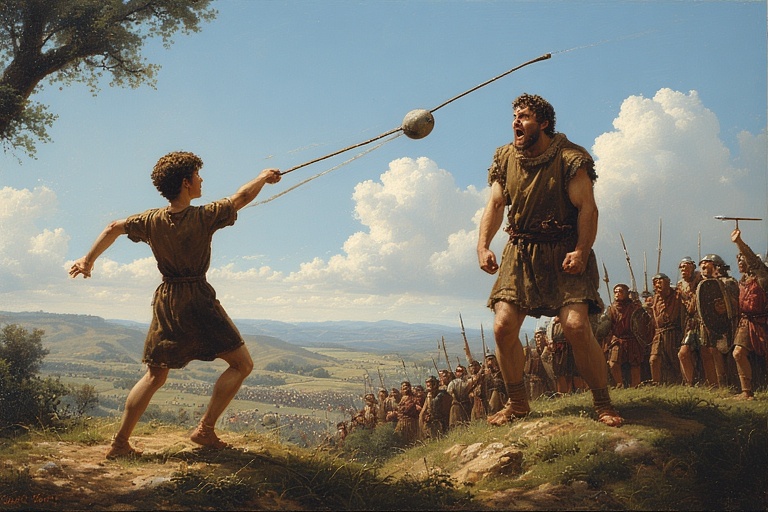
As David steps forward to face Goliath, there’s something almost poetic in the way he approaches the giant. Goliath sees David and mocks him, asking if they’ve sent out a dog to fight him. But David doesn’t back down. He speaks with boldness, saying, “You come against me with sword and spear and javelin, but I come against you in the name of the Lord Almighty, the God of the armies of Israel, whom you have defied.” (1 Samuel 17:45). David knows that this battle is not his to fight alone, but God’s. And that’s the key to his courage. It’s not about David’s skill; it’s about God’s strength.
When David takes his sling and hurls the stone, it strikes Goliath right smack dab in the middle of his forehead, giving him a nice big hole there. The giant falls to the ground with a thud. And that’s it. David doesn’t even have a sword to finish the job, so he takes Goliath’s own sword and uses it to decapitate him. The Israelis see Goliath defeated, and they’re filled with courage. They chase the Philistines off, and the victory is won, not by the might of man, but by the power of God.
There’s so much to unpack in this story. But here’s the thing: On the surface, it’s about the ”little guy” defeating the giant, but when we dig deeper, it’s about how David’s relationship with God gave him the courage to stand up against something far greater than himself. It’s about putting faith into action, about how trusting in God’s faithfulness leads to victory.
David didn’t just win a physical battle that day, he proved a spiritual point. The battle wasn’t about David’s abilities; it was about God’s power. And in that, there’s a huge lesson for us. How often do we look at our own limitations and think, “There’s no way I can do this,” forgetting that the real victory comes when we let God fight on our behalf?
This story challenges us to trust God when the odds seem impossible. It asks us if we truly believe that God is bigger than any giant we face. Whether that giant is fear, doubt, sin, or an actual situation we’re going through, we need to remember that if God is with us, who can be against us? (Romans 8:31).
And we can’t miss the beauty in David’s heart. It wasn’t pride or arrogance that drove him to fight Goliath, it was a deep, unwavering trust in the Lord and a desire to honor God’s name. His motivation wasn’t for personal glory, but for God’s glory.
When we read this story, we’re not just reading about a battle; we’re reading about God’s faithfulness, His power, and how He equips us, even when we feel small and powerless, to face the giants in our lives. It’s a powerful reminder that with God, all things are possible. David’s victory wasn’t just about him, it was about God’s power working through him. And that same power is still at work today.
When we look at the story of David and Goliath (1 Samuel 17), we see more than just a victorious battle, it’s a powerful example of how our past can shape our future, but it does not have to define it. David didn’t come into his battle with Goliath unaware of the evil he had witnessed. In fact, he was well-acquainted with danger. He was no stranger to threats from lions and bears. But when he stood before the giant, David didn’t rely on his own strength or the fear of past foes; he trusted in the living God who had delivered him before, and would do so again.
The name “Goliath” (גָּלְיָת, Golyat) in Hebrew can be broken down to carry meanings associated with “splendor” or “exile,” a striking combination that immediately sets the tone for who he represents. Splendor speaks to outward impressiveness, something dazzling to the eye, commanding attention through size, armor, reputation, and presence. Exile, on the other hand, speaks of separation, removal, and distance from rightful dwelling. When these ideas sit side by side, they reveal something deeper than physical description. Goliath was not merely large; he embodied an impressive force that stood outside the covenant, impressive yet alien, magnificent yet cut off. His towering stature made him appear dominant, but his very name whispered that he stood apart from the favor and order of God.
In this way, Goliath becomes more than a Philistine champion. His presence on the battlefield symbolized the intrusion of something foreign into the land and life of the people of God. He stood as a visible reminder of what does not belong, a splendor that has no roots in covenant faithfulness. The battle was not only between two armies, but between what is aligned with God and what exists in exile from Him. Goliath’s greatness was external, measurable, and intimidating, yet it was disconnected from the source of true strength. What confronted Israel that day was not just a giant of flesh and bone, but a manifestation of opposition that looked powerful while standing entirely outside God’s favor.
David, by contrast, stands in sharp relief. His name (דָּוִד, Dawid) means “beloved,” a name rooted not in outward impressiveness but in relationship. Where Goliath’s name carries the weight of splendor severed from belonging, David’s name rests in being known and chosen. The contrast is not merely between a giant and a shepherd, but between exile and nearness, between power displayed and faith anchored. David’s victory was not a personal triumph meant to elevate him; it was a public declaration that what stands outside God’s favor cannot ultimately prevail against trust placed within it. The giant represented exile pressing in, but the outcome revealed that exile does not have the final word.
Seen this way, the story stops being only about an old battle and starts showing a pattern that shows up again and again. Things that hurt, dominate, or hang around from the past tend to look bigger than they really are. They stand there long enough that people start believing they can’t be moved. But Scripture keeps saying otherwise. Anything cut off from God’s covenant may look strong for a time, but it doesn’t last. Victory doesn’t come from meeting force with force. It comes from staying anchored to what God has already said and done. The account doesn’t pretend the struggle isn’t real, and it doesn’t rush to tie everything up neatly. It simply shows that what God calls His own is not left in exile, and what looks overwhelming is not beyond His reach.
In Romans 12:2, Paul says not to be shaped by the world’s way, but to be transformed by the renewing of the mind, so that God’s will can be recognized for what it truly is, good, acceptable, and complete. The word translated “transformed” is metamorphoō. It means a real change of form, not a surface adjustment. It’s the same word used for Jesus at the transfiguration. What Paul is talking about isn’t better habits or improved thinking. It’s a change that happens from the inside and works its way outward.
That kind of renewal doesn’t happen by pretending the past never existed. It happens when what has been broken is handed over to God to be dealt with properly. The word “renewing” comes from anakainō, which carries the idea of something being rebuilt, not patched. Something worn down, damaged, or corrupted being made usable again. It’s not a one-time event, and it isn’t instant. It’s the steady work of God reshaping how the mind works, how decisions are made, and how life is approached.
Paul isn’t talking about a mental exercise here. This isn’t “think better thoughts.” He’s talking about God getting into the mess that’s already there and changing how the mind works. Most people don’t think the way they do because they chose it. They learned it. From fear. From getting hurt. From doing whatever it took to survive. And those patterns don’t just go away because someone decides to be spiritual.
That’s where God comes in. Over time, the mind stops running on those old tracks and starts lining up with what God says is true. Not because of effort. Not because of willpower. But because God reworked it. That’s where discernment comes from.
Let’s bring this down to real life, to the everyday stuff we deal with. So often, people will tell you, “Just forget the past, move on, get over it.” Like it’s that easy. Like you just snap your fingers and everything that hurt, every mistake, every scar disappears. But the Bible doesn’t ask us to pretend it didn’t happen. That’s not the point. The point is, don’t let the past run the show anymore. Don’t let it write the script for your present. Those “giants” in our lives? They aren’t always things you can see with your eyes. They’re the hurts, the fears, the traumas, the memories that sneak in and try to shape how you act, what you believe, the choices you make. They’re silent, sometimes sneaky, and they make themselves bigger than they really are if we let them.
And here’s the thing, so many people, doctors, psychologists, counselors, they tell us the same thing in their own way. Face it. Deal with it. Process it. Rewrite the story in your head. Flip your thinking. Some of them might not even believe in God, but some do, and that part is beautiful, because it lines up perfectly with what Scripture says about renewal. Dr. Caroline Leaf, a cognitive neuroscientist, talks a lot about this, about how the brain can actually be rewired, healed from negative thinking, from trauma, from the loops that keep people stuck. It’s science talking about something that the Bible has been saying all along. Renewal isn’t just spiritual fluff, it’s a real, measurable change.
And the Greek word for “mind” is νους (nous)_, and it’s bigger than just thinking or remembering. It’s your whole inner command center, how you weigh things, how you decide what matters, what is right, what is wrong. Your values, your judgment, your choices, they’re all coming from this place. And this is exactly where the battle happens. The more we let God work in that space, the more He reshapes it, the more we start thinking His way instead of the way our past trauma, fear, or habits have trained us to think. Freedom starts here. Real freedom. Not pretending, not surface fixes, but a heart and mind gradually getting back to what God intended.
And speaking of heart, Hebrew לֵב (leb), that word isn’t just about feelings. Back then, the heart was the control center, thought, will, decision-making, it all came from the heart. So when Proverbs 4:23 says, “Keep your heart with all diligence; for out of it are the issues of life,” it isn’t just emotional advice. It’s a command, guard your inner world, protect it. Don’t let the lies, the hurts, the old betrayals, the fear, the shame, don’t let them keep you in exile from God. This is your life we’re talking about, flowing out from what’s happening inside.
Prayer matters, yes, but it’s not the whole story. We can’t pray and act like pressing a button will erase the scars. Transformation means doing the hard thing, choosing it every day, choosing to release what has bound us, choosing to forgive, even when it hurts, choosing to believe God’s promises, that we are more than conquerors through Christ Jesus (Romans 8:37). The Greek word there, νικητής (nikētēs), is vivid, victor, overcomer, one who pushes through, takes the win. That’s exactly what David did with Goliath, and that same victory is ours, every single time.
The reality, Satan will always try to yank us back, trap us in the chains of our past, guilt, shame, fear, old wounds that never fully healed. But Paul tells us in Philippians 3:13–14, “this one thing I do, forgetting those things which are behind, and reaching forth unto those things which are before, I press toward the mark for the prize of the high calling of God in Christ Jesus.” The Greek word ἐπεκτεινόμενος (epekteinomenos) is perfect here, it’s stretching, reaching with everything we’ve got, every ounce, every part of who we are, toward what God has promised. It’s intentional, active, not lazy, not half-hearted.
And listen, this isn’t easy. It’s not a one-time decision. It’s daily, stubborn, saying “no” to letting the past dictate today, saying “yes” to trusting God’s power, to trusting God’s promises. Just like David trusted God to save him from the lion, the bear, and ultimately the big bully Goliath, we are called to step forward with courage, knowing that God is with us, knowing that through Christ, we are victorious, no matter the evil, no matter the weight, no matter how old the scars are. We don’t fight alone. God fights. And that changes everything.
We know that through Christ, we are healed, set free, and made new. That’s not just a nice idea, it’s reality. The victory isn’t something we have to earn from scratch, it’s already ours. And because of that, we can stand firm, steady, against whatever tries to come at us, whatever giants try to loom over our lives. We do it knowing God is right there with us, just like He was with David on that battlefield, right there every step of the way, giving strength, courage, and the power to overcome, even when the odds feel impossible.