The Witness You Wear
by SKH
The Holy Spirit gave SKH this idea in explanation of the necklaces we both wear.
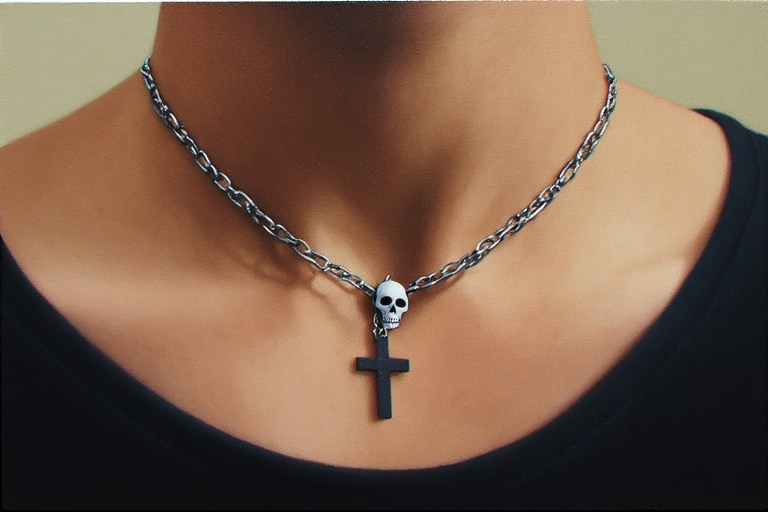
There are people who wear both the Cross and the skull, and most never stop long enough to consider what that actually says. They put them on casually, as if they were just accessories, never realizing that symbols have their own language. Even when no one is speaking, the things we carry on our bodies are already declaring something about what we believe, what we accept, or what we agree with. The Cross and the skull together aren’t neutral, they’re in tension, and that tension speaks louder than fashion or habit. Every time they are worn, they are making a statement, whether the wearer notices it or not, and that statement carries weight.
The skull has always carried a clear, unmistakable message. You don’t have to interpret it, and it doesn’t care if you try, it simply testifies to an appointed end. From the very beginning, right after the fall, God’s decree over the flesh was spoken plainly. Genesis 3:19 “For dust you are, and to dust you shall return.” That is not poetic language. It’s a sentence. And I mean that in every sense: it’s a legal sentence, a verdict, a declaration over every human being. It’s not just a line of words, it’s a pronouncement that sets the condition of natural life. It leaves no wiggle room. The skull represents that outcome, death. It’s the visible, inescapable reminder that flesh cannot sustain itself, that without intervention, every person returns to the same stillness. That’s the hard truth the skull carries, and you can try to make it edgy or decorative, but it doesn’t lose its meaning.
Then there’s the Cross, standing right next to that message, and it doesn’t try to deny what the skull shows. It doesn’t soften it, it doesn’t avoid it, and it certainly doesn’t pretend death isn’t real. The Cross meets death head-on, at its fullest, and answers it at its deepest. It’s not just a symbol of suffering or sacrifice. The Cross is where judgment, sin, and death themselves were confronted and overturned. It’s the place where Yeshua, the Messiah, stepped in and faced every weight, every claim, every sentence that death had over humanity, and He broke it from the inside. The Cross is not decoration. It is confrontation, intervention, and authority all at once. And it changes everything for the one who actually steps into what it represents.
When someone wears both the skull and the Cross, they are carrying two witnesses at once. One declares the inevitability of death, and the other declares that death has been entered and has been overcome. The tension is not in the symbols themselves, but in whether the life of the one wearing them agrees with one more than the other, the scull but not the Cross, or the Cross but not the scull. Because it is entirely possible to acknowledge death as a reality, even to the point of embracing its imagery, while never entering into what the Cross requires.
The Cross is not only about what Yeshua accomplished externally; it calls for something internal. Luke 9:23 “If anyone desires to come after Me, let him deny himself, take up his Cross daily, and follow Me.” This is where many turn the Cross into decoration, because the true meaning presses into the will. It is not about wearing an image of sacrifice while preserving self-rule; it is about consenting to a death that happens before the body ever reaches the grave.
So now the one wearing both has to reckon with something real, something unavoidable. You have to ask yourself: are you living like death is still in charge, or are you living like Yeshua has already stepped in? The skull alone doesn’t lie. It’s simple, brutal, and persistent. It simply says what we all become if Yeshua hadn’t intervened. It says life ends, the body goes back to dust, and the silence after breath is not interrupted. That’s what it means to wear a skull without understanding the Cross. You can put it on for style, for shock, even to remind yourself that death is real, but that doesn’t change what it represents
Then there’s the Cross. The Cross is an answer, but it’s not a soft one. It steps into the middle of death and says, “You don’t get the final word anymore.” Yeshua didn’t sidestep it. He didn’t make it easier. He went straight into it, faced it fully, and came out the other side with authority over it. The skull’s sentence is final without the Cross, but the Cross interrupts that sentence. That’s why the question of what you’re wearing isn’t trivial. It’s a test of which reality you’ve chosen to live in.
And here’s the part that should hit hard: without Him doing what He did, we would all stay that way. Not just dead in a body, but dead in every way that matters. The skull wouldn’t be a fashion statement or a conversation starter. It would be the truth about every life, final and unbroken. There would be no hope. No interruption. No power breaking in from outside. Death would claim every one of us and hold us, because death is relentless. It doesn’t release its grip naturally. We would all be stuck, and no human effort could change that.
But because the Cross exists, that finality doesn’t have to be ours. It isn’t just a promise we wear, it’s a reality we step into, a reality that changes how we move through life. The skull still speaks, loud and unrelenting, but now it points backward rather than forward. It reminds us of what was deserved, of what we would face without intervention. The Cross says something else entirely: “This end is not your end.” That is a statement that demands a response. Are you stepping into it, or are you letting death still dictate the terms of your life?
The Cross’s testimony is that death itself was entered, confronted, and overcome. It wasn’t avoided or bypassed. Messiah went all the way in. Revelation 1:18 tells us, “I am He who lives, and was dead, and behold, I am alive forevermore… and I have the keys of Hades and of Death.” Those keys are not symbolic window dressing. They declare authority and control. What once held power no longer governs. Death does not get the final word when the One who faced it did not remain in it.
Wearing both symbols isn’t about decoration. It’s about truth. The question isn’t whether the skull and Cross can coexist visually, it’s whether they coexist in the heart and in the life. If the Cross is just on the outside, it changes nothing. The skull continues to speak as the ultimate witness, reminding us of finality and what would have happened. The statement of death remains unless it is interrupted.
But when the Cross is embraced as more than an image, when its work touches life, and obedience follows, the skull changes. It no longer declares inevitable doom. It becomes a marker of what was deserved, of what might have been, and of what has been overcome. It becomes testimony. The one wearing both now carries two voices, and the meaning shifts entirely because the Cross has intervened in the story.
Decoration and declaration are not the same. Decoration leaves symbols untouched. Declaration lets them shape the life that carries them. The Cross as declaration says that death has been entered and broken. It says that following Yeshua changes reality now, that life beyond death is assured, not just a hope for later, and that surrendering self allows that life to grow in the present.
The one who wears both is never neutral. They are declaring a story, whether consciously or not. Which story is true for them? Does their life line up with the Cross, or does it remain under the skull? One speaks of what happens to all without intervention. The other speaks of what obedience, sacrifice, and resurrection make possible. One is the sentence of death. The other is the promise of life. And the wearer must reckon with which is shaping the truth of their life.
Prayer
Father, make what we carry outwardly, the signs, the symbols, the reminders, true reflections of what is alive within us. If we wear the sign of the Cross, carry it not as decoration or habit, but as a call to walk in the Work it represents. Destroy pride, selfishness, fear, and every part of the flesh that resists You, and fill us completely with the life You have made alive in us through Messiah. Cause that the Cross reminds us to govern our thoughts, our choices, our words, and our actions, so that what we wear matches what we live.
Awaken us fully to the reality of death, but not to dread or despair. Reveal the depth of what You accomplished through Your Son. Flood our hearts with gratitude for the One who stepped into the finality we could not escape, and remind us daily that life beyond death is no longer theoretical, it is a reality, a present inheritance. Transform that awareness into how we speak, how we treat others, and how we face each day.
Command our lives to declare the truth behind the symbols we carry. Align our actions, our words, our hearts, and our minds with the testimony of the Cross. Fill every symbol we wear or display with Your presence and purpose, so nothing is empty, hollow, or without meaning. Make every symbol point to Your reality, every outward sign backed by inward obedience, and every reminder of death transformed into testimony of life, hope, and rescue.
We declare this in Your Son’s precious Holy name, Yeshua. Turn this prayer into a life surrendered, a heart aligned and a witness in motion. Amen, Amen.
✝️ ✝️ ✝️ ✝️ ✝️
If this message blessed you, please leave a comment. I would love to hear from you.
© 2026 AMKCH and SKH
AI-assisted images created with “Perchance” at my direction
✝️ ✝️ ✝️ ✝️ ✝️
.
.
VERY WELL WRITTEN. IT NEEDS TO BE SEEN… THANK YOU