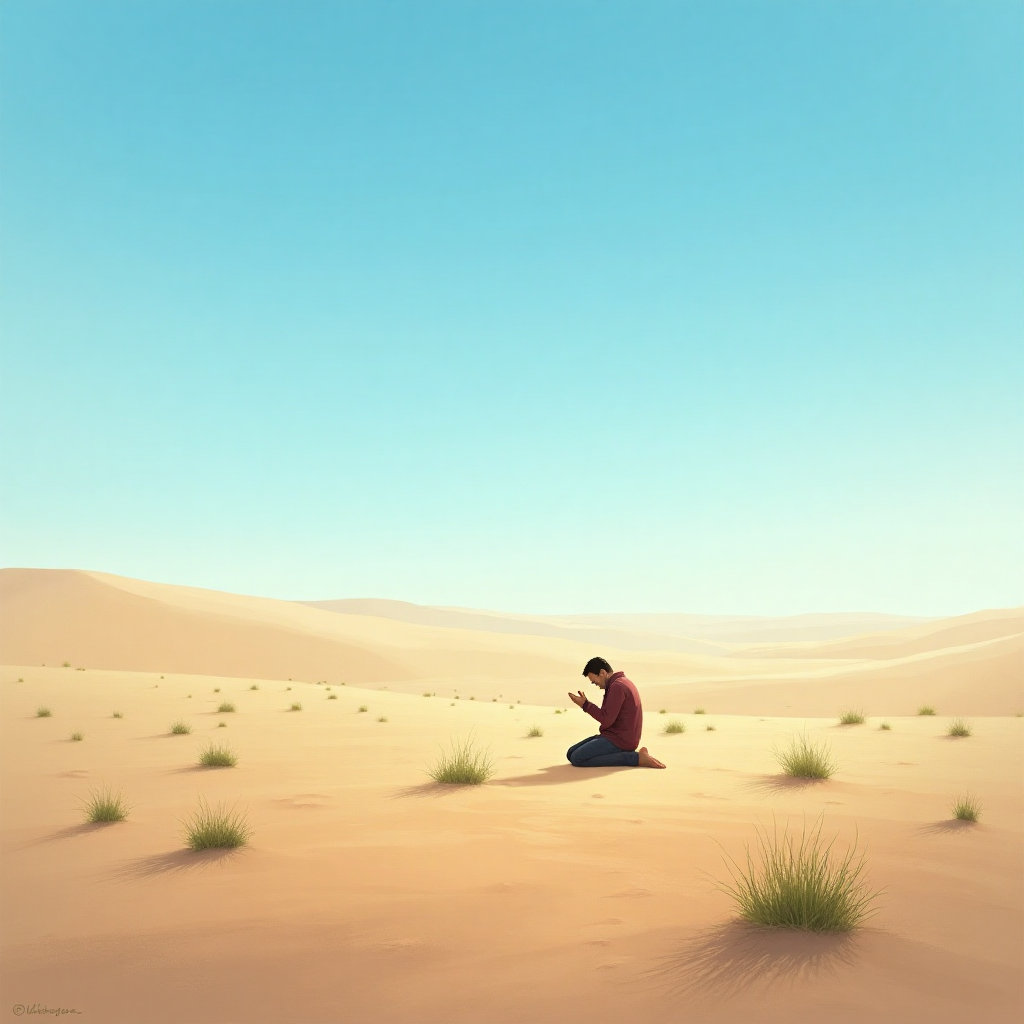
– What the wilderness still teaches us
The wilderness. That word alone carries weight. Not the romantic kind either. It’s the place nobody volunteers for. You don’t plan a vacation there. You end up there. Usually after something has already gone wrong, or slipped through your fingers, or stopped making sense. Dry. Quiet in the wrong way. Empty in a way that makes you notice yourself more than you want to. And yes, most of us have been there, whether we ever used the word or not.
But here’s the thing. Scripture never treats the wilderness like a mistake. We do. God doesn’t. When you slow down and actually watch what He does there, you realize it’s not just a place of lack. It’s a place of stripping. And once things are stripped away, something else can finally happen. God can speak without competing with the noise we usually surround ourselves with.
Israel knew the wilderness better than most. Forty years worth of knowing it. And people love to say they were lost. But I don’t think that’s true at all. They were lost in Egypt, even while they were fed. They were found in the wilderness, even while they were hungry. Egypt told them who they were. God had to undo that. And undoing takes time.
The Hebrew word for wilderness is midbar מִדְבָּר, and that alone tells you more than geography ever could. It comes from dabar דָּבַר, to speak. That is not an accident. The wilderness is where God speaks because it is often the only place we finally listen. No backup plan. No distractions. No pretending. Just sand, sky, and the uncomfortable awareness that you are not in control of much at all.
Israel did not meet God in a palace. That part matters more than we usually admit. God did not wait until they had structure, order, or a building with polished stones. He met them when there was nothing around them but open land and open sky. No walls. No stored supplies. No sense of security. And somehow that was exactly the point. When there is nothing else to lean on, you finally see what you have really been leaning on all along.
That is why God could say what He said in Deuteronomy 8:2 without apology. He told them plainly that He led them through the wilderness to humble them, to test them, and to know what was in their hearts. That word humble is anah, and it does not mean gentle improvement. It means to bring low, to press down, to afflict. That sounds uncomfortable because it is. The wilderness presses on you. It squeezes out whatever has been hiding under comfort. Pride does not survive there very long. Neither does the illusion that you are self-made or self-sustained.
And testing, that word is nasah, means to try, to prove, to examine. God was not trying to trap Israel or catch them failing. He was exposing what was already there. The wilderness does that. It does not create unbelief. It reveals it. It does not invent fear. It draws it to the surface where it can finally be faced honestly. Like heat on metal, it shows what is solid and what is not. And yes, that process is uncomfortable. But it is also truthful.
Israel had to learn dependence the hard way because there was no other way left. Food was not guaranteed. Water was not guaranteed. Direction was not guaranteed. Every single day forced them to look upward instead of inward. And that rubs against human nature. We like systems. We like predictability. We like knowing how things will turn out. The wilderness offers none of that. It offers presence instead.
People often say God abandoned Israel in the wilderness because they lacked comforts. Scripture says the opposite. That is where His provision became visible in ways they could not ignore. That is where manna appeared. And even the name tells the story. Man, transliterated man, means “What is it.” They did not recognize it. They could not label it. They could not store it. They could not control it. They had to trust God for it daily. That was not a flaw in the system. That was the system doing exactly what it was meant to do.
God gave them what they needed, not what they expected. And that truth still stings a little if we are honest. We want explanations. God often gives provision instead. We want clarity. God gives enough light for the next step. And that kind of daily dependence reshapes a person, whether they are ready for it or not.
That is why Jesus later reaches back into that wilderness story in John 6:31–35 and says He is the true manna, the bread of life. He ties Himself directly to that moment. Just as God fed Israel when they could not feed themselves, Messiah feeds us where nothing else satisfies. Hunger does not always mean lack of food. Sometimes it means lack of meaning, peace, or direction. And the wilderness makes that hunger impossible to ignore.
Still, Israel struggled. That part matters too. They grumbled. They complained. They questioned. In Exodus 17:2–7, they were thirsty and angry and they asked the question that always surfaces in dry seasons. “Is the LORD among us or not?” That question has not disappeared with time. It still shows up whenever prayers feel unanswered and circumstances stay hard longer than expected.
But notice what God does. He does not abandon them for asking. He provides anyway. Water comes from a rock. A rock. In the middle of a desert. That is not subtle. That is God saying very clearly that provision does not depend on environment. It depends on Him. Even when faith is thin, He remains faithful.
Psalm 107:35–37 says God turns wilderness into pools of water and dry land into springs. That is not just poetic language. It describes how God works. He specializes in reversing what looks final. The wilderness feels empty, but it is not empty of God. It is often full of Him in ways we only recognize after the fact.
The wilderness also has a strange effect on memory. In Numbers 11:4–6, Israel starts longing for Egypt. They remember the food and forget the chains. That happens to us too. Hard seasons make the past look kinder than it was. But the wilderness is not about returning to what once was. It is about being prepared for what comes next. Egypt was familiar, but it was not freedom. God was not leading them backward. He was leading them forward, even when it felt slower than they wanted.
Jesus enters His own wilderness in Matthew 4:1–11, led there by the Spirit, not by accident. Hungry. Alone. Tempted. And how does He respond. With Scripture. “It is written.” Over and over. That matters. The wilderness is not survived by emotion. It is navigated by truth. God’s Word becomes an anchor when circumstances offer none.
And Moses. He meets God in the wilderness too. In Exodus 3:1–6, he is not doing anything remarkable. He is tending sheep. Ordinary work. Ordinary day. And suddenly God interrupts it with fire that does not consume. The wilderness becomes holy ground without warning. Moses did not plan that moment. God did.
The wilderness changes people. That is its purpose. God is working toward tob, meaning good. Not easy. Not comfortable. Good. Strong. Faithful. Refined. The wilderness strips, but it also shapes. When you come out of it, you are not the same. You see differently. You trust differently. You listen differently.
So when the wilderness comes, and it will, do not rush to call it punishment. God speaks there. God provides there. God reveals hearts there. The wilderness is not the end of the story. It is often where the story finally becomes real. And God knows exactly what He is doing, even when all you can see is sand.
One thing the wilderness does that we do not talk about enough is this. It removes the illusion that faith is mostly about how we feel. In the wilderness, feelings come and go like heat waves. One day there is confidence. The next day there is fear. The next day there is anger. If faith were built on emotion alone, Israel would never have made it through a single year, let alone forty. The wilderness teaches that trust has to run deeper than mood. It has to rest on who God is, not on how today feels.
That is why God repeated Himself so often out there. He did not give one miracle and disappear. He stayed. Cloud by day. Fire by night. Daily bread. Repeated instruction. Repeated mercy. Repeated correction. The wilderness was not God testing Israel once and moving on. It was God walking with them long enough for truth to sink in. And sometimes truth only sinks in through repetition.
It also teaches timing. The wilderness does not rush. We do. God does not. Israel wanted to arrive before they were ready. God refused. Entering the land without trust would have been disaster. The wilderness slowed them down so they would not destroy themselves later. That is hard to accept when you are the one walking through it. But it is mercy, even when it feels like delay.
And here is something else that shows up if you watch closely. The wilderness exposed leadership. Moses was shaped there just as much as the people were. His patience was tested. His fear was confronted. His dependence on God deepened. God did not only prepare a nation in the wilderness. He prepared a shepherd to lead it. Often the wilderness is not just about you. It is about what God is doing through you later.
That is why the wilderness cannot be measured by productivity. Nothing looks impressive out there. No cities built. No armies trained. No wealth accumulated. And yet some of the most important work God ever did happened in that stretch of sand. Identity was formed. Covenant was given. Trust was learned. Worship was established. Things that last were built where nothing looked permanent.
And yes, it still hurts. Scripture never pretends otherwise. Hunger hurts. Waiting hurts. Not knowing hurts. But pain does not mean absence. Silence does not mean neglect. God was as present in the wilderness as He was at Sinai, as He was at the Jordan, as He was in the land. His presence just looked different there.
Sometimes the wilderness is the only place where idols finally lose their grip. Egypt had shaped Israel’s thinking more than they realized. The wilderness had to undo that. Comfort can keep idols hidden. Scarcity exposes them. When nothing else works, the heart reveals what it truly trusts. That revelation is uncomfortable, but it is also freeing.
And here is the quiet truth underneath all of it. God knows exactly how long the wilderness needs to last. Not a day longer. Not a step wasted. Israel did not wander because God was confused. They walked until the lessons took root. Until trust replaced fear. Until dependence replaced pride. Until obedience began to grow from the inside instead of being forced from the outside.
So when you find yourself there, and you recognize the signs, the dryness, the waiting, the questions that keep circling back, do not assume you missed God. You may be closer to Him than you have ever been. The wilderness strips away the noise so the voice of God can finally be heard. It teaches you how to walk without leaning on what used to hold you up.
And when the wilderness does its work, when the season shifts and you step forward again, you carry something with you that comfort never could have given. You carry trust that has been tested. Faith that has been lived. Knowledge that God provides, not in theory, but in experience.
The wilderness is not where faith dies. It is often where it finally becomes real.
If you liked this message please leave a positive comment. I would love to hear from you.
.
.