– Unlikely tools of God’s leading
You know there are times in our lives when we think we’ve got everything figured out, right? We’ve planned our route, set our course, and we feel sure we know exactly where we’re headed. We think the road ahead is clear, every turn mapped, every obstacle anticipated, and we move forward with confidence, believing nothing will surprise us. But then, out of nowhere, something happens. Maybe it’s a detour that we never saw coming, a sudden stop that forces us to pause, or even a small, seemingly insignificant thing… a donkey, for example, that causes us to reconsider our direction, to rethink our choices, and to question our assumptions. That’s exactly what happened to a man named Balaam in the Bible. And while Balaam is often remembered primarily for his encounter with a talking donkey, there is so much more to this story, so much depth, and so many layers that reveal how God works in the most surprising and unexpected ways, using even the smallest or strangest things to accomplish His purposes.
Balaam was a prophet, someone who had the special calling and spiritual authority to bless or curse people with his words, a navi (נָבִיא) who spoke what God revealed to him. In Numbers 22, we find that King Balak of Moab was filled with fear. Israel, under the leadership of Moses, had just crossed the Red Sea in a miraculous act of God, and they were gaining victories over the lands around them. Each step they took was guided and protected by God’s presence, and the surrounding nations watched in alarm as God’s people advanced. Now, Moab was next in line, and Balak was deeply worried. He knew that Israel would eventually make their way into his territory, and he wanted to stop them before they could conquer his land, to halt what God had ordained if he could. So, Balak devised a plan: he would hire Balaam to pronounce a curse on Israel, hoping that human words could counteract God’s plan.
Balak sent messengers to Balaam, offering promises of great rewards, riches, honor, and even a high position if Balaam would just come and curse Israel on his behalf. On the surface, it sounded like an easy enough offer. Yet, when Balaam received the message, God spoke to him directly, saying, “You shall not go with them. You shall not curse the people, for they are blessed” (Numbers 22:12). Balaam was a man of God, devoted to His calling, but he was also human, and the allure of riches and honor tested him. He wanted to honor God with his obedience, yet he also desired the tangible reward offered by the king, a temptation that revealed the tension between human desire and divine instruction. Balaam did not accept God’s initial refusal as the final answer. He asked God again, seeking permission to go with the messengers, and God, perceiving the longing in Balaam’s heart and his desire for personal gain, allowed him to go, but with a stern and unambiguous warning: he could only speak the words that God commanded him to speak, nothing more, nothing less.
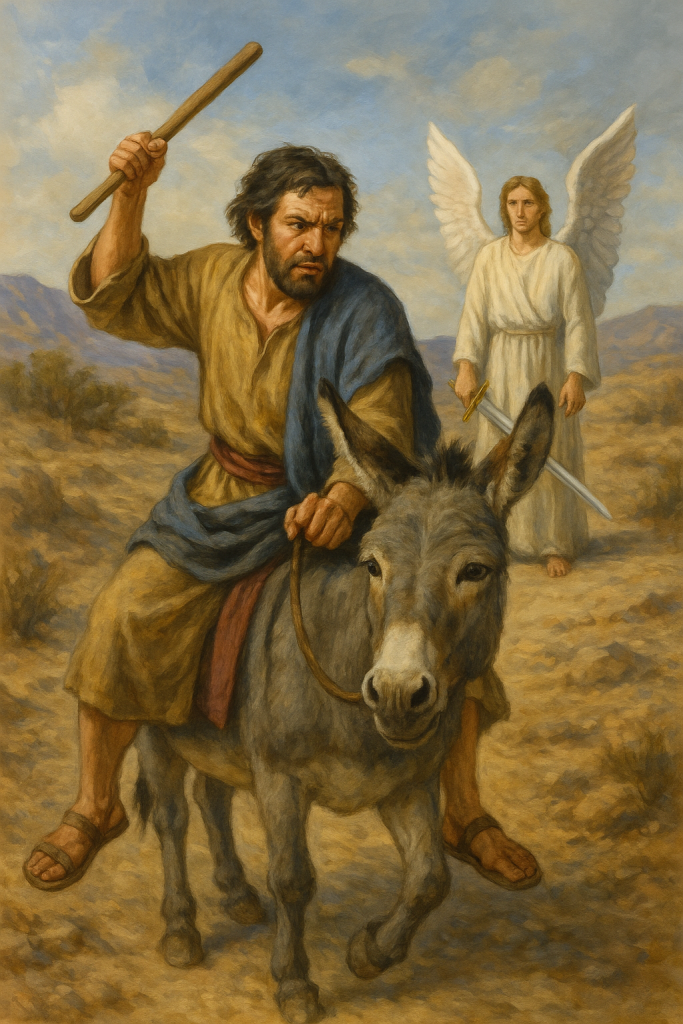
So Balaam mounted his donkey, convinced he was acting within the bounds God had set. Yet this is when events took a strange and unexpected turn. The donkey saw the angel of the Lord standing in the way, a divine messenger with sword drawn, blocking the path ahead, but Balaam could not see the angel. The donkey tried repeatedly to turn aside, to avoid the angel, but Balaam, frustrated and unaware of the heavenly obstruction, struck the donkey each time. Finally, in a moment that must have seemed impossible, the donkey spoke, asking Balaam why he had beaten her. Balaam, bewildered yet unfazed, answered the donkey, and in that instant, God opened Balaam’s eyes so that he could see the angel standing before him. The angel said, “I have come to oppose you because your path is reckless before me. The donkey saw me, and she turned away; if she had not, I would have killed you” (Numbers 22:32). In this bizarre and almost comical event, God used what seemed absurd to command Balaam’s attention, to redirect his course, and to warn him that the path he had chosen was dangerous and could have led to death. This story shows us that God’s methods are not bound by human expectation. He can use anything, even a donkey, to get our attention and steer us onto the right path.
Balaam, seeing his error and realizing that he had been pursuing his own desire more than God’s will, repented and acknowledged that he could only speak the words that God gave him. He submitted fully to God’s instruction, recognizing that human plans cannot override divine command. Balaam went with the messengers, but instead of cursing Israel, every attempt he made to curse the people was turned by God into blessing. Three times he opened his mouth intending harm, and three times God transformed his words into berakhah (בְּרָכָה), blessings over Israel (Numbers 23–24). This teaches us a profound truth: God’s plan is unstoppable, and human schemes, even when they involve spiritual authority, are powerless against the will of God. Balaam’s own attempts to manipulate God’s promise were futile, and the blessings of God could not be reversed by human intention.
Now here is a twist that many overlook: what happened to King Balak? After witnessing that Balaam could not curse Israel, Balak became furious. He had hoped to weaken Israel with the prophet’s words, yet Balaam’s blessings strengthened God’s people instead. Balak tried to pressure Balaam again, offering even greater rewards, hoping to sway him, but Balaam remained steadfast in obedience to God. In the end, instead of bringing harm, Balaam’s words of blessing declared that no one could thwart the plans God had set in motion for His people.
But here is a lesson we often forget: King Balak did not receive the message. Despite witnessing Balaam’s inability to curse Israel and seeing the undeniable power of God at work, Balak did not turn to God in repentance or recognition of His authority. Instead, he sought another way to undermine Israel. In Numbers 25, we see the next phase of Balak’s plot. Frustrated with his failure to defeat Israel through Balaam’s words, Balak orchestrated a plan of moral seduction. He encouraged the Moabite women to entice the Israelite men and lead them into idolatry and immorality. This resulted in widespread sin among the Israelites, with many falling into pagan worship and rebellion against God. Yet even in this scenario, God’s justice prevailed. Judgment came upon those who participated in the sin, demonstrating that while God allows human choice, He also maintains order, righteousness, and the fulfillment of His covenant promises. Balaam himself, despite his momentary obedience in blessing Israel, is remembered as one who ultimately led others into sin through his later actions. Both Balaam and Balak faced the consequences of their choices. Balaam’s longing for personal gain and willingness to entertain sin contributed to his downfall, while Balak’s scheming did not achieve the victory he desired and ultimately brought disaster upon him and his people.
The story of Balaam, the donkey, and King Balak is a vivid and powerful reminder that God’s plans cannot be thwarted. No matter how hard we try to oppose Him, no matter what obstacles or schemes are placed in our path, God’s will always prevails. Balaam’s donkey, which may have seemed absurd at first, was a tool God used to redirect a wayward prophet. It reminds us that God sometimes works in the most unlikely, unexpected, and even humorous ways to achieve His purpose. Just as God used Balaam’s mouth to bless Israel, He can use the strangest means, the smallest instruments, or the most surprising circumstances to fulfill His promises in our own lives.
King Balak, on the other hand, thought he could manipulate the situation, control Balaam, and force a human solution to stop God’s plan. Yet he learned, as we must, that no human manipulation can outwit the sovereignty of God. His plans failed, his schemes backfired, and his attempt to curse what God had already blessed only led to disaster. God’s protection over His people is absolute, and His purposes cannot be subverted by even the most clever human designs.
When we encounter frustrating delays, detours that seem senseless, or circumstances that block our way, we must pause and reflect on Balaam, his donkey, and the king who tried to curse Israel. Sometimes, what appears to be an obstacle, a nuisance, or a roadblock is actually God’s gentle or even firm way of guiding us, correcting our path, or protecting us from harm. It may not make sense at the moment. It may feel inconvenient, embarrassing, or irritating. But these divine detours are part of God’s guidance. Faith calls us to trust in His timing, His methods, and His plan. If we submit to God and follow His direction, we can rest in the assurance that no human opposition, no obstacle, no king, and no circumstance can override what God has ordained. His plan is perfect, His will is unstoppable, and His purposes always prevail.
If you liked this message please leave a comment! I look forward to hearing from you!
image by chatgpt at my direction