There is something about Yeshua that sets Him apart from every other human being who has ever walked this earth. He knew who He was. He knew where He came from and He knew who had sent Him. He knew what He had been sent to do, and He knew where He was going. Because His identity was secure, He did not have to spend His life proving Himself to other people.
When we say that Yeshua had no ego, we need to understand what we mean. We are not saying that He lacked confidence, personality, authority, dignity, or any understanding of His own identity. He knew exactly who He was. He spoke with authority, confronted hypocrisy, corrected people, and refused to be manipulated. He could stand before powerful religious leaders and tell them the truth without backing down. There was nothing weak or uncertain about Him.
What Yeshua did not have was the human need to make Himself important in the eyes of other people. He did not need applause, constant recognition, titles, or admiration to establish His worth. He did not need to be the most important person in the room. He did not need everyone to know how important He was. Yeshua simply knew who He was.
One of the clearest statements He made about this is found in John 8:50, where He said, “I do not seek my own glory.” The Greek word for “seek” is zēteō, “seek,” and “glory” is doxa, “glory.” The point is that Yeshua was not pursuing personal recognition. He was not living His life trying to obtain honor from people.
That is a very different way of living from the way human ego operates. Ego wants to be noticed. It wants recognition. It wants the credit. It wants admiration and respect. It does not like being overlooked, corrected, questioned, or challenged. When a person’s sense of importance depends upon how other people treat him, he can become very defensive when that importance is threatened.
Yeshua was not controlled by that need.
Throughout His ministry, He repeatedly directed attention toward the Father rather than toward Himself. In John 5:30, He said, “I do not seek my own will but the will of him who sent me.” The Greek word for “will” is thelēma, “will.” Yeshua’s concern was not getting His own way. His concern was carrying out the Father’s will. That is a tremendous difference between self-centeredness and submission to God.
In John 6:38, He said, “I have come down from heaven, not to do my own will but the will of him who sent me.” Again, Yeshua’s life was not centered upon promoting Himself. He understood His mission as something He had received from the Father. He knew His purpose, and because He knew His purpose, He did not need to create one around Himself.
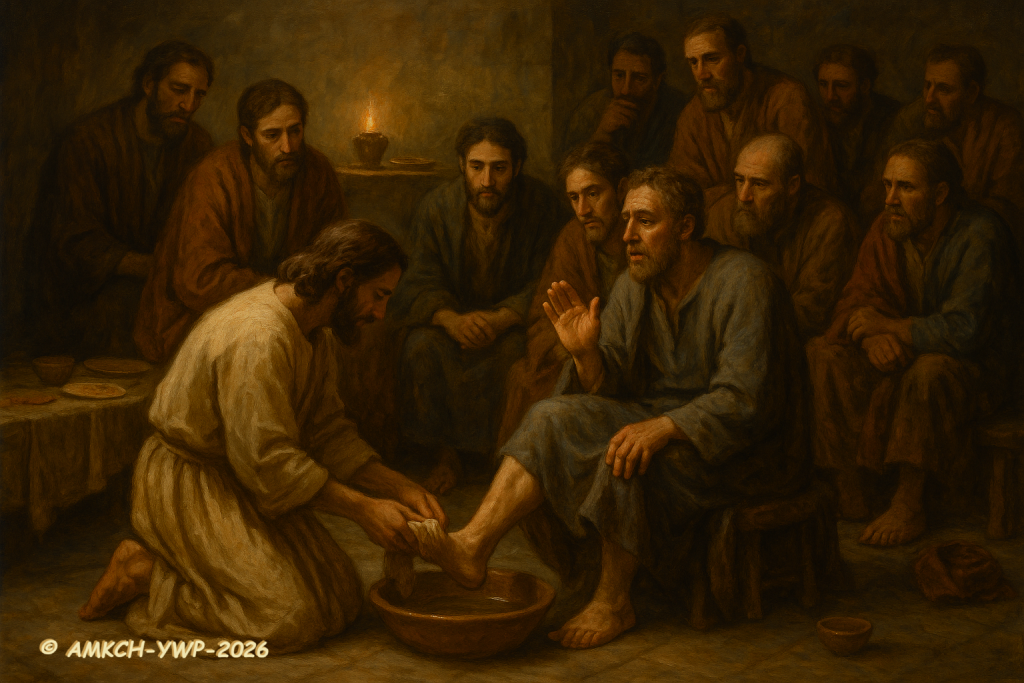
We see this same security of identity in John 13:3-5. Before Yeshua washed the disciples’ feet, John tells us that Yeshua knew the Father had given all things into His hands. He knew He had come from God, and He knew He was returning to God. Then He got up from the meal, took a towel, and washed His disciples’ feet.
That is one of the most powerful pictures of humility in Scripture. Yeshua knew exactly who He was, yet He willingly performed the work of a servant. He did not think that having authority meant He was too important to serve. His knowledge of His position did not make Him arrogant. Instead, His security allowed Him to humble Himself without feeling that serving somehow lowered His worth.
That gives us an important understanding of humility. Humility does not mean pretending that you are nobody. Yeshua never did that. He knew His authority. He knew His relationship with the Father. He knew His mission. True humility is not denying what God has given you. It is refusing to turn what God has given you into an excuse for self-exaltation.
Paul brings this directly into his teaching in Philippians 2:3, where he tells believers to do nothing from selfish ambition or vain conceit. The Greek word for “selfish ambition” is eritheia, “selfish ambition.” The word for “vain conceit” is kenodoxia, “empty glory.” That second word is especially interesting in this teaching because it describes glory that is empty. A person can appear important, receive attention, and collect admiration while there is very little humility underneath it.
Paul then tells believers in Philippians 2:5 to have the same mindset that was in Christ Jesus. The following verses describe Yeshua humbling Himself and taking the form of a servant . This is not accidental. Paul is showing us what the opposite of selfish ambition looks like. Yeshua did not use His position to elevate Himself over others. He willingly humbled Himself.
And there is something we should notice about that. Yeshua did not become humble because He did not know who He was. He humbled Himself because He did know who He was.
That is why the foot-washing in John is so powerful. John tells us that Yeshua knew His authority before telling us that He washed their feet. He did not need to pretend He was less than He was in order to be humble. He knew His greatness, and that knowledge did not prevent Him from serving.
That is completely different from religious ego.
Yeshua had already confronted religious ego among the leaders of His own day. In Matthew 23:5-7, He described scribes and Pharisees who did their works to be seen by others. They loved places of honor, the best seats, and public greetings. The Greek expression for “to be seen” is theōreō, “see.” Their religious activity had become tied to how they appeared before people.
That was the problem. They were doing religious things, but they wanted people to notice them doing religious things. Yeshua was not impressed by that.
And we need to be honest enough to recognize that the same danger exists in religious leadership today. Not every preacher has an ego. Not every large ministry is driven by pride. Not every person who writes books, speaks to large crowds, or has many followers is seeking personal glory. We cannot judge every person simply by outward success.
But there are religious leaders who clearly become attached to admiration, recognition, authority, and personal importance. That is not something we should pretend does not happen simply because the person carries a Bible or stands behind a pulpit.
A person can preach Scripture and still have an ego. A person can know the Bible and still be proud. A person can have genuine spiritual gifts and still crave admiration. A person can begin with a sincere desire to serve God and gradually become more interested in being recognized as the person who serves God. That is where we have to pay attention.
What happens when the preacher is corrected? What happens when someone disagrees with him? What happens when another preacher receives more attention? What happens when someone else gets the credit? What happens when the leader is not praised? What happens when people stop treating him as the most important person in the room?
Those moments can reveal what applause hides.
Scripture gives us a standard for spiritual leadership. Peter told the elders in 1 Peter 5:2-3 to shepherd God’s people willingly, not for dishonest gain and not by lording it over those entrusted to them, but by being examples to the flock. The Greek word for “lording it over” is katakyrieuō, “domineer.” That is not the picture of a leader who needs to control people in order to feel important.
Yeshua taught the same principle in Matthew 20:25-28. He explained that earthly rulers exercise authority over people, but His followers were not to operate that way. Instead, the one who wanted to become great was to become a servant. Yeshua then pointed to Himself, saying that He came not to be served but to serve and to give His life for others.
The Greek word for “servant” is diakonos, “servant.” Yeshua was not presenting service as something beneath spiritual greatness. He was showing that service is part of true greatness.
This is where we need to distinguish authority from ego. Authority itself is not the problem. Yeshua had authority. He exercised it openly and powerfully. The problem comes when authority becomes a means of elevating the person who possesses it. Yeshua never needed His authority to feed His ego.
He could tell the truth without needing to humiliate people. He could correct without needing to make Himself look superior. He could confront religious hypocrisy without turning the confrontation into a performance about Himself. He could refuse manipulation without becoming controlled by anger.
That is because His identity did not come from the people standing in front of Him.
Yeshua knew who He was.
He knew He belonged to the Father. He knew His purpose. He knew His authority. He knew where He came from and where He was going. The crowd did not give Him His identity, so the crowd could not take it away.
That is something human beings struggle with. When our identity depends upon other people’s opinions, their opinions can control us. If we need admiration, then the absence of admiration hurts us. If we need to be respected, disrespect becomes a threat. If we need to be right, correction becomes an attack. If we need recognition, being overlooked becomes almost unbearable.
Yeshua did not live from that place.
He could be rejected without changing His message. He could be criticized without abandoning His mission. He could be falsely accused without becoming consumed with defending His reputation. He could endure humiliation without allowing humiliation to determine His identity.
And that becomes especially powerful when we remember what He endured at the end of His earthly life. The One who had every right to glory accepted humiliation, suffering, and death. He did not suddenly decide that He needed to prove His greatness to those who mocked Him.
He knew who He was.
That is why Philippians 2:8-11 is so important. Paul describes Yeshua humbling Himself and becoming obedient even to death on a cross. Then God exalted Him. The Greek word for “exalted” is hyperypsō, “exalt.” Yeshua did not have to exalt Himself. The Father exalted Him.
There is a beautiful order here. Yeshua humbled Himself, remained obedient to the Father, and the Father ultimately exalted Him. Human ego wants to reverse that order. Ego wants to exalt itself first and then have everyone else recognize the greatness it has already claimed.
Yeshua did not do that.
He trusted the Father.
That gives us something very important to consider when we look at religious leadership today. We should not automatically assume that a person with a large following is egotistical, nor should we automatically assume that a person with a small following is humble. Numbers do not reveal the heart. Titles do not reveal the heart. Platforms do not reveal the heart. Even knowledge of Scripture does not automatically reveal the heart.
Character is revealed over time.
Can the person receive correction? Can he admit when he is wrong? Can he give credit to someone else? Can he listen without becoming defensive? Can he serve when nobody is watching? Can he allow another person to have the attention? Can he disagree without becoming vindictive? Can he lead without needing to dominate?
These questions seriously matter because religious ego can hide beneath a very polished appearance.
A preacher may sincerely believe he is defending God’s truth when he is actually defending his own reputation. A teacher may believe he is protecting sound doctrine when he is actually protecting his position. A leader may believe he is defending his ministry when he is really defending his own importance.
Only God knows the heart completely, so we must be careful about accusing people of motives we cannot see. But we can examine behavior, and Scripture tells us to recognize people by their fruit.
That brings us back to Yeshua.
He did not seek His own glory.
He did not live for human praise.
He did not use His authority to make Himself greater than others.
He did not need to be constantly recognized.
He knew who He was.
And because He knew who He was, He was free to serve.
That may be one of the greatest lessons in this entire subject. A person who is secure in God does not have to constantly establish his importance before other people. He can teach without needing applause. He can serve without needing recognition. He can receive correction without feeling that his entire identity has been attacked. He can let someone else receive the praise without feeling diminished.
Yeshua demonstrated this perfectly.
He possessed authority without arrogance. He possessed greatness without self-exaltation. He possessed knowledge without belittling others. He possessed a divine identity without spending His earthly life demanding that everyone recognize it.
He knew who He was.
And because He knew who He was, He did not need an ego to tell everybody else.
Prayer
Holy Father, I thank You for Yeshua and for the example He gave me of true humility. He knew exactly who He was, where He came from, and why He had been sent, yet He never needed the praise or approval of people to establish His worth. Help me to learn that same security in You.
Keep me from seeking recognition, admiration, or honor for myself. When I am corrected, help me receive it with humility. When I am overlooked, help me remain content. When someone else receives praise, help me rejoice without feeling diminished. Teach me to recognize the difference between standing for Your truth and defending my own pride.
Let my life point people toward You rather than toward myself. Help me remember that true greatness is found in serving, just as Yeshua served. Father God, keep my heart humble, my motives clean, and my identity firmly rooted in You.
In Yeshua’s precious name. Amen.
✝️✝️✝️✝️✝️
I hope you learned from this message. BUT… Don’t take my word for it. Like the Bereans in Acts 17:11, search the Scriptures daily to see whether these things are so. Open your Bible, study God’s Word for yourself, and ask the Holy Spirit to guide you into all truth. Don’t simply accept my conclusions. If what I’ve written agrees with Scripture, hold fast to it. If it doesn’t, let God’s Word be your final authority.
✝️✝️✝️✝️✝️
If you liked this message, please leave a positive comment. I would love to hear from you!
© AMKCH 2026
image done by my chatgpt at my direction.
If any of these people looks like you or someone you know, that is purely coincidental. They are not.
✝️✝️✝️✝️✝️.
.