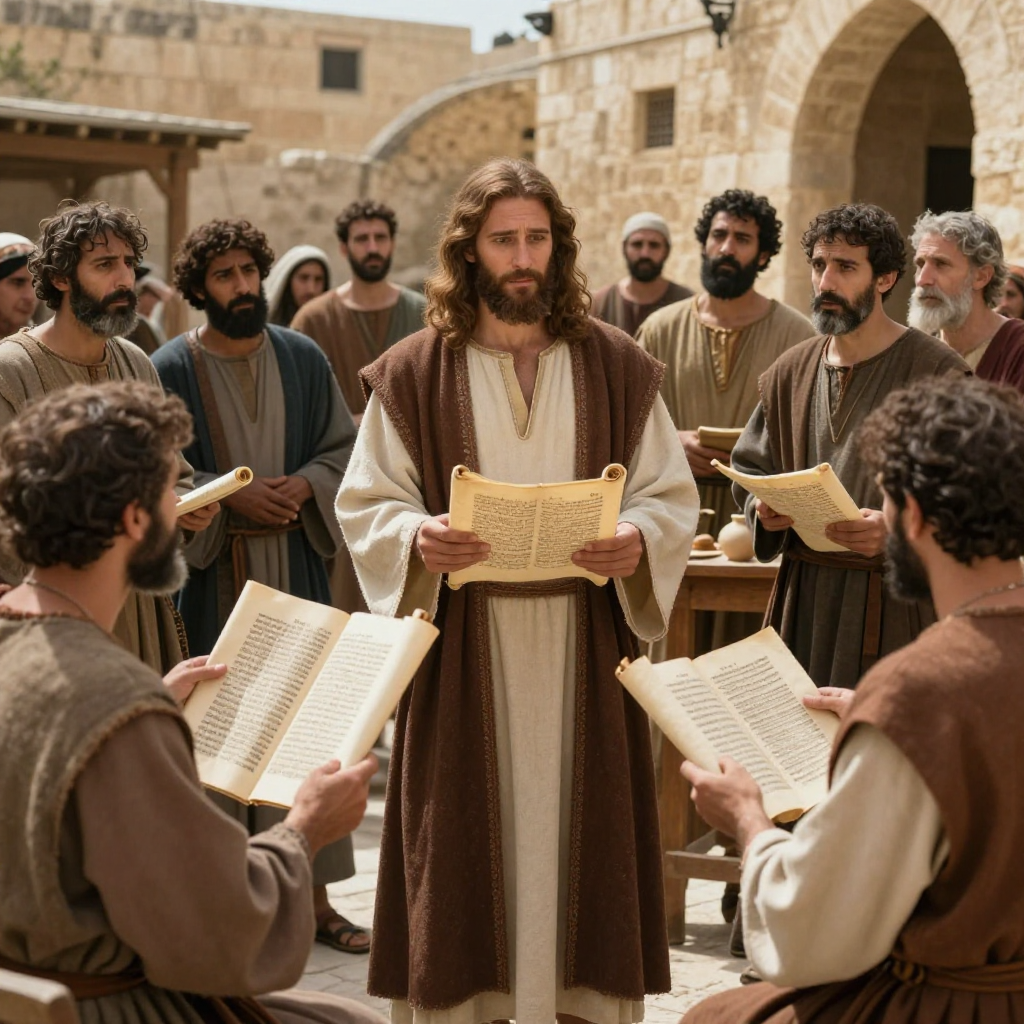
There is a sentence Paul wrote that can easily be read over without realizing just how much is packed inside it. He said, “None of the rulers of this age understood it. If they had, they would not have crucified the Lord of glory,” 1 Corinthians 2:8. That is an astonishing statement. Paul was not saying that nobody had ever heard the Scriptures. He was not saying that nobody had ever spoken about the coming Messiah. He was saying that the people who were involved in what happened to Jesus did not truly understand or even know who He actually was. They had the Scriptures, yes. They had the Law. They had the Prophets. They had the promises. They had generations of people who had been waiting for the One God would send. They had all that. Yet when He stood in front of them, they just did not recognize Him.
Paul’s actual Greek words make this even clearer. He wrote ἔγνωκεν, egnōken, has known or recognized, and then ἔγνωσαν, egnōsan, they knew or recognized. He then used ἐσταύρωσαν, estaurōsan, they crucified, and called Jesus τὸν κύριον τῆς δόξης, ton kyrion tēs doxēs, the Lord of glory. Paul’s point is actually pretty simple. If they had truly known who Jesus was, they would not have done what they did.
That raises a very important question. How could people who knew the Scriptures fail to recognize the One those Scriptures pointed toward?
The answer begins long before Bethlehem. Throughout the Torah and the Tanakh, God shows us that people can hear His words, know the stories, understand the religious language, and still fail to understand what God is doing. The problem is not always a lack of information. Sometimes people have already decided what God must look like, what His servant must look like, what His kingdom must look like, or how His promises must be fulfilled. When God does something differently than they expected, they can look directly at His work and still miss it.
That pattern is all through Scripture. Joseph’s brothers knew their father’s words, but they did not understand what God was doing through Joseph. Moses was rejected by some of his own people before God used him to deliver them. David was overlooked even by those closest to him when Samuel came looking for the one God had chosen. Again and again, Scripture shows us that human beings can judge what God is doing according to their own expectations instead of God’s purpose.
The prophets also gave Israel words that would become deeply important when Jesus came. Isaiah described the servant in language that does not sound like the kind of person people naturally expect God to exalt. Isaiah wrote, נִבְזֶה וַחֲדַל אִישִׁים, nivzeh va-chadal ishim, despised and rejected by men, and continued by describing him as אִישׁ מַכְאֹבוֹת, ish makh’ovot, a man of pains or sorrows. The passage says that He would be regarded as someone from whom people would hide their faces, and that he would be despised and not esteemed, Isaiah 53:3.
Isaiah did not stop there. He described someone who would be oppressed and afflicted yet would not open his mouth, כַּשֶּׂה לַטֶּבַח יוּבָל, ka-seh la-tevach yuval, like a lamb being led to slaughter, Isaiah 53:7. The language presents suffering, rejection, silence, and obedience. That does not fit the picture people naturally create when they imagine earthly or Heavenly power. Yet Jesus repeatedly showed that God’s way was not the world’s way.
This helps explain why so many people missed who Jesus was. They were looking for the Messiah, but many were looking for Him through their own expectations. Jesus did not come with the kind of earthly display that would satisfy those expectations. He came healing people, touching those that others would avoid, eating with people that others rejected, forgiving sinners, teaching ordinary people, confronting religious hypocrisy, and refusing to build His kingdom around the power structures people understood.
John described the tragedy in one short sentence: “He was in the world, and the world was made through him, yet the world did not recognize him,” John 1:10. The Greek says ὁ κόσμος αὐτὸν οὐκ ἔγνω, ho kosmos auton ouk egnō, the world did not know or recognize Him. Jesus was there among them, but they just did not understand who He was.
Peter later spoke to the people in Jerusalem after Jesus had been crucified and raised from the dead. He said, “Now, brothers, I know that you acted in ignorance, as did your rulers,” Acts 3:17. His Greek words are οἶδα, oida, I know, κατὰ ἄγνοιαν, kata agnoian, in ignorance or without knowledge, and ἐπράξατε, epraxate, you acted or did. Notice what Peter does not say. He does not say that they had no responsibility because they were ignorant. They did. But he simply identifies the condition in which they acted.
Peter immediately explains that what happened to the Messiah was something God had announced long beforehand through the prophets, Acts 3:18. So the suffering of Christ was not an accident that God had to figure out afterward. The Scriptures had already spoken.
Paul makes the same point in an especially strong way when he speaks about the people of Jerusalem in Acts 13. He says that the people living in Jerusalem and their rulers did not recognize Jesus. The Greek word is ἀγνοήσαντες, agnoēsantes, not knowing or failing to recognize. These were people who heard the voices of the prophets being read every Sabbath, yet by judging Jesus they fulfilled what the prophets had written, Acts 13:27.
The prophets were being read to them. They were hearing the Scriptures regularly. Yet when Jesus appeared among them, they did not understand what those words were pointing toward. They had the words, but they did not understand their fulfillment.
But there is something very important we have to keep in view here. The fact that they did not understand what they were doing does not mean that the crucifixion was outside God’s purpose. Jesus had come to give His life. He said, “No one takes it from me, but I lay it down of my own accord,”John 10:18. He also said that He came “to give his life as a ransom for many,”Matthew 20:28,and when He spoke of His blood being poured out, He connected it with “the forgiveness of sins,” Matthew 26:28.
So when Paul says that the rulers would not have crucified the Lord of glory if they had known who He was, he is not saying that the cross was unnecessary. Jesus willingly gave His life because that was the work He came to accomplish for us. Without what Jesus did, we would have no salvation. We would remain in our sins, and there would be no resurrection hope for us. Paul later put the heart of that gospel into very plain words: “Christ died for our sins according to the Scriptures, that he was buried, that he was raised on the third day according to the Scriptures,” 1 Corinthians 15:3-4.
Jesus Himself warned people about hearing without truly understanding. He said that people could hear and not understand and could see and not perceive, Matthew 13:13-15. The problem was not that their ears were broken or that their eyes did not function. They could hear and see. The problem was that they were not receiving what God was showing them.
Paul gives us a personal example of this. Before he became a follower of Jesus, Paul persecuted the people who belonged to Jesus. Later he wrote about himself, “I was formerly a blasphemer, a persecutor, and a violent man. But I was shown mercy because I acted in ignorance and unbelief,” 1 Timothy 1:13. The Greek is ἀγνοῶν, agnoōn, being ignorant or acting without knowledge, and ἐποίησα, epoiēsa, I did or I acted, followed by ἐν ἀπιστίᾳ, en apistia, in unbelief. Paul knew Scripture before he truly understood Jesus, but his understanding had not led him to the truth about Him.
That ought to humble anybody who studies the Bible. We can know Scripture and still misunderstand what it is showing us. We can be sincere and still be wrong. We can hold tightly to something we were taught and still need to change our understanding.
That is why Jesus has to remain the standard. Not Paul. Not Peter. Not a preacher. Not a denomination. Not a tradition. Not our favorite interpretation. Jesus.
When Jesus taught, He brought people back to what God had said, and His own life showed us what God’s character looks like. We can see mercy, love, forgiveness, and compassion in the way He treated people. We can see how He dealt with sinners, how He treated suffering people, and how He confronted hypocrisy. When we are trying to understand what God wants from us, Jesus gives us the example we can actually look at.
So when we come across something difficult in Scripture, we have to be willing to ask a very honest question: Does the way I am understanding this actually agree with Jesus?
That question is not disrespectful to Scripture. It is a necessary question because Jesus is not merely another voice among many voices. He is the One we are commanded to hear. When people tried to trap Him with religious arguments, He went deeper than the argument and dealt with the heart of the matter.
The same principle applies when we read Paul’s writings. Paul himself said that he once acted in ignorance. That does not mean everything Paul wrote is wrong. It means we should never stop thinking simply because someone has religious authority, or because a passage has been quoted for generations. Paul was a servant of Christ, but Paul was not Christ. Peter was an apostle, but Peter was not Christ. Moses was God’s servant, but Moses was not Christ. The prophets spoke the words God gave them, but none of them was Christ.
Jesus is the standard by which everything else must be understood.
If people who had the Scriptures could misunderstand Jesus when He was standing right in front of them, then we should not assume that having a Bible in our hands means we automatically understand everything we read. That is why humility matters when we study God’s Word. We have to be willing to say, “Father God, if I have misunderstood this, show me.” We have to be willing to lay down an interpretation when the life and teaching of Jesus expose something in it that does not belong there. We have to care more about truth than about protecting something we were taught.
The Scriptures had already spoken about a suffering servant. They had already spoken about rejection. They had already shown that God’s chosen one would not necessarily arrive looking the way human beings expected. Isaiah’s words about the servant being despised, rejected, afflicted, and led like a lamb should make us very careful about deciding beforehand what God’s work is supposed to look like, Isaiah 53:3, 7.
And Paul later looked back at what happened and said, “If they had known it, they would not have crucified the Lord of glory,” 1 Corinthians 2:8.
If they had known.
That little phrase carries a huge warning for anyone who studies God’s Word. We can have the Scriptures open right in front of us and still miss what God is showing us. We can know the words without understanding the truth they are pointing us toward.
And that brings the question right back to us.
Do YOU recognize our Savior?
✝️✝️✝️✝️✝️
Prayer:
Holy Father, we come before You today with grateful hearts. We praise You because You are God, and there is none like You. You have given us Your Word so that we can know You, and You gave us Jesus so that we could see Your heart in a way we could understand. Father, we thank You for that. We thank You for Your patience with us, because there are times when we have Your Word right in front of us and still don’t see what You are showing us.
Father God, open our eyes and our understanding as we study. Don’t let us simply read words and assume we already know what they mean. Help us to recognize truth when You put it in front of us. Help us to look at Jesus, listen to what He taught, and pay attention to the way He lived. If something in our thinking needs to change, give us the humility to change it. We don’t want to defend what we have always believed. We want to know what is true.
We praise You for Jesus, for His love, His mercy, His truth, and His obedience to You. Thank You for showing us Your heart through Him. Keep us close to You, keep us willing to learn, and keep us from becoming so sure of ourselves that we stop listening to You. We give You the praise, the worship, and the honor, Father God. In Jesus’ name, amen.
✝️✝️✝️✝️✝️
Don’t take my word for it. Like the Bereans in Acts 17:11, search the Scriptures daily to see whether these things are so. Open your Bible, study God’s Word for yourself, and ask the Holy Spirit to guide you into all truth. Don’t simply accept my conclusions. If what I’ve written agrees with Scripture, hold fast to it. If it doesn’t, let God’s Word be your final authority.
If you liked this message, please leave a positive comment. I would love to hear from you!
© AMKCH 2026
Image done by imagefree at my direction.
If any of these people looks like you or someone you know, that is purely coincidental. They are not.
✝️✝️✝️✝️✝️
.