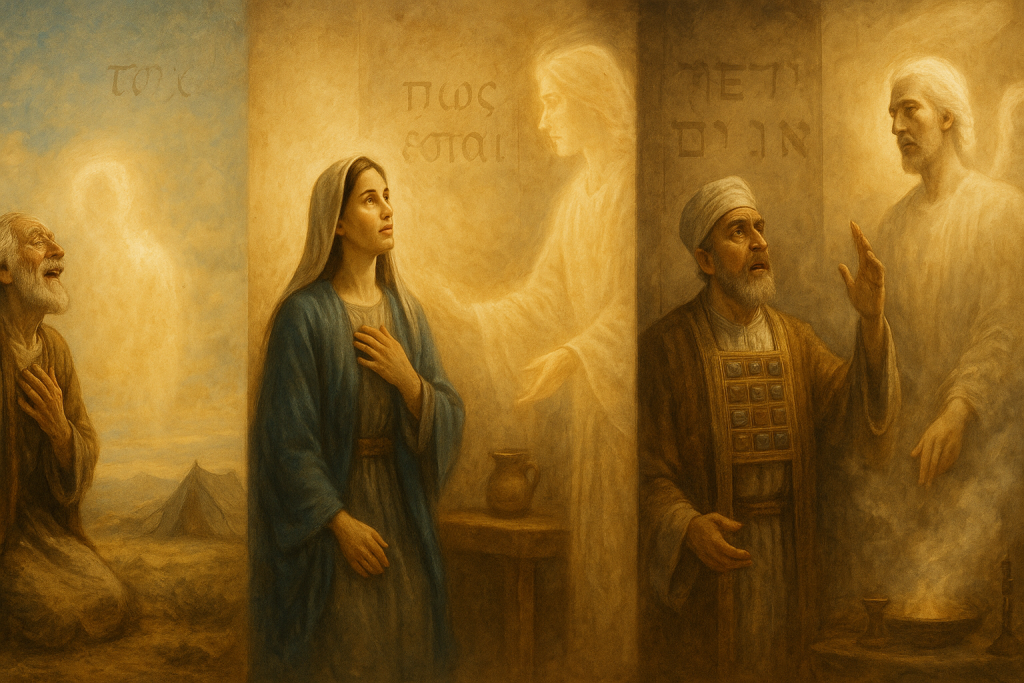
Mary is a young woman, betrothed to Joseph. That betrothal is binding in the Jewish tradition: legally, socially, spiritually. Everyone expects her future to follow a set path. She is promised to Joseph, her reputation and life are tied to this commitment. She hasn’t lived with him yet; she hasn’t shared her body or her household. In the eyes of society, her life is secure, her honor intact.
Then God interrupts everything. The angel Gabriel appears, telling her she will conceive a child by the Holy Spirit (Ruach HaKodesh, רֻחַ הַקֹּדֶשׁ, meaning Holy Spirit). Not by Joseph. Not by human means. The news is staggering. It defies nature; it defies God’s given law for mankind, and societal expectation. It is an action she cannot initiate or control. It is something that only God can do.
This is the tension of the story. Mary is placed in a situation where life moves beyond her hands, beyond human law, beyond what anyone could predict. She is aware that this could expose her to suspicion, shame, or misunderstanding. Her consent is essential, yet the mechanism, the Holy Spirit conceiving, is fully divine. She does not act alone, but she chooses to participate. She says, “Behold the maidservant of the Lord; let it be to me according to your word” (Luke 1:38), her yes (כן hēn, Greek: ἔν, meaning yes, so be it). That yes is her act of faith, courage, and obedience.
Some struggle with this: how could God allow this while she was betrothed? Was it against His law of adultery? The answer is that God’s law governs human behavior, not divine action. Mary did not have sexual relations with anyone. She did not commit adultery. The Holy Spirit’s action was supernatural, not human, and therefore did not violate God’s law. God acted in a way beyond human limits, but He preserved Mary’s integrity, her honor, and her virginity.
The miracle is intentional and protective. God does not violate her; He honors her integrity. Joseph is instructed by an angel to take her as his wife and protect her (Matthew 1:20-21). The Holy Spirit’s action, while beyond human control, safeguards Mary’s reputation and fulfills prophecy (Isaiah 7:14 Hebrew: almah, meaning young woman, virgin). It is a supernatural act that intersects perfectly with her humanity.
Mary’s experience mirrors a reality many women know: life can be larger than our control. Circumstances can press upon us, forces beyond us can shape our path. Yet the story shows that a woman’s voice, her heart, her consent, and her faith remain powerful. Mary’s yes matters because it allows God’s plan for humanity’s salvation to unfold. She is not passive; she is fully engaged in the miracle.
The timing, her being betrothed, is critical. It places her in an in-between space: standing on the edge between her old life and the life God was calling her to. This makes her a figure of trust, obedience, and purity. God’s intervention at this moment ensures the miracle happens within the framework of human expectation and divine law simultaneously. It shows that God can act beyond human limits but does so with care, intention, and respect for the woman’s role.
Mary’s story is extraordinary because it is both human and divine. She faces a situation beyond her control, yet she participates willingly. She experiences fear, uncertainty, and societal risk, but her faith, obedience, and courage are central. The Holy Spirit acts where humans cannot, yet Mary’s yes gives the miracle its reality. She embodies the truth that even when life moves beyond your hands, your heart, your faith, and your willingness to step forward are what make God’s plan manifest.
This is why Mary is powerful. She is the first woman to live in full partnership with God’s miraculous action. She shows that while humans cannot create miracles on their own, a willing, faithful heart can cooperate with God’s work. Even while bound by betrothal, even facing potential shame, even in circumstances beyond comprehension, Mary’s yes transforms history.
Her story is uncomfortable, yes. But it is also miraculous, and profoundly human. It tells women: life may be bigger than you, forces may act beyond your control, but your courage, your faith, and your consent to God are powerful. You may not control the “how,” but your heart shapes the outcome. Mary’s yes counts, and that is the true miracle.
image by chatgpt at my direction
.
.