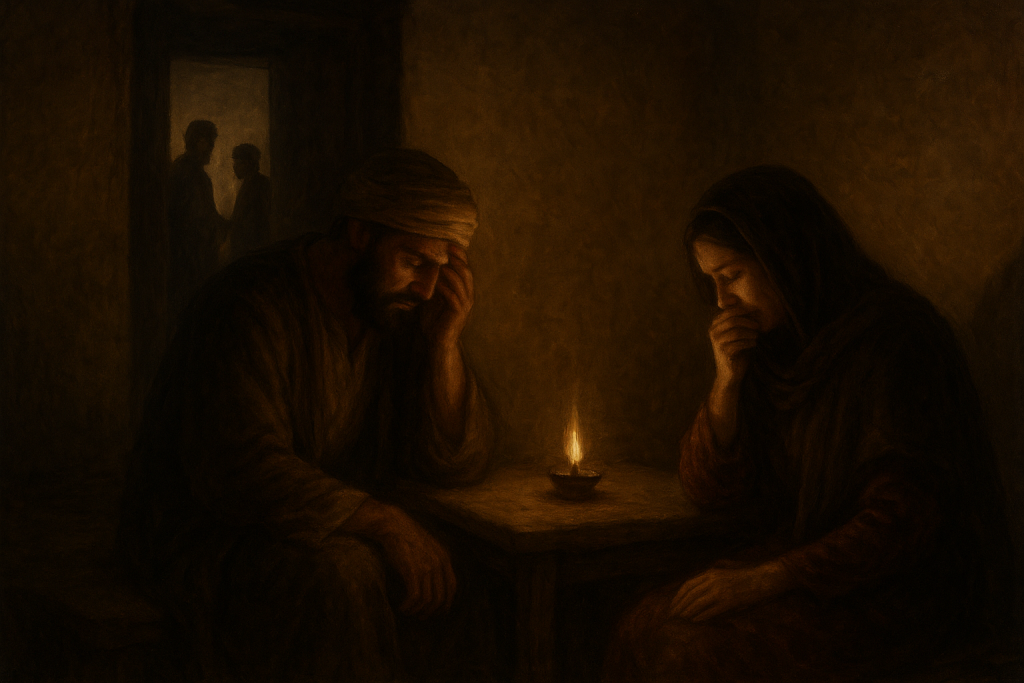
As I was reading John 13 this morning, I found myself thinking: how did Judas’ father, Simon, feel about all this? John mentions him several times, which makes me think Simon knew Jesus too, and which also begged for this kind of study. Enjoy.
✝️
Before you can understand Simon, you first have to understand the world that formed him. First century Judea was a pressure cooker of longing, meaning the people were living under constant internal tension, expectation, and desire for deliverance that never fully settled.
Rome’s boots were on every road, and the sense of occupation was not theoretical, it was daily, visible, lived, felt in taxes, soldiers, checkpoints, and the quiet reminder that another nation ruled over them.
Pharisees tightened their doctrinal fences around the Law (Torah, תּוֹרָה, instruction), meaning they built layers of interpretation and protective rules around God’s commandments, forming what is often described as hedges around the Law to preserve covenant identity and prevent breaking it (look at Deuteronomy 4:2, which warns not to add or subtract from God’s word).
Sadducees held the Temple reins like political currency, meaning they controlled the priestly system tied to sacrifice, worship, and access to the sacred space. With it they also held influence, status, and cooperation with Roman authority in order to maintain their position.
Essenes hid in the desert with scrolls and fire in their eyes, meaning they withdrew from the main religious system entirely, living in separation, copying Scripture, and pursuing purity and devotion away from what they saw as corruption in the Temple world.
Zealots whispered rebellion under their breath, meaning there was an undercurrent of revolutionary thought among some who believed that God’s kingdom would come through force, resistance, and uprising against Rome rather than waiting in submission or spiritual endurance.
So, into this world was born a child named Yehudah (יְהוּדָה, meaning “praise, thanksgiving”), born to a man named Shimon (שִׁמְעוֹן, from שָׁמַע shama, “to hear, to listen, to obey”). In Hebrew thought, hearing is never passive; it is response. This is why Shema Yisrael (שְׁמַע יִשְׂרָאֵל, Deuteronomy 6:4) is not merely auditory, it is covenant allegiance: “Hear and obey, O Israel, the LORD is one.” Names in Hebrew culture were not decorations. They were prophetic banners placed over identity and destiny.
When Shimon named his son Yehudah, he spoke over him praise, thanksgiving, and royal lineage, the tribe from which kingship would emerge (Genesis 49:10). Yehudah is the root behind Yehudi (יְהוּדִי, Jew), a covenant identity rooted in belonging to God’s promise rather than mere ethnicity. The fall of Judas was not just personal ruin; it carried the weight of symbolic fracture within Israel’s story.
Judas grew up in a multilingual world: Hebrew for prayer and Scripture, Aramaic for the marketplace, and Greek for trade and governance. He argued prices in Aramaic, understood Scripture in Hebrew, and heard Roman proclamations in Greek. When John calls him “huios Simōnos Iskariōtēs” (υἱὸς Σίμωνος Ἰσκαριώτης), he identifies Judas through his father’s house, not political identity. Ish Kerioth (אִישׁ קְרִיּוֹת) marks him as Judean from Kerioth, not Galilean. That distinction mattered deeply in lived culture. Judea sat closer to Temple authority and religious power structures, while Galilee carried a reputation of distance, rawness, and being questioned by the establishment (compare with John 7:52).
The gematria of Yehudah is astonishing: י (10) + ה (5) + ו (6) + ד (4) + ה (5) = 30, the very number of silver pieces (Matthew 26:15; Zechariah 11:12–13). His name echoes, almost like a shadow within language itself, the valuation of betrayal. Shimon’s gematria is 466, often reflected in interpretive tradition alongside shemesh (שֶׁמֶשׁ, sun), imagery tied to illumination, discernment, and revelation (Malachi 4:2, “sun of righteousness shall rise”). A father whose very name carries association with hearing and light watching his son move into betrayal creates a tension that feels almost unbearable to articulate.
In Jewish households, fathers bore spiritual responsibility for sons. Shimon would have recited the Shema with Judas daily, bound God’s words upon his life (Deuteronomy 6:6–7), brought him into synagogue life, and shaped his understanding of Torah through lived instruction. Judas would have known the Suffering Servant (Isaiah 53), the pierced one (Zechariah 12:10), and the prophetic patterns of redemption long before encountering Yeshua. A father did not merely raise a child; he carried the role of covenant transmission. Shimon likely saw promise in Judas, intelligence, precision, strength in understanding structure, traits that would later become tragically misdirected.
When Judas followed Yeshua, it may have seemed like fulfillment, alignment with something long anticipated. But betrayal shattered that expectation into something no father is prepared to interpret.
What did Shimon believe about Yeshua? If he believed He might be Messiah, Judas’s betrayal would have shattered everything holy (Isaiah 9:6–7; Psalm 2). If he believed Yeshua was dangerous or unorthodox, Judas’s betrayal may have initially seemed justified through a human lens—until the weight of innocence revealed itself in fulfillment of prophecy.
Family shame in that world ran deep. A son’s sin reflected on the father (Proverbs 17:25), which is why John repeatedly anchors Judas to Shimon. Identity was covenantal and generational (Exodus 20:5–6). The community would whisper, withdraw, observe from distance. Judas’ mother, unnamed in the narrative but never unseen before God, would carry grief in silence that language could not hold.
And the foot washing. Yeshua (יֵשׁוּעַ, “salvation”), only hours before betrayal, washed Judas’s feet (John 13:5–12). The rabbi taking the position of lowest servant, performing what was culturally reserved for the least. The word niptō (νίπτω) carries the sense of washing, cleansing, even ritual preparation. Mercy was not withheld even in the presence of betrayal. If Shimon had known this moment in full weight, it would hold unbearable tension: love fully extended, yet rejected within the same breath of history.
Greek adds depth: “the devil had already put into the heart of Judas” uses ballō (βάλλω), meaning to throw, cast, insert, place inward. Not mere suggestion but directional implantation (John 13:2). It introduces the mystery of influence and responsibility, where inner alignment becomes decisive.
Kerioth mattered. Judeans often viewed Galileans as provincial, less refined in proximity to Temple authority. Judas was formed within a space closer to religious and political complexity. Familiarity with systems of power can create both access and vulnerability.
The thirty pieces of silver echo Torah law: the value of a wounded servant (Exodus 21:32). The insult is not only economic but covenantal, reducing worth within the framework of law itself.
When news reached Kerioth, Simon and his household would have lived through the slow unfolding of communal report—the layered whisper of shock, interpretation, judgment. The Hebrew word bagad (בָּגַד) carries covenant betrayal, relational rupture, and breach of trust. Simon was not only father of a sinner; he was father of the betrayer. His wife would carry grief that no sentence could stabilize, a sorrow too deep for public language.
Even when Judas returned the silver (Matthew 27:3–5), there would have been a flicker of hope, repentance, before collapse into death. The sorrow multiplies: betrayal, remorse, and loss. Yet Scripture does not turn Simon into ridicule. The naming preserves him within the record of sorrow rather than stripping him into obscurity.
Now lift the veil. Satan entered Judas (Luke 22:3). Not metaphor alone, but direct spiritual involvement. Within covenant understanding, family is never isolated from spiritual consequence (Deuteronomy 5:9–10). When Yeshua says, “not all of you are clean” (John 13:10), it reflects discernment of inner spiritual condition already present.
Prophecy threads the tapestry: Psalm 41:9 (“my close friend… lifted his heel against me”), Zechariah 11:12–13 (thirty pieces of silver), Genesis 37:28 (Joseph sold for silver). Scripture does not treat betrayal as interruption but as pattern moving toward redemption.
Judas’ family walks a shadow that mirrors Israel itself, wounding, scattering, grief, and ultimately redemption history unfolding through brokenness. Shimon’s very name, from shama (שָׁמַע, “hear”), echoes divine responsiveness. Exodus 3:7 declares, “I have surely seen… I have heard their cry.” God is never absent from the hearing of broken households.
Perhaps Simon wrestled with forgiveness, recognition, and the impossible weight of what his home became. Or perhaps, in hidden places grief creates where words fall silent, he began to sense that even betrayal had not escaped the reach of redemption, waiting for the fullness of HaMashiach (הַמָּשִׁיחַ, the Anointed One).
✝️✝️✝️✝️✝️
PRAYER
Father, You are holy above all, the One who reigns without beginning and without end. You are light without darkness, truth without failure, mercy without limit. Heaven declares Your glory, and the earth still answers to Your voice. We honor You, we bow before You, and we acknowledge that all wisdom begins and ends in You. You are the God who sees every generation, every pressure, every hidden weight carried by Your people. Nothing in history is outside Your sight, and nothing in our lives is hidden from Your understanding. You remain faithful when kingdoms rise and fall, and Your Word stands when everything else shifts.
Give us understanding as we read Your Word. Not pride of knowledge, but clarity of heart. Let Scripture become living again to us, not distant or academic, but breathed by You into our spirit. Teach us to hear as Shimon was called to hear—truly, deeply, and obediently.
Shape us through Your truth. Draw us away from confusion and into the simplicity of Your presence. And keep our eyes fixed on Yeshua, the Messiah, the expression of Your salvation, who reveals Your heart perfectly to us.
Let everything in us return to You in love, reverence, and surrender.
In Yeshua’s Holy name, Amen, Amen.
✝️✝️✝️✝️✝️
If you liked this message, please leave a positive comment. I would love to hear from you!
© AMKCH 2026
image done by my chatgpt at my direction.
If any of these people looks like you or someone you know,
✝️✝️✝️✝️✝️
.
.