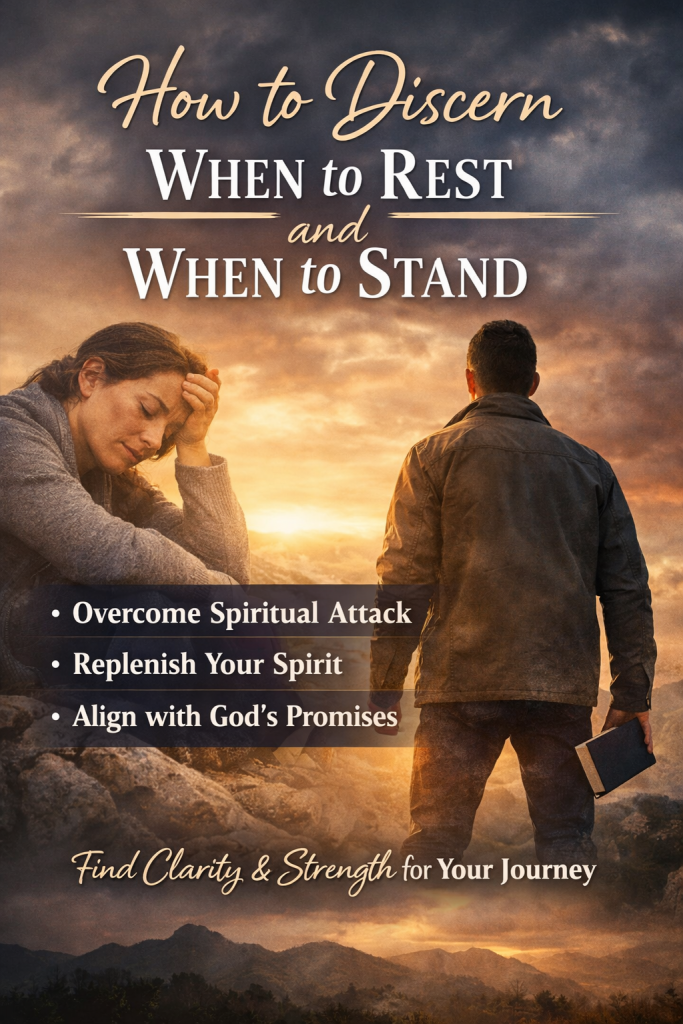
There are moments in the believer’s life when the heart feels heavy, when the spirit seems to stretch beyond its capacity. Even each step can feel like it carries the weight of unseen burdens, pressing quietly until every movement demands intention. Sometimes the weight comes from within, an exhaustion that is the natural consequence of life poured out in devotion, service, and obedience. Other times, the weight comes from the outside, a force that resists, opposes, or distracts, seeking to divert you from the path God has set just for you. These experiences, though they may feel similar, are profoundly different, and God’s Word offers language to help us discern one from the other.
In the Torah, the experience of weariness is captured in the Hebrew verb יָגַע (yaga‘). Yaga‘ means to grow weary, to become physically or spiritually exhausted from labor or effort. It is not sin. It is not failure. It is simply the natural outcome of a life given freely without pause, without restoration. Moses demonstrates this when he sits from morning to evening, continually judging disputes among the Israelis, carrying the burdens of the people, pouring his nefesh, his life force, into their needs. He does this faithfully, yet Jethro, his father-in-law, observes, “What you are doing is not good. You will surely wear yourself out.”(Exodus 18:17–18). This is not condemnation, and it is not attack. It is observation: even the most faithful can exhaust themselves when their giving exceeds their replenishment. Moses is certainly not weak; but he is human. His exhaustion is a reflection of devotion, and God’s provision of help through delegation is the answer, not judgment.
Elijah provides another example of yaga‘ in 1 Kings 19. After confronting the prophets of Baal on Mount Carmel, after fire fell from Shamayim (Heaven), and the prophets of Baal were exposed, Elijah flees into the wilderness. He sits beneath a broom tree and prays, asking God to take his life. (1 Kings 19:4) There is no demonic presence, no spiritual enemy pressing in at that moment. Elijah is simply exhausted. His ruach, his spirit, is depleted. God’s response is neither correction nor strategy. He sends an angel with bread and water, providing sustenance, and Elijah sleeps. God lets him rest and restore before continuing his mission. Spiritual fatigue, in its purest form, is not addressed by fighting or striving; it is healed through restoration, through taking a break, through receiving what has been withheld.
Even in faithful labor, weariness is natural. Paul reminds us in Galatians 6:9, “And let us not grow weary (κοπιάω, kopiáō) in well doing, for in due season we shall reap, if we faint not.”The Greek κοπιάω (kopiáō) carries the weight of physical or spiritual exhaustion, the same reality Moses and Elijah knew. It is the fatigue that comes from pouring out your nefesh, your life force, into service, devotion, and obedience. Paul’s instruction is not condemnation; he is not saying, “Do more,” or “You are weak.” He is acknowledging that giving faithfully can tire the spirit, and he exhorts believers to persist without confusing natural fatigue for failure.
Notice the balance: he says, “do not grow weary,” but he also acknowledges that weariness exists. That’s critical, God does not expect endless output without pause. Yaga‘, kopiáō, these words show us that exhaustion is part of faithful living. The key is how we respond. Do we rest and allow God to restore what has been spent, like He did for Elijah under the broom tree? Or do we misread fatigue as attack and start fighting battles that aren’t there, draining ourselves further? Isaiah 40:31 reminds us: “But those who wait on the Lord shall renew their strength; they shall mount up with wings like eagles; they shall run and not be weary; they shall walk and not faint.” Here is assurance that God’s replenishment is available to the faithful.
This verse also frames endurance in a forward-looking way: “for in due season we shall reap.” Rest, restoration, and careful discernment are part of the process. Ecclesiastes 3:1 confirms,“For everything there is a season, and a time for every matter under heaven.”It reminds the heart that fatigue is not the end; it is part of God’s timing. Recognizing kopiáō in your life allows you to abide faithfully, even when your ruach is tired, trusting that God is orchestrating the unfolding of His purposes. Psalm 121:1–2 reinforces this trust: “I lift up my eyes to the hills. From where does my help come? My help comes from the Lord, who made heaven and earth.”
Spiritual attack, in contrast, is deliberate and targeted. The New Testament describes opposition with words like ἀνθίστημι (anthistēmi), meaning to resist, to stand against, to oppose, and διάβολος (diabolos), meaning the accuser, the one who throws opposition against you. Spiritual attack is not the slow depletion of life given freely; it is active pressure, designed to hinder, confuse, or derail. James instructs, “Submit to God. Resist the devil, and he will flee from you.” (James 4:7). Resistance here is necessary. Rest alone cannot resolve it. Standing firm, aligning with God’s truth, and speaking His Word are the only proper responses. Ephesians 6:10–11 complements this:“Finally, be strong in the Lord and in the strength of His might. Put on the full armor of God, that you may stand against the schemes of the devil.”
Daniel prays with devotion, fasting and seeking God’s presence, but the answer does not come immediately. For twenty-one days, he waits, and in that waiting he feels a force holding back what he knows is promised. He is not weary from labor; his ruach is steady, clear, fully engaged. Yet something presses against him in the unseen, a resistance that is deliberate and intentional. To mistake this moment for exhaustion would have been to step back when he was meant to stand, to miss the divine timing by misreading the weight of what was happening. 1 Peter 5:8–9 warns us: “Be sober-minded; be watchful. Your adversary the devil prowls around like a roaring lion, seeking someone to devour. Resist him, steadfast in the faith.”
Daniel’s struggle is different from Moses’ or Elijah’s weariness because the weight he feels is not the natural result of giving out of his nefesh or ruach. He is not drained from devotion, nor exhausted from carrying burdens that belong to others. Instead, the pressure pressing against him is intentional, external, and unseen, what Scripture clearly calls spiritual opposition. In Daniel 10:13–14, the angel explains:“But the prince of the kingdom of Persia withstood me twenty-one days; and behold, Michael, one of the chief princes, came to help me, for I had been left there with the kings of Persia. Now I have come to give you insight and understanding.” Here we see a spiritual force deliberately resisting God’s messenger, blocking the fulfillment of God’s purposes for a time.
In Hebrew and Greek thought, there is a clear distinction: יָגַע (yaga‘) describes the natural weariness of life and labor, the depletion that comes from giving faithfully; whereas deliberate resistance by a spiritual adversary is expressed with words like ἀνθίστημι (anthistēmi), meaning to stand against or resist, and διάβολος (diabolos), meaning the accuser or opponent. Daniel’s situation shows the difference vividly: fatigue comes from life’s demands, attack comes from the unseen realm, and discerning which is which changes how we respond.
The “why” is crucial. If Daniel had misread this opposition as personal fatigue, he might have withdrawn, rested, or paused, thinking his ruach had reached its limit. But here, the correct response is not rest; it is alignment. It is persistent prayer, steadfast trust in God, and a refusal to step back from obedience, even when every natural sense of time, expectation, and spiritual heaviness tempts him otherwise. The delay itself is not random; it is part of God’s orchestration, a carefully timed moment where discernment is required. Seeing opposition for what it truly is, rather than confusing it with personal exhaustion, allows us to respond rightly. 2 Corinthians 12:9–10 reminds us: “My grace is sufficient for you, for My power is made perfect in weakness. Therefore I will boast all the more gladly of my weaknesses, so that the power of Christ may rest upon me. For when I am weak, then I am strong.”
This teaches us that spiritual attack often mimics fatigue. It can make us doubt our energy, question our devotion, or feel drained, but the source is external. The spiritual realm can press against our prayers, slow the fulfillment of promises, and challenge our faith. The difference lies in the cause and the response: fatigue calls for restoration and renewal from God; attack calls for steadfastness and alignment with His truth. Daniel’s experience demonstrates that discernment is not optional; it is essential. Recognizing the unseen opposition and responding correctly allows God’s purposes to unfold without being sidetracked by misread signals.
And this is not just ancient history. In our own lives, we face moments that feel heavy, confusing, or overwhelming. Sometimes we are genuinely tired, our hearts and spirits worn from devotion or responsibility. Sometimes we face forces outside our control, unexpected challenges, opposition, or spiritual pressure. Learning from Daniel, we can pause to ask: Is this fatigue that needs God’s restoration, or is this an attack that requires steadfast faith and truth? Often, life requires both, rest and resistance, discernment and action. The wise heart notices the source of the weight, listens to God’s guidance, and chooses the proper response. In doing so, we align with His timing, protect our nefesh and ruach, and allow His purposes to move forward unhindered.
Even Yeshua experienced both realities. In John 4:6, we read, “Jesus, being wearied from His journey, sat by the well.” The Greek word κοπιάω (kopiaō) conveys physical and spiritual exhaustion from labor or travel. Yeshua rests. Yet immediately after His baptism, He faces πειράζω (peirazō) in the wilderness, a deliberate, targeted temptation from the adversary. This is not fatigue. It is spiritual attack. One experience calls for receiving rest; the other calls for resolute alignment with truth. Both are real, both are human, and both require discernment.
The danger lies in misreading these experiences. When fatigue is mistaken for attack, we fight battles that do not exist, exhausting our nefesh even further, pouring out energy that belongs in God’s hands. When attack is mistaken for fatigue, we withdraw, stepping back at the very moment when persistence, prayer, and spiritual clarity are required. God meets each situation differently. Fatigue calls us to restoration, to nourishment, to pause, to receive what we have expended, just as He met Elijah in the wilderness. Attack calls us to resistance, to standing firm, to aligning with His truth, as Daniel experienced when unseen forces sought to delay the answer to his prayers. Sometimes, the two intersect. Exhaustion can create vulnerability to attack, as it did for Yeshua after forty days of fasting, reminding us that timing is never random. Physical and spiritual depletion can create thresholds through which opposition seeks to enter, and discernment becomes critical, not merely to protect ourselves, but to invite God’s presence more deeply, to see His hand guiding both rest and resistance in every moment.
How do we truly discern the difference? The Spirit within whispers, subtle yet clear. Fatigue speaks softly: “Receive rest. Let Me replenish what has been spent. You are not failing; you are human. You are not abandoned. Trust the pause I provide.” Attack presses, urgent and deliberate: “Stand firm. Declare My truth. Refuse to be moved. Your alignment matters in ways you cannot yet see.” Both call for God. Both require faith. One invites us to abide, to drink deeply of His presence, to let our nefesh and ruach be restored. The other invites us to stand, unwavering, anchored in His truth, letting our obedience resist the pressure that seeks to divert us.
In all of this, God’s heart remains constant. To the weary, He is tender, providing sustenance, renewal, and gentle care, as He did with Elijah beneath the broom tree. To those under attack, He is empowering, giving clarity, courage, and discernment, as He did for Daniel facing the prince of Persia. Neither state is more spiritual than the other. Both are real. Both are deeply human. Both are opportunities for the Spirit to move in us, shaping endurance, wisdom, and revelation. The wise heart does not rush to act, nor shrink back in fear. Instead, it learns to perceive these currents, to read the whispers and the pressures around them, to know when to rest and when to stand, and sometimes to do both in the same moment, each step taken with attentive obedience to God’s timing, each breath held in trust of His presence.
PRAYER
Almighty and holy God, we lift Your name above all names. You are sovereign, mighty, and faithful; Your wisdom guides the heavens, and Your love surrounds all creation. Lord, we worship You for who You are, our refuge, our strength, our ever-present help in times of need. Father, when our hearts grow heavy and our spirits weary, breathe life into our nefesh and ruach. Restore what has been spent, refresh our devotion, and teach us to discern the weight of fatigue from the force of opposition. Strengthen us to stand firm in obedience, to persist in prayer, and to trust Your timing, even when the answer seems delayed. Guard our hearts from discouragement, empower our faith, and let Your truth be our shield. May we walk in Your presence with courage, clarity, and steadfast love, rejoicing that You are with us in every moment, shaping endurance, wisdom, and revelation. In Yeshua’s Holy Name, Amen.
✝️ ✝️ ✝️ ✝️ ✝️
©AMKCH 2026
If this message blessed you, please leave a comment. I really would love to hear from you.
AI-assisted images created with DALL‑E 3 at my direction
✝️ ✝️ ✝️ ✝️ ✝️
.
.