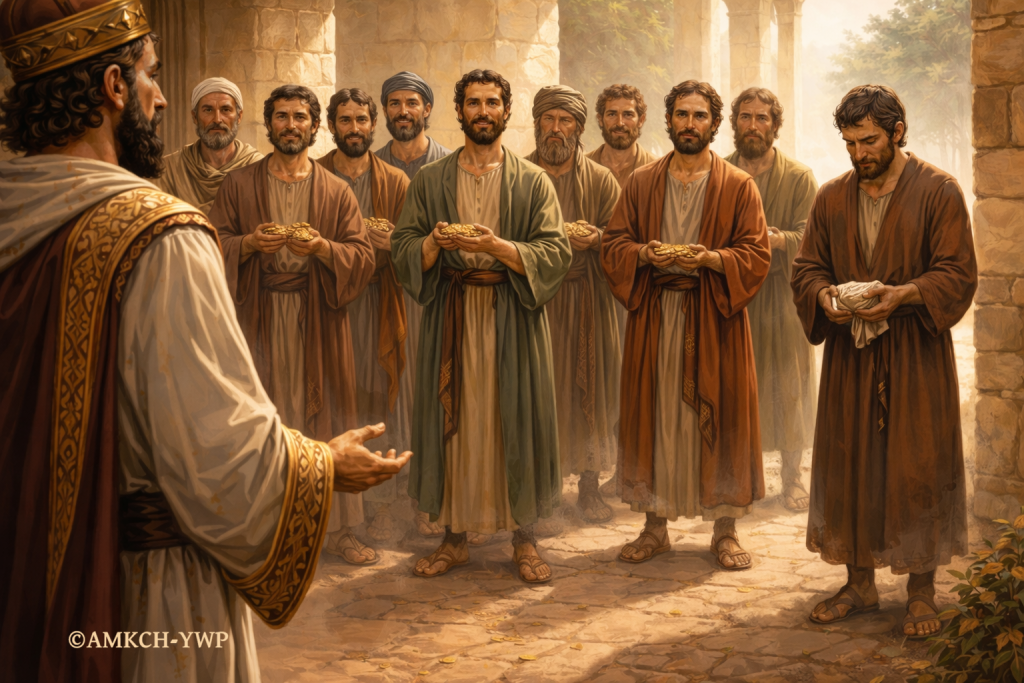
We step into the parable in Luke 19, and it is alive, pulsing with expectation, responsibility, and the weight of what it means to be entrusted. A nobleman, preparing to receive a kingdom, calls his servants and entrusts each with a mina (coin). Not a fortune, not even a great sum, but enough to test the heart, to see what each will do with what is given. Each servant receives one, with the same instruction: engage in business, act, multiply, steward faithfully until I return. The simplicity of the mina conceals the true weight of its lesson. The parable is not about the money; it is about hearts, trust, fear, and responsibility.
As we move through the story, we see the first servants stepping forward with their minas. They take what is given, they risk, they invest, they act. Even if they tremble, even if uncertainty presses on them like a weight, they return having multiplied what was entrusted. Their hands are stained with effort, their hearts may have raced with anxiety, yet they acted in alignment with the master’s intent. Their fear, if any, was tempered by yirah (reverent awe, trembling before holiness), a fear that aligns, moves, and multiplies rather than hides. They honored the giver with faithful action.
Then comes the last servant, the one often called “wicked.” He approaches hesitantly, carrying his mina wrapped carefully in a cloth. His hands shake as he holds it, trembling not from the weight of the coin but from the distortion of his fear. His words reveal the heart’s misalignment: “Lord, here is your mina, which I kept laid away in a cloth. For I was afraid of you, because you are a severe man. You take what you did not deposit, and reap what you did not sow.” The servant perceives the master as austēros (harsh, strict, exacting), and he misreads his character. The master calls the servant ponēros (morally corrupt, harmful, rotten beneath the surface). The exchange is piercing, not because God is unkind, but because fear has twisted perception, paralyzed action, and revealed what was in the heart.
Notice the servant’s hands, trembling as he folds the cloth. It is not the coin he fears losing, but his own misjudgment of the master. Fear misreads the heart of God, and when that fear drives our hands to stillness, the gift He entrusted remains unused. Stewardship is not just about multiplying gifts, it is about letting our hearts respond faithfully, even when fear whispers, “Do nothing.” This is the heart of negative fear: it hides, misrepresents, and paralyzes.
Pause here and imagine the differences between the two scenes. The other servants, hands worn, faces glowing with the satisfaction of engagement, await their reward. The last servant, fingers trembling, palms pressed together, presents his wrapped mina. There is a physical heaviness to his fear, a spiritual tension pressing in on him, a heartbeat that races with worry and misunderstanding. He imagined harshness where there is justice. He preserved, but he did not multiply. His fear distorted reality, and in that distortion, he failed.
Fear is not condemned. The Scriptures, when we read them carefully, distinguish between fear that humbles, aligns, and acts, and fear that distorts, paralyzes, and excuses. The negative fear, the kind the last servant exhibits, does not arise from reverence or alignment; it arises from misperception, misunderstanding, or self-protection. This is the same pattern we see in human history: Adam hiding in the garden after taking the forbidden fruit, saying, “I was afraid because I was naked, so I hid myself.” Cain, after taking Abel’s life, saying, “I am a fugitive and a wanderer on the earth, and whoever finds me will kill me.” Both felt fear, both acted out of distorted perception, both hid and withdrew. The fear itself was human, natural, even understandable. But it became destructive because it misrepresented God’s character and warped the heart’s response.
Contrast that with positive fear. The other servants, trembling perhaps, took their minas and engaged. Their palms sweat, their hearts race, yet they act. This is reverent fear, yirah, awe that trembles but moves. Negative fear withdraws, positive fear engages. Stewardship thrives in the presence of awe, falters under the weight of misunderstood threat. Every gift God entrusts calls for this alignment, and every hesitation rooted in distorted fear diminishes the purpose of what was given. Positive fear recognizes the weight of responsibility but moves forward because it understands the giver’s true character.
In the parable, the mina represents more than money. It represents every gift God entrusts to us: our time, our insight, our influence, our spiritual gifts, our opportunities to serve, our understanding of His Word. Each is given, not to lie dormant, not to be wrapped and hidden, but to be multiplied. When fear misreads God, it causes the gifts to lie dormant. When awe, reverence, and trust govern fear, even trembling hands act, multiplies the gift, and honor the giver.
We can
pause and reflect on human hearts across Scripture. Fear can arise in every situation: fear of punishment, fear of failure, fear of rejection. The negative fear in the last servant mirrors the fear of those who misread God’s character elsewhere. Adam hid. Cain feared. Peter denied. Each acted out of fear that is represented God or misunderstood their circumstance. But Jonah fled for a different reason. Jonah did not run because he feared God’s harshness; he ran because he knew God’s mercy. He understood that the Lord is
gracious, compassionate, slow to anger, and abundant in loving kindness. His struggle was not terror of God’s severity but resistance to God’s compassion toward Nineveh. Jonah’s flight reveals not distorted fear, but a heart wrestling with divine mercy. Scripture consistently shows God’s response: He confronts the heart, corrects, and redirects. Fear is acknowledged, discerned, and transformed when aligned with truth.
This parable shows that fear reveals the state of the heart. The last servant’s fear revealed mistrust, misunderstanding, and self-preservation. The first servant’s trembling fear revealed trust, engagement, and courage. God, in His wisdom, sees the motives behind our fear. This discernment is not harshness; it is justice, alignment, and instruction. Fear is not inherently wicked; it is what the heart does in fear that matters.
The master’s judgment in Luke 19 is firm, yet it carries lessons rather than condemnation alone. The wicked servant’s fear prevented multiplication. His inaction misrepresented the master’s generosity. The first servants’ risk revealed trust and yielded reward. This is a Kingdom principle: gifts are given for engagement, fear that misrepresents God leads to withdrawal, reverent fear leads to faithful action. The principle is true in all areas of life: every gift, every opportunity, and every responsibility entrusted to us is meant to be invested, not hidden.
Even beyond the parable, the Scriptures echo this same tension: the faithful multiply, the fearful hide, the obedient risk, the paralyzed with fear withdraw. God’s discernment sees our hearts, guides our steps, and encourages alignment with His purposes. God does not give a spirit of fear that paralyzes; He gives power, love, and self-discipline (2 Tim 1:7). Faithful stewardship flows from this Spirit-guided alignment.
The faithful servants are rewarded not because fear vanished, but because they acted in spite of it. The reward follows courage aligned with truth. Fear that honors God transforms into faithful stewardship, blessing, and multiplication. Fear that misrepresents God leads only to missed opportunity. This is the Kingdom’s principle, written into every gift, every opportunity, every moment of choice.
Imagine the return of the nobleman, the scene vivid in the mind: the servants, some with glowing faces, coins multiplied in hand, hearts racing with anticipation and relief. The last servant approaches, hesitant, the cloth rustling in his grasp. The master looks at him, sees the heart behind the fear, calls out the distortion: ponēros. The contrast is striking. Courage, even trembling, is rewarded. Withdrawal and misperception are corrected. The lesson is alive and unforgettable.
We can pause again and reflect: where in our lives do we act out of negative fear? Where do we shrink, hide, or excuse our inaction? Where has fear distorted our perception of God’s character, our gifts, or our responsibilities? And conversely, where have we acted even trembling, trusting, engaging, multiplying what was entrusted to us? The parable calls us to examine our posture toward God and opportunity.
Even in daily life, every moment of stewardship calls for discernment. Gifts arrive quietly: the chance to encourage, to create, to serve. Negative fear whispers, “Do nothing.” Positive, reverent fear (yirah) whispers, “Move forward faithfully, even trembling.” The difference shapes outcomes, hearts, and the multiplication of what God entrusts.
Prayer: ✝️ ✝️ ✝️ ✝️ ✝️
Father, You are righteous, generous, and just. Correct any distortion in our perception of Your character. Teach us true yirah that leads to faithful action, not fear that paralyzes. Help us to multiply all You have entrusted, to act in alignment with Your purposes, and to live with courage and trust while we await Your return. Strengthen us to honor You in every gift, opportunity, and responsibility You place in our hands. Cause our fear to reflect Your holiness and move us into faithful action rather than withdrawal. Help us to recognize Your character, trust Your ways, and multiply what You entrust to us. In Yeshua’s Holy Name, Amen Amen.
✝️ ✝️ ✝️ ✝️ ✝️
If this message blessed you, please leave a comment. I would love to hear from you.
✝️ ✝️ ✝️ ✝️ ✝️
Copyright Notice:
Teaching and accompanying illustration ©AMKCH-YWP, 2026. All rights reserved.
AI-assisted drafting by ChatGPT (GPT-5 Mini) for conceptual and editorial support only.
✝️ ✝️ ✝️ ✝️ ✝️
.