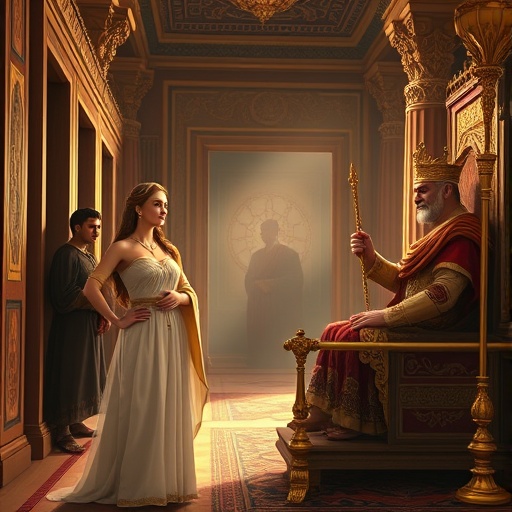
The story of Esther doesn’t open with heroes or miracles, it starts in the shadows of exile, in a place where it looks like God is absent. Persia’s empire stretches wide, from India to Ethiopia, and right at the center of it all is a king named Ahasuerus (Xerxes), throwing a wild six-month party just to show off how powerful and wealthy he is. Then comes Queen Vashti. She refuses to parade herself before a drunken crowd just because the king snaps his fingers. That one act of defiance? It costs her the crown.
Suddenly, there’s a search for a new queen, and that’s where Esther steps in. She’s a young Jewish girl being raised by her cousin Mordecai, and from the outside, she doesn’t seem like someone with influence. But when the palace calls for virgins to be brought in, she’s taken, whether she wanted it or not. Mordecai tells her to keep her Jewish identity a secret, and in the midst of perfumes, beauty treatments, and rehearsed smiles, Esther ends up finding favor with everyone, including the king. But make no mistake, this is not a Cinderella story. This is the unseen hand of God, quietly setting pieces in place.
Now, God’s name is not mentioned a single time in the book of Esther. Not once. But He is everywhere. The timing, the positioning, the favor, the rising tension, it all moves like a divine chessboard. Then the enemy shows his face: Haman. Arrogant, insecure, and power-hungry. He’s promoted by the king, and when Mordecai won’t bow to him, Haman takes it personally. He doesn’t just want Mordecai dead. He wants every Jew in the empire wiped out. He gets the king to seal a decree of annihilation with his ring, casting lots (Purim) to pick the execution date. Death by bureaucracy.
But Mordecai doesn’t panic, he sends word to Esther. “You’ve got to speak up,” he tells her. “Maybe this is why you’re queen. Maybe this is your moment.” Esther knows the risk. You don’t just walk into the king’s court uninvited. That could mean execution. But she doesn’t back down. She fasts for three days. She tells Mordecai to get the people to do the same. There’s no temple, no priest, no prophet. Just faith. Just fasting. Just raw dependence on God.
Then she walks in. And the king raises his golden scepter.
She doesn’t immediately expose Haman. She plays it slow. Two banquets. Two invitations. Haman, bloated with pride, thinks he’s being honored. Meanwhile, the king can’t sleep one night, so he has the royal records read to him, because who doesn’t use bureaucracy as a bedtime story? And what does he hear? That Mordecai had saved his life once. Just in time.
Haman comes to the palace that morning ready to ask for Mordecai’s head. Instead, he’s told to honor Mordecai publicly, dress him in royal clothes, parade him through the streets. The humiliation is deliciously divine.
At the second banquet, Esther drops the hammer. “I’m a Jew. And someone’s trying to kill my people.” The king is horrified. Haman is exposed. And before the day ends, Haman is impaled on the very gallows he built for Mordecai.
But the threat isn’t gone. The king can’t undo his decree, it’s law. So he empowers Esther and Mordecai to write a new one: the Jews can defend themselves. When the day comes, they fight, and they win. The deliverance is complete.
And that’s where Purim is born, a feast not of survival, but of reversal. The day meant for death becomes a day of victory.
Esther’s story isn’t about a woman with a plan. It’s about a God with a purpose. A God who can work in silence. A God who can move through beauty pageants, palace politics, and midnight insomnia. A God who doesn’t need to announce Himself to be present. He hides in plain sight.
It also shows that fasting and prayer aren’t rituals for holy people, they’re weapons for desperate ones. When God seems silent, when the odds are stacked, when the enemy looks like he’s already won, fasting becomes a declaration: “We have no power of our own, but our eyes are on You.” It’s not about twisting God’s arm. It’s about tuning our hearts. Esther was changed in that fast. She found the courage she didn’t have before. She stepped into her calling not with certainty, but with surrender.
Esther didn’t have a burning bush. She didn’t hear a voice from Heaven. All she had was a moment. A dangerous, terrifying, history-turning moment. And she took it.
Today, God still works like that. He still hides in places where no one’s looking. He still uses exiles, orphans, and outsiders. He still puts people in strategic positions for reasons they don’t understand until the crisis hits. He still calls His people to fast, pray, and act.
You don’t have to be a queen to be used by God. You just have to say yes when it counts. You might not see His name written in the sky, but trust me, His fingerprints are all over your story.