God’s Presence Even In Dark Places
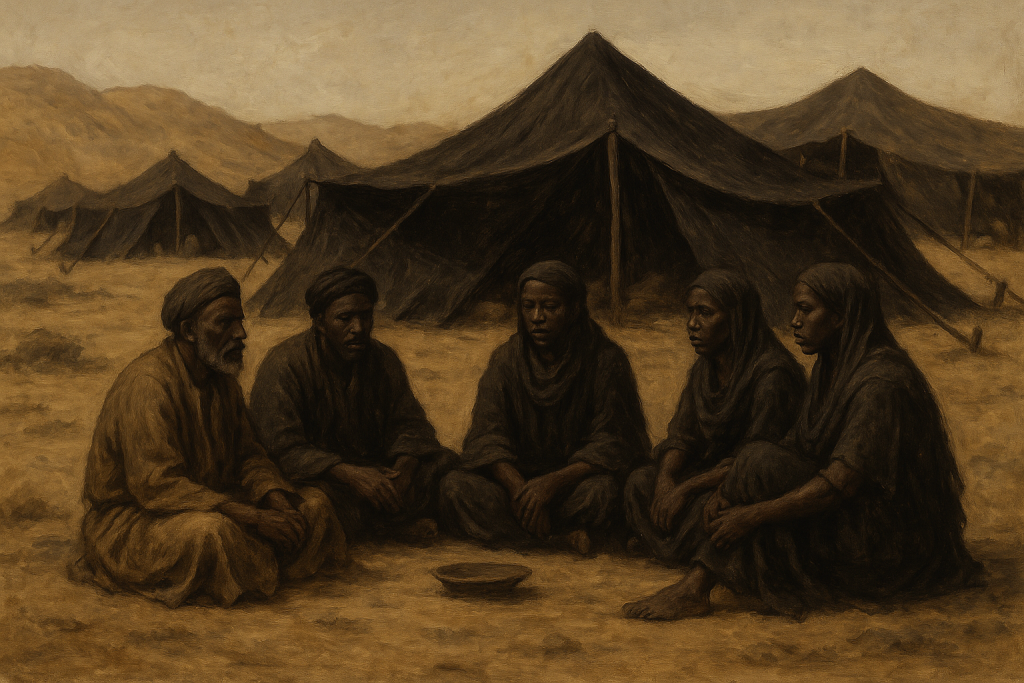
Song of Songs 1:5: “I am dark, but lovely, O daughters of Jerusalem, like the tents of Kedar, like the curtains of Solomon.”
The queen of Sheba says it, not with shame, but with confidence: “I am dark, but I am lovely.” And immediately, she brings up the tents of Kedar. Not marble palaces. Not cedar-paneled sanctuaries. Tents. Black, dust-covered, wind-worn tents, iconic, ancient, and so deeply misunderstood unless you know where to look. The black goat-hair panels of these tents absorb the harsh desert sun by day and retain warmth by night, a poetic reflection of enduring grace and protection under God’s care. The Hebrew word for tent here is ohel (אֹהֶל), a simple, mobile dwelling, tied to nomadic life and survival in harsh environments.
To understand the tents of Kedar, you have to go back. Not just to the days of Solomon, but to the origin of Kedar himself. Kedar wasn’t an idea. He was a man, a real historical figure. He was one of Abram’s grandchildren, the second son of Ishmael, and Ishmael was the son of Hagar, an Egyptian slave woman who met God in the wilderness.
That’s where this whole trail begins. A wilderness. A woman cast out. A spring of water. And a voice.
Genesis 16:1–16: Hagar is pregnant and alone, running from Sarai’s harshness, carrying a child, not of her own will but of someone else’s plan. And it’s there, in the no-man’s-land between despair and death, that the Angel of the LORD appears and gives her a name to speak over her son, Y’ishmael, which means (יִשְׁמָעֵאל), “God hears.” Because God had heard her affliction. Her loneliness. Her sighing.
And then, the promise: Genesis 16:11–12: “Behold, you shall bear a son… and he shall be a wild donkey of a man, his hand against everyone and everyone’s hand against him, and he shall dwell over against all his brothers.”
That wasn’t a curse, it was a description of strength. Ishmael would not be tamed. He would be fierce, independent, free-roaming. He would not bow to other men. He would be, quite literally, a desert nomad.
Later, in Genesis 17:20: “As for Ishmael, I have heard you: I have blessed him and will make him fruitful and multiply him greatly. He shall father twelve princes, and I will make him into a great nation.”
Twelve princes. Not just sons. Not wanderers. Nasi’im (נָשִׂיאִים), rulers, leaders, men with dominion. That number twelve should sound familiar, It mirrors the twelve sons of Jacob. Isaac received the covenant, but Ishmael was still blessed. This was no accidental genealogy. This was a divine echo in a parallel line.
Kedar was one of these twelve princes, a son of Ishmael, and his name, Qēḏār (קֵדָר), means dark or blackened. This likely referenced both the color of their tents and the sun-darkened skin of a desert people. The Kedarites were nomads, goat-herders, and warriors. They dwelled in the harshness of the Arabian wilderness, far from the stone walls of Jerusalem or the carved cedars of the temple courts. Their homes were made from the coarse black hair of goats, woven into thick panels of cloth that absorbed heat by day and retained it by night.
To live in a tent of Kedar meant living outside, outside city gates, outside temple rituals, outside covenant lineage. It meant surviving in wind and dust, sand and storm. Their lives were marked by mobility, resilience, and a distance from everything “holy” in the eyes of Israel. They were often seen as unclean, uncultured, and uninformed about the ways of YHWH (יְהוָה).
Psalm 120:5: “Woe to me, that I sojourn in Meshech, that I dwell among the tents of Kedar!”
The writer uses Meshech (Məšeq, מֶשֶׁךְ) and Kedar (Qēḏār קֵדָר) to represent foreign, godless lands, places of war, not peace. It’s as if he’s saying, “I am exiled. I am surrounded by those who do not know God, nor seek Him.”
But the story doesn’t end in distance. God doesn’t leave Kedar in the shadows. And He certainly doesn’t forget His promise to Hagar.
Because centuries later, the prophet Isaiah catches a glimpse of what’s coming:
Isaiah 42:11: “Let the wilderness and its towns raise their voices; let the settlements where Kedar lives rejoice. Let the people of Sela sing for joy; let them shout from the mountaintops.”
That’s not just poetic, it’s prophetic. Isaiah 42 speaks of the coming Servant, the One who would bring justice to the nations. And Kedar’s people are named. Their settlements. Their voices. They are invited into the chorus. The wilderness will sing.
Even more striking is Isaiah 60:7: “All the flocks of Kedar shall be gathered to you, the rams of Nebaioth shall minister to you; they shall come up with acceptance on My altar, and I will glorify My glorious house.”
What a reversal. The flocks of Kedar, the offspring of a son born outside the covenant, are now accepted on God’s altar. They are not just permitted; they are welcome. Not just tolerated; they are a glory to His house.
This is no accident. It’s the continuation of a promise made under the desert sun, beside a spring, to a slave girl who was told her son would matter. That he would be heard. That he would grow. That he would lead.
And lead he did.
The Kedarites became one of the most powerful Arabian tribes. Their black tents stretched across vast territories. Their archers were feared in battle. Their livestock sustained their people and their trade. But even with all that, the world called them “outsiders.” Dark, rugged, unrefined. And yet, God remembered them.
So now, come back to the Song of Songs. The woman speaks, possibly a Shulammite, possibly a shepherdess, maybe even symbolic of Israel herself, and says: “I am dark, but lovely, like the tents of Kedar.”
She is not ashamed of her appearance. Her skin has been kissed by the sun, not pampered by palace shade. She compares herself not to ivory towers or golden gates, but to the tents of a nomadic people once considered spiritually distant, yet are chosen by God to be part of His prophetic vision.
Her words carry layers. “Dark” doesn’t mean sinful. It means weathered. It means honest. It means I’ve been through things, and I’m still here. It means, “Don’t mistake my rough edges for a lack of worth.”
And it’s as though God whispers back: “I know those tents. I made a promise to them. I walked with their ancestors. I watched them through every windstorm. I still do.”
When the Messiah came, He came to tabernacle among us. John 1:14: “And the Word became flesh and dwelt among us, and we have seen His glory, glory as of the only Son from the Father, full of grace and truth.” Literally, skēnoō (σκηνόω), He pitched His tent among us. He didn’t build a palace. He took on flesh and walked in our deserts. He came to the tents, not just the temples.
So if you feel like you live in a place that’s too dark, too rough, too forgotten, remember Kedar.
God heard the cry of Hagar.
He blessed the son others rejected.
He raised up twelve princes where no one expected royalty.
And He welcomed those flocks into His sanctuary.
God never forgot the tents. And He won’t forget yours either.
So yes, you are dark. Life has burned you.
But don’t stop there.
You are lovely.
Because He still pitches His tent beside yours.
This message carries deep resonance for anyone who’s ever felt overlooked, mislabeled, or distanced because of how they look, where they come from, or how the world perceives them. The phrase “I am dark, but lovely” is not about shame, it’s about identity, value, and beauty that has endured hardship. It speaks directly to people who have had to survive under pressure, under assumptions, under systems that didn’t always see the worth God sees.
For many people of African and Arabian descent, especially in cultures where “darkness” has been wrongly equated with negativity, this teaching could feel like a holy vindication. It reveals how “darkness” in the Bible, is not a curse, it’s often a place where God moves powerfully. The tents of Kedar, dark and dusty, were named and remembered in prophecy. That’s not rejection. That’s inclusion at the highest level.
When the world says, “too rough,” God says, “You’re My beloved.” When history erases, God records. When people marginalize, God makes princes.
So yes, it’s a message that could reach the heart of many Black readers with a mix of healing, dignity, and awe. Because in God’s Word, darkness of people is not disqualified, it’s called lovely.
✝️ ✝️ ✝️ ✝️ ✝️
©AMKCH-YWP-2026
If this message blessed you, please leave a comment. I would love to hear from you.
images were done by my chatgpt at my direction.
✝️ ✝️ ✝️ ✝️ ✝️
.
.
Hi, after reading this amazing piece of writing i
am also glad to share my familiarity here with mates.
Unquestionably believe that which you stated. Your favourite justification appeared to be at the web
the simplest thing to remember of. I say to you, I definitely get
irked even as folks consider issues that they plainly do not know about.
You managed to hit the nail upon the highest and also outlined out the entire thing without having side-effects , folks could take a signal.
Will probably be back to get more. Thanks
Thank you, I really appreciate that. I’m glad it came across clearly to you. Sometimes the simplest truths are the ones people miss the most.
If I can say it plainly, being in a “desert” doesn’t mean you’re off track. Sometimes it’s exactly where the most precise work is happening. Not loud. Not visible. But real.
You’re always welcome here anytime.