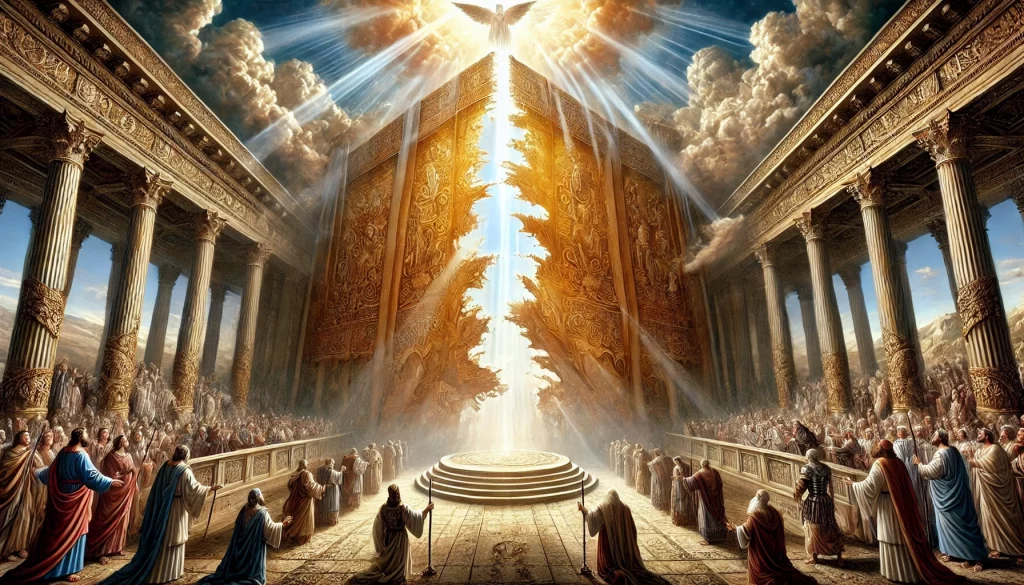
When Yeshua hung upon the cross, the visible world reacted. The earth trembled. Stones fractured. Tombs opened. But something even greater than the shaking ground was happening inside the Temple in Jerusalem. Matthew records it with holy simplicity: Matthew 27:51, “And behold, the veil of the temple was torn in two from top to bottom; and the earth shook, and the rocks were split.”
That was not an incidental detail. That was Heaven declaring a verdict.
To understand the weight of that moment, we must step back into the Temple itself. In Hebrew, the veil was calledparokhet, meaning a separating curtain. It was not decorative. It was not symbolic in a sentimental way. It was structural, judicial, and theological. It divided the Holy Place from theKodeshHaKodashim, the Holy of Holies, the innermost chamber where the Ark of the Covenant had rested and where the glory of God had once filled the space above the kapporet, the mercy seat.
The veil stood as a witness.
It testified that sin creates distance. From the moment Adam stepped outside obedience, humanity could not casually walk into divine Presence. Holiness is not cruelty. Holiness is purity. And impurity cannot enter pure fire without consequence.
Only one man could pass beyond that veil. The High Priest, the Kohen HaGadol, meaning the Great Priest. And he could enter only once each year, on Yom Kippur, the Day of Atonement.
Yom Kippur falls on the tenth day of Tishri, usually in September or October on the Gregorian calendar. The Torah calls it Shabbat Shabbaton in Leviticus 23:32, “It shall be to you a Sabbath of solemn rest.” A Sabbath multiplied. The stillest day of the year. The culmination of the Aseret Yemei Teshuvah, the Ten Days of Repentance that begin at Rosh Hashanah. These are the Days of Awe, when hearts are examined and relationships restored.
On that day, Israel practiced teshuvah, meaning return. Not mere apology. Return. A turning back into covenant alignment. A laying down of pride. A seeking of mercy.
But even on that holiest day, access was limited.
The Kohen HaGadol entered with blood. After washing. After sacrifice. After incense filled the chamber so he would not gaze directly upon the glory. The Hebrew word for atonement is kaphar, meaning to cover. The sacrifices covered sin. Year after year. The ritual repeated because the conscience was never permanently cleansed.
The veil remained.
It remained as a constant declaration: reconciliation is costly. Atonement requires blood. Holiness is not approached casually.
Then came that hour.
Outside the city walls, Yeshua, the Lamb of God, bore the weight of sin. And when He cried out in John 19:30, “It is finished,” He spoke the Greek word tetelestai, meaning paid in full, accomplished, completed. At that very moment, the earth shook. Rocks split. Tombs opened and yes, the dead were raised.. And the parokhet, the veil, was torn.
Not from bottom upward, as if angry men had seized it.
From top to bottom.
God tore it.
That veil was enormous, nearly sixty feet high, thickly woven, far beyond human strength to rip apart in an instant. Its tearing from top to bottom signified unmistakably that this was a divine act. Heaven acted.
Why?
Because the true Yom Kippur was unfolding.
The writer of Hebrews tells us what the Temple had always foreshadowed. Hebrews 9:12, “He entered once for all into the holy places, not by the blood of goats and calves, but by His own blood, thus securing eternal redemption.” The phrase “once for all” translates the Greek word ephapax, meaning once, never to be repeated.
The yearly covering became a final cleansing. The shadow met the substance.
Under the Old Covenant, access was restricted. The sacrificial system was necessary because sin required payment, yet those sacrifices could never fully remove guilt. They pointed forward. They prepared the way. They testified that a greater sacrifice was coming.
And now that greater sacrifice stood accomplished.
The tearing of the veil declared that the barrier between God and humanity, which had existed since the fall, had been judicially addressed. God did not lower His holiness. He satisfied it. Sin was not ignored. It was judged in Messiah’s flesh. Hebrews explains in Hebrews 10:20 that the veil corresponds to His body, “through the curtain, that is, His flesh.” As His flesh was torn, the curtain was torn.
The Old Covenant was not abolished in failure. It was fulfilled in completion. It had always pointed to Messiah. 1 Timothy 2:5, “For there is one God, and one mediator between God and men, the man Messiah Yeshua.” The earthly High Priest foreshadowed the eternal High Priest. The earthly sanctuary foreshadowed the heavenly reality.
This was a covenantal shift.
Before, only the Kohen HaGadol could draw near, and only once each year. Now, Jew and Gentile alike are invited. The dividing wall falls. Ethnicity no longer determines access. Ritual lineage no longer governs nearness. Faith in Messiah grants entrance.
Hebrews 4:16 declares, “Let us then with confidence draw near to the throne of grace, that we may receive mercy and find grace to help in time of need.”
Confidence, not because we are pure in ourselves. Confidence, because the sacrifice is sufficient.
The presence of God, once localized in one chamber behind embroidered cherubim, is no longer confined. Through Messiah, the ruach, meaning breath, wind, Spirit, indwells believers. The promise of Jeremiah 31:33, “I will put My law within them, and I will write it on their hearts,” becomes reality.
The veil’s tearing was not merely about Temple architecture. It was about restored communion.
Even creation testified. Colossians 1:20, “Through Him to reconcile to Himself all things… making peace by the blood of His cross.” The earthquake was not theatrics. It was cosmic acknowledgment that redemption was accomplished.
The Day of Atonement found its fulfillment outside the city walls. The annual ritual gave way to eternal redemption. The covering became cleansing. The distance became nearness.
We no longer stand outside a curtain wondering if atonement will hold for another year.
We draw near.
Not casually. Not irreverently. But covenantally, through blood that speaks a better word.
The veil was rent.
The old world of distance ended.
The sacrificial repetition ceased.
The New Covenant was inaugurated.
And the Presence that once dwelt in a chamber now dwells in surrendered hearts.
Father, we stand in awe of what You tore open for us. Thank You that through Your Son, Yeshua HaMashiach, that barrier is gone, that sacrifice is complete, and the way is living and eternal. Teach us to walk in reverent nearness, in gratitude and obedience, drawing near with full assurance of faith. In Yeshua’s Holy Name, Amen, Amen.