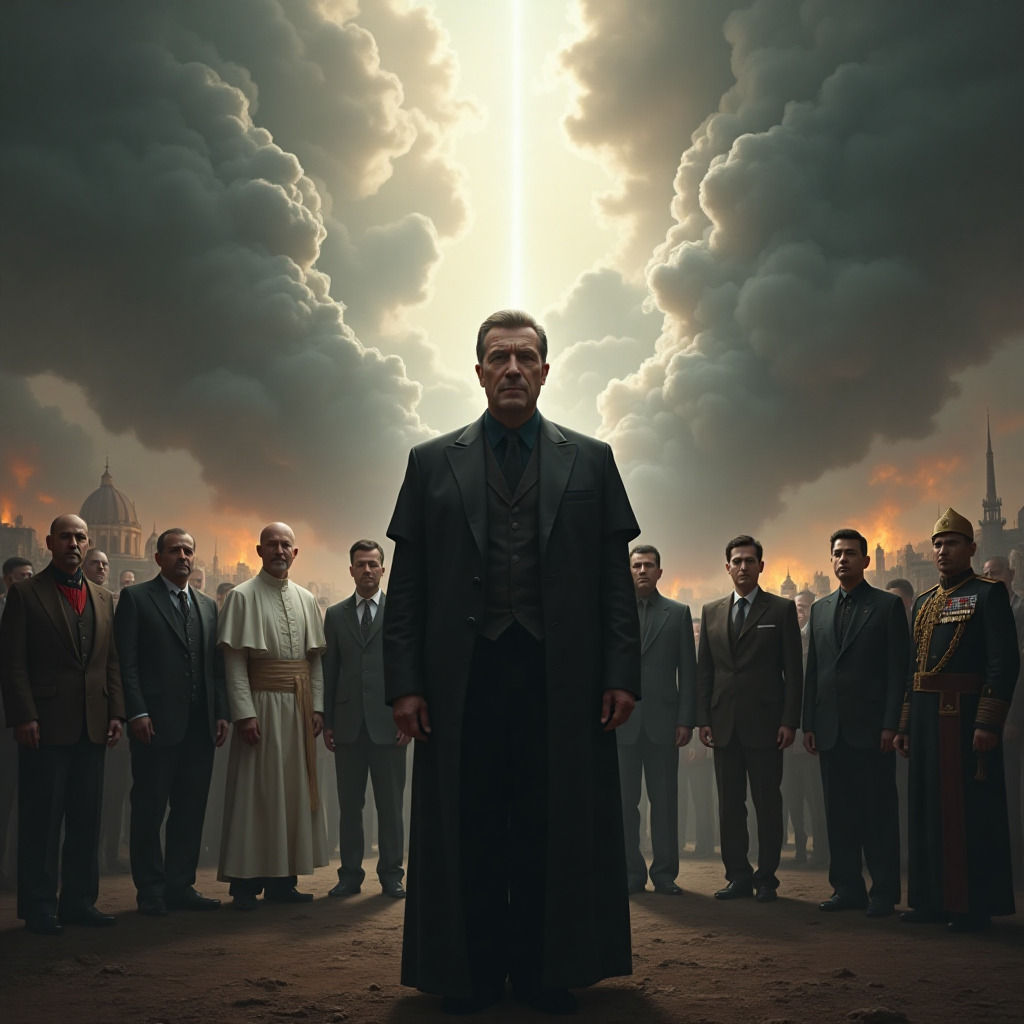
Unmasking the Beast: The Rise of the False Church, the Little Horn, and the Lawless One: A Biblical Warning from Daniel, Paul, and Revelation
It would be tempting to look at Daniel as just a book of lions and dreams, but Daniel is not just a bedtime story—it’s the foundation stone of nearly all New Testament prophecy. It tells the truth about what kingdoms will rise, how they’ll fall, and how a final blasphemous figure will stand in God’s holy place pretending to speak for Him. We’re not told his name, but we are told how he behaves, what he changes, what he exalts, and most importantly, how he oppresses God’s remnant. And by the time we’re done, you’ll see that this isn’t just about Babylon, Greece, or Rome… it’s about something still rising, and possibly already here.
Let’s look at Daniel 7, which is a vision given to Daniel while he was still under Babylonian captivity. He sees four great beasts coming up from the sea, different from each other. These beasts are not literal zoo animals—they are empires, earthly kingdoms ruled by men, not God. Daniel says the beasts came “up from the sea,” and anytime you see the “sea” in prophetic language, it often points to nations, masses of people, chaos, and rebellion (compare with Revelation 17:15).
Each beast represents a kingdom, starting with Babylon, then Medo-Persia, then Greece, and finally a terrifying fourth beast unlike the others—more brutal, more destructive, and with ten horns. Daniel is particularly concerned with this fourth beast. Not just because it’s scary, but because of what grows out of it.
From this beast, a little horn rises up—small at first, but then it uproots three of the ten horns, takes their place, and grows strong. Let’s read it straight from Daniel 7:8:
“I considered the horns, and, behold, there came up among them another little horn, before whom there were three of the first horns plucked up by the roots: and, behold, in this horn were eyes like the eyes of a man, and a mouth speaking great things.”
Now don’t miss this: a horn in prophetic language represents power, authority, kingship. But this one has eyes like a man and speaks great things. That phrase “great things” in the Hebrew is gᵉḏôlôṯ (גְּדֹלוֹת)—which doesn’t just mean “important,” it means boastful, arrogant, swelling words. This is not someone humbly leading people to worship God. This is someone exalting himself above what is written, speaking as if he were divine.
We’ll see this same figure again, described in similar terms in 2 Thessalonians and Revelation 13, but here in Daniel we get the foundation: the little horn is a blasphemous, cunning, deceptive religious-political figure who rises up after the fourth beast (Rome), and becomes more dominant than all the others.
Jump down to Daniel 7:25. Here we get his full job description:
“And he shall speak great words against the most High, and shall wear out the saints of the most High, and think to change times and laws: and they shall be given into his hand until a time and times and the dividing of time.”
Let’s break this apart phrase by phrase, slowly:
“He shall speak great words against the most High…”
Again, gᵉḏôlôṯ—boastful, exalted, even blasphemous speech. This is a false religious leader who is not content to just rule men—he sets his words against God. It’s a direct challenge to divine authority. You’ll hear echoes of this when Paul describes the “man of sin” who “exalts himself above all that is called God or that is worshipped.”
“And shall wear out the saints of the most High…”
The Hebrew here is bela’ (בְּלָא)—to afflict, to consume, to harass continuously. This doesn’t just mean physical persecution, though that’s part of it. It’s emotional, spiritual, relentless. He will drain the faithful remnant, one command at a time. The saints will be mocked, shut down, burned out, and labeled as extremists.
“And think to change times and laws…”
This is perhaps the most shocking part. The word think here is sabar (סָבַר)—meaning to intend, plan, plot. He plots to change the sacred structure of time itself. God’s times—His mo’edim (מוֹעֲדִים)—appointed seasons, sabbaths, feast days, calendar rhythms—are all part of His divine law. And this man says, Nah. I’ve got a better system. He literally attempts to rewrite heaven’s calendar and God’s law.
And the worst part?
“They shall be given into his hand until a time and times and the dividing of time.”
That phrase refers to a prophetic period—“a time” (1 year), “times” (2 years), and “half a time” (half a year)—which adds up to 3½ years. This is the same time period echoed in Revelation for the tribulation and the reign of the beast. God allows him power, but only for a set season. The saints suffer, yes, but the kingdom is still God’s, and the end is already written.
Now let’s not rush past this, because here’s where it gets real.
There is no earthly power today that claims to change God’s times and laws more than the papal system. This isn’t about attacking individual Catholics—many love God with all their hearts—but about the institution that historically claimed the authority to override Scripture with tradition. It was the Roman Catholic Church that removed the second commandment (about idols), split the tenth to keep the number ten, and shifted the day of worship from the seventh day Sabbath to Sunday, openly saying they had the authority to do so. That’s a direct fulfillment of “changing times and laws.”
And this system rose after Rome fell, just like Daniel said. The little horn didn’t come during pagan Rome’s height—but after it splintered. The Vatican emerged as a religious-political power during the decline of the Western Roman Empire, and it gained influence by uprooting three of the barbarian kingdoms (the Heruli, Vandals, and Ostrogoths), just as Daniel saw in vision.
Daniel wasn’t just seeing four beasts—he was seeing four empires, and one counterfeit religious system that would try to take the place of the true. A system that looked holy but spoke blasphemies. A system that claimed the authority of God but persecuted the people of God. That’s not conspiracy—it’s history backed by Scripture.
And Daniel didn’t stop there. In Daniel 8, the vision shifts slightly, showing a little horn again, this time coming out of the goat (Greece), but growing toward the “pleasant land” (Israel) and exalting itself as the “prince of the host.” That’s a claim to messianic authority. It even says he casts truth to the ground and prospers in doing so (Daniel 8:12). He wins… for a while.
But his time is numbered.
***
We left Daniel with a clear image in mind: a grotesque, powerful, and blasphemous little horn rising out of the fourth beast—the Roman system—speaking arrogantly against the Most High, persecuting His people, and altering His sacred times and laws. Now, we cross the bridge into the New Testament, where Paul warns the early believers of this same figure, using a different name but identical traits. He doesn’t call him a “little horn.” He calls him “the man of sin.” And what Daniel saw in symbols, Paul exposes in plain language.
Let’s turn to 2 Thessalonians 2, a chapter so thunderous in its clarity that many churches shy away from reading it out loud. But you and I, we’re not going to shy away. We’re going to face it word by word.
Paul begins in verse 1 by talking about “the coming of our Lord Jesus Christ, and our gathering together unto him.” So he sets the context—it’s about the Second Coming, not just some vague trouble in the early church. Paul says in verses 2-3:
“That ye be not soon shaken in mind, or be troubled… as that the day of Christ is at hand. Let no man deceive you by any means: for that day shall not come, except there come a falling away first, and that man of sin be revealed, the son of perdition.”
Before Christ returns, there must be two things:
- A falling away, and
- A revealing of the man of sin.
Now the word translated falling away is apostasia (ἀποστασία), which you probably hear the English word apostasy in. It means a deliberate departure from truth, a rebellion, a divorce from the original doctrine. And not by the world—but by the church. This is a prophecy about spiritual decay within the visible body of believers. Something that once called itself part of the true assembly would twist the truth and give rise to a false authority. And out of that falling away, the man of sin would be revealed.
Let’s look at that name: “man of sin.” The Greek here is ho anthrōpos tēs hamartias (ὁ ἄνθρωπος τῆς ἁμαρτίας), literally the man characterized by lawlessness or rebellion against God’s law. The name itself signals what kind of authority he wields—he doesn’t just sin, he embodies it. He is a walking contradiction to God’s Word. But Paul also gives him another name: “the son of perdition.”
That phrase is only used one other time in the Bible—to describe Judas Iscariot in John 17:12. Judas, the insider, the one who walked with Jesus, held the money bag, appeared trustworthy, but betrayed the Lord with a kiss. So, this “man of sin” is not a crazed pagan king screaming from a balcony; no, he’s more subtle. He wears the face of religion. He walks among the disciples. He operates from within.
Now comes Paul’s bluntest warning in verse 4:
“Who opposeth and exalteth himself above all that is called God, or that is worshipped; so that he as God sitteth in the temple of God, shewing himself that he is God.”
This man does five things:
- He opposes God.
- He exalts himself above all gods.
- He takes his seat in the temple.
- He pretends to be God.
- And he demands worship.
Let’s walk slowly through the Greek, because it’s rich:
- “Opposeth” is antikeimenos (ἀντικείμενος) — standing in opposition, not passive resistance but an active enemy.
- “Exalteth himself” is huperairō (ὑπεραίρω) — to lift oneself high, beyond measure, to put oneself in a godlike status.
- “Sitteth in the temple of God” — not a literal Jewish temple here (it had already been destroyed when Paul wrote this), but rather, Paul always used naos (ναός) as the spiritual temple—the church, the Body of Christ.
- “Shewing himself” is apodeiknymi (ἀποδείκνυμι) — to present or exhibit oneself as divine.
So this leader doesn’t stand outside the church throwing stones. He enters into the house, walks up to the pulpit, and pretends to speak on God’s behalf—even declaring himself the “Vicar of Christ.” Does that sound familiar?
Let’s pause and consider: has there been a historical religious system that not only ruled as a church, but also declared its leader infallible when speaking ex cathedra, and called him the “Holy Father”? A title reserved for God alone? And has that same office claimed authority over the moral law, the power to forgive sin, the right to dictate feast days, and the authority to sit as head of the church on earth? This isn’t about demonizing people—it’s about recognizing prophetic truth. Paul wasn’t giving us idle warnings. He was painting a profile.
And then Paul drops a powerful line in verse 6:
“And now ye know what withholdeth that he might be revealed in his time.”
What restrains him? What was holding this “man of sin” back?
Paul says the believers already knew—but he doesn’t name it directly. Most early Christians believed the Roman Empire was that restraint. Pagan Rome, for all its brutality, was a secular power. It prevented the rise of a false Christian leader. But once Rome fell, that vacuum was filled by the Bishop of Rome, who rose from being a local pastor to becoming the supreme head of church and state. Paul’s warning became history.
Then comes the final blow in verse 7:
“For the mystery of iniquity doth already work: only he who now letteth will let, until he be taken out of the way.”
The mystery of iniquity—that phrase in Greek is to mustērion tēs anomias (τὸ μυστήριον τῆς ἀνομίας)—means a secret lawlessness already creeping in, unnoticed. Even in Paul’s day, the corruption had begun. Men were already twisting doctrine, loving power more than truth, craving titles and control. And Paul says it would continue until the restraining force is removed.
And when that happens?
“Then shall that Wicked be revealed, whom the Lord shall consume with the spirit of his mouth, and shall destroy with the brightness of his coming.”
That Wicked—capital W—is a person, not a concept. The Greek is ho anomos (ὁ ἄνομος)—the lawless one. Same root as “man of sin.” He is not just breaking commandments. He is a false Christ-like figure seated in power. But his reign ends when Christ returns. Jesus won’t negotiate with him, debate him, or rebuke him gently. He will consume him—analiskō (ἀναλίσκω)—to destroy utterly, like fire consuming chaff.
Now don’t miss this: Paul says this imposter is destroyed by the spirit of Christ’s mouth—which ties directly to Revelation 19:15, where the returning Christ strikes the nations with the sword of His mouth—His Word. Truth is His weapon.
Let’s close this part with verse 9-10:
“Even him, whose coming is after the working of Satan with all power and signs and lying wonders, and with all deceivableness of unrighteousness in them that perish…”
The Greek is brutal here. “Lying wonders” is pseudos sēmeia (ψευδῆ σημεῖα)—false miracles. He will mimic the Holy Spirit’s gifts, but it will be counterfeit. The man of sin won’t come with horns and fangs. He’ll come with robes, incense, soft words, and “miracles.” But they won’t lead people to repentance—they’ll lead them into delusion.
Because they “received not the love of the truth, that they might be saved.”
That’s the tragedy.
They didn’t love the truth.
And the truth isn’t a doctrine. It’s a Person. Jesus said, “I am the truth” (John 14:6). To reject truth is to reject Him.
***
In Daniel, we saw the little horn arise from the fourth beast, speaking great words against the Most High, wearing out the saints, and thinking to change times and laws. In Thessalonians, Paul took us deeper and stripped the symbols away, naming him the man of sin, the son of perdition, one who sits in the temple of God claiming to be God. He would not only deceive many but would rise to power by a mystery of lawlessness already at work in the apostolic age.
But now we reach the final scroll. The curtain is pulled back entirely in Revelation, where John is given a panoramic, heaven-sent vision of this very same figure—no longer a little horn, no longer a shadowy church leader, but now a beast rising from the sea, powered by the Dragon himself. If Daniel’s prophecies were thunder in the distance and Paul’s were lightning flashes in the dark, Revelation is the full storm crashing over the earth.
Let’s begin in Revelation 13:1, where John says:
“And I stood upon the sand of the sea, and saw a beast rise up out of the sea, having seven heads and ten horns, and upon his horns ten crowns, and upon his heads the name of blasphemy.”
Now we must pause. That image isn’t new. Daniel 7 had four beasts—the lion, the bear, the leopard, and the indescribable final beast with iron teeth and ten horns. But here, John sees them all rolled into one monster. Revelation 13:2 confirms it:
“And the beast which I saw was like unto a leopard, and his feet were as the feet of a bear, and his mouth as the mouth of a lion: and the dragon gave him his power, and his seat, and great authority.”
The Greek for “beast” here is thērion (θηρίον), meaning a wild, savage creature—untamed, dangerous, destructive. This isn’t a political leader alone. It’s a spiritual-political system that crushes, deceives, and devours, and it draws its authority from the dragon, who is plainly identified in Revelation 12:9 as Satan himself.
So, this beast is a satanic imitation of God’s kingdom. Just like Christ received authority from the Father and the Spirit descended like a dove, this beast receives authority, a throne, and power from the Dragon. It is the false messiah, the corrupted form of religion and rule. It deceives, mimics, counterfeits.
And notice the three parts:
- It has the mouth of a lion — proud speech and doctrine.
- The feet of a bear — strength to crush.
- The body of a leopard — quick to pounce and covered in spots (think camouflage, deception).
This isn’t one man in isolation. This is a system—a religious and political fusion that began as a small horn, grew into a global religious institution, and will end as a full satanic beast demanding the loyalty and worship of mankind.
Now look at verse 3:
“And I saw one of his heads as it were wounded to death; and his deadly wound was healed: and all the world wondered after the beast.”
Many Bible students believe this refers to the collapse of the Roman Empire—when the pagan head was wounded—and the later rise of the Holy Roman Empire, where a so-called “Christian” church resurrected the power structure under a religious banner. What had been Rome’s sword became the papacy’s staff. The wound was healed. And the whole world “wondered after the beast.”
And verse 4? It tells us who they really worship:
“And they worshipped the dragon which gave power unto the beast: and they worshipped the beast, saying, Who is like unto the beast? who is able to make war with him?”
So even though they think they’re honoring a spiritual leader, a respected religious institution, or a global authority, they’re actually worshipping Satan. Because behind the mask of religion, behind the robes and incense and rituals, the power is demonic. This beast speaks great things—just like the little horn in Daniel—and is given power for 42 months, or 1,260 days—the same prophetic time period in Daniel 7 and Revelation 11, where God’s people are under siege by this power.
Verse 7 brings it home:
“And it was given unto him to make war with the saints, and to overcome them: and power was given him over all kindreds, and tongues, and nations.”
Just like Daniel’s little horn, this beast makes war on the saints. Not with tanks and missiles—but with decrees, false doctrines, forced conversions, inquisitions, and laws that silence and slay those who resist. For centuries, millions were tortured and killed under the guise of “correcting heresy.” And yet, Revelation 13:8 shows that this beast gains a massive following:
“And all that dwell upon the earth shall worship him, whose names are not written in the book of life…”
This is the ultimate deception. The people who do not truly belong to Christ will worship the beast. But they won’t know they’re doing it. They’ll believe they’re serving God. That’s the sobering part. These aren’t just atheists. These are religious people deceived by the most convincing spiritual counterfeit in history.
But it doesn’t stop there. Because just like Satan mimics the Father and the beast mimics the Son, now comes the False Prophet—a counterfeit Holy Spirit.
Revelation 13:11 says:
“And I beheld another beast coming up out of the earth; and he had two horns like a lamb, and he spake as a dragon.”
This second beast looks like a lamb—gentle, innocent, religious—but speaks with the voice of a dragon. It’s a spiritual authority that pretends to represent Christ (the Lamb), but actually spreads the doctrines of Satan.
This second beast causes the world to worship the first beast, performs false miracles, and even brings fire down from heaven in the sight of men—imitating the Holy Spirit at Pentecost.
And then he enforces the infamous Mark of the Beast (Revelation 13:16-17). Now remember, the mark is not a random microchip or barcode. It is a sign of allegiance to the beast system. In Scripture, the hand represents action and the forehead represents belief and thought (see Deuteronomy 6:6-8). This mark is a counterfeit to the seal of God (Revelation 7:3), which is placed on the forehead of those who keep His commandments (Revelation 14:12).
The mark of the beast is therefore a rejection of God’s commandments and an embracing of man-made traditions—particularly those that come from the beast’s own changes to God’s law. This ties back directly to Daniel 7:25, where the little horn thinks to change times and laws. He cannot change God’s law, but he presumes to.
What law did this religious power try to alter?
The Sabbath.
God’s law says the seventh day is the Sabbath. The beast power changed it to Sunday, claiming authority to do so. That’s not a political move. That’s a spiritual claim to supremacy over God’s Word.
And what “time” did he change?
The biblical calendar—God’s moedim, His appointed times. Passover, Unleavened Bread, Firstfruits, and so on—all wiped away and replaced with man-made holidays.
This is the final battle of worship. The beast doesn’t care if you pray or fast or attend church. He wants worship on his terms, with his altered times, his modified laws, and his seat in the temple of God.
But Revelation doesn’t end with the beast. It ends with the Lamb standing on Mount Zion, with His 144,000 sealed in truth, having not bowed the knee. And Babylon—the great harlot who rides the beast—is fallen, judged, and destroyed in one hour (Revelation 18).
Who is this harlot?
Revelation 17:4-6 says:
“And the woman was arrayed in purple and scarlet colour, and decked with gold and precious stones and pearls… and upon her forehead was a name written, MYSTERY, BABYLON THE GREAT, THE MOTHER OF HARLOTS AND ABOMINATIONS OF THE EARTH… and I saw the woman drunken with the blood of the saints, and with the blood of the martyrs of Jesus.”
A religious institution, clothed in royal colors, claiming to be the Bride, yet drunk with the blood of the true saints. A mother of harlots, meaning other false systems came from her. She sits on seven hills (Revelation 17:9)—a geographic clue echoed through church history.
Her fate is sealed.
And the beast she rides? He turns on her. That’s how Satan treats his own. The system he used to deceive the nations—he burns and devours when her time is up.
So, in summary:
- Daniel showed us the little horn that rises from the fourth beast—Rome.
- Paul showed us the man of sin, seated in the temple of God, claiming to be divine.
- John showed us the beast rising from the sea, energized by Satan, worshipped by the world, and enforced by a false prophet.
They are the same entity, revealed in fuller and fuller detail.
And in every era, God calls His people to come out of Babylon, to refuse the mark, to follow the Lamb wherever He goes.
Let the Spirit speak now.
The story opens in the days of Babylon, as a young prophet named Daniel is shown terrifying visions in the night. Not dreams of fair kings and noble kingdoms, but of beasts—wild, strange, unnatural. Each one arises from the sea, clawing for power, tearing down the last. Four beasts. Four empires. And the last is the worst.
It has iron teeth and ten horns, and from those horns comes one that is small—but speaks great words. This little horn doesn’t look dangerous at first, but it has eyes like a man and a mouth that speaks arrogantly. It’s not a nation. It’s not a general. It’s something more subtle—a religious power, growing out of the last empire, Rome.
Daniel 7:25 tells us exactly what it will do:
“And he shall speak great words against the most High, and shall wear out the saints of the most High, and think to change times and laws: and they shall be given into his hand until a time and times and the dividing of time.”
In Hebrew thought, only God has the right to ordain times and laws. This power is a pretender to the throne, a religious counterfeit, and it is so persuasive, so powerful, that it actually wears down the saints—not just kills them, but wears them out spiritually, emotionally, systemically.
And that’s just the beginning.
Now fast forward hundreds of years. The Roman Empire has long crumbled, but its spiritual shadow remains. Paul the apostle, writing to the Thessalonians, speaks of a mystery already at work in his time. He doesn’t name it outright. But he warns that before Christ returns, something else must happen.
2 Thessalonians 2:3:
“Let no man deceive you by any means: for that day shall not come, except there come a falling away first, and that man of sin be revealed, the son of perdition…”
This is no ordinary sinner. Paul calls him ho anthrōpos tēs hamartias—the man of sin—and ho huios tēs apōleias—the son of destruction. Those terms had only ever been used for someone like Judas, who walked close to the truth, wore the garments of religion, and yet was utterly corrupt within.
Paul goes on:
“Who opposeth and exalteth himself above all that is called God, or that is worshipped; so that he as God **sitteth in the temple of God, shewing himself that he is God.” (2 Thess. 2:4)
He sits where only God should sit—in the temple. Not the old stone temple of Jerusalem, but the naos, the inner sanctuary, which by Paul’s day was used to describe the body of Christ, the true ekklēsia, the Church.
This figure is religious. He doesn’t burn churches. He leads them. And while he claims to stand for Christ, he exalts himself above Christ—changing laws, redefining worship, twisting grace into license. And Paul warns that the mystery of iniquity—mystērion tēs anomias—was already working in his day.
And what restrains it?
“Only he who now letteth will let, until he be taken out of the way.” (2 Thess. 2:7)
The early church fathers believed this “restrainer” was the Roman Empire. Once it fell, nothing stopped this religious system from rising to fill the vacuum, and when it did, it didn’t come as a barbarian tribe or an open enemy. It came dressed in priestly robes, quoting Scripture, ruling over kings, seated in cathedrals, and claiming the authority of God Himself.
And that’s where Revelation thunders in.
John sees it all in full: a beast rising out of the sea, having seven heads and ten horns, just like the dragon from chapter 12—because this beast is his child.
Revelation 13:2:
“And the beast which I saw was like unto a leopard, and his feet were as the feet of a bear, and his mouth as the mouth of a lion: and the dragon gave him his power, and his seat, and great authority.”
This beast is not new—it’s the same succession of kingdoms from Daniel, only now unified into one. It is the totality of false religion and political corruption, carried forward by Rome, resurrected in spiritual garb, and now drawing its power not from God but from Satan.
Its wound was healed, and the whole world wondered.
And just like Daniel’s little horn, it makes war with the saints and changes God’s times and laws. That’s not symbolic. This beast literally changed the biblical Sabbath to Sunday, replaced God’s feast days with man-made holidays, and claimed authority to forgive sins, intercede for souls, and judge the earth.
It’s not a man. It’s a system. And it has a throne.
Revelation 13:8 warns: “And all that dwell upon the earth shall worship him, whose names are not written in the book of life…”
It is a global deception. Not just about morals, but about worship, who gets it, when it happens, and how it’s done. And just when it seems it couldn’t get worse, John sees a second beast, a false prophet, with two horns like a lamb, but speaking like a dragon.
This second beast imitates Christ, performs signs and wonders, and causes the world to worship the first beast. It even calls down fire from heaven, just like Elijah, just like Pentecost, but it’s a lie, a false Pentecost, a deceptive spirit-filled revival with a dragon’s voice beneath the hallelujahs.
And then comes the mark, on the hand and forehead, just as God told His people to bind His Word in Deuteronomy. The mark is a counterfeit of God’s seal, and it identifies who you obey.
Do you obey God’s commandments? Or man’s traditions?
Because the beast system has always claimed it could change God’s law. And those who follow it—even in ignorance, are aligning themselves against the Word of God, unless they repent and come out.
But there’s a remnant.
In Revelation 14, the Lamb stands with 144,000, not marked by the beast but sealed by the Father. And how are they described?
“Here is the patience of the saints: here are they that keep the commandments of God, and the faith of Jesus.” (Rev. 14:12)
That is the true Church—the ones who love Jesus and keep His commandments, not as a burden, but as a joy. Not out of fear, but out of fire-born love.
And then, in the final blow, Babylon the Great, the mother of harlots, seated on seven hills, drunk with the blood of the saints, is judged, destroyed by the very beast she once rode. Because Satan has no loyalty. He burns his own throne when he’s done using it.
But God?
He gathers His people. Every one whose name is written in the Lamb’s Book of Life. Every one who refused to bow the knee, even when it cost them everything. Every one who said, “I will not accept the mark. I will follow the Lamb.”
So here’s the call: “Come out of her, My people, that ye be not partakers of her sins, and that ye receive not of her plagues.” (Revelation 18:4)
Because the TRUE Church has no pope, no golden throne, no corrupt priesthood. It has a Great High Priest who ever lives to intercede, a Word that cannot be changed, and a Bride that will not bow to Babylon.
It began in Daniel’s night visions.
It was confirmed by Paul’s warning.
It was unmasked in John’s apocalypse.
And it ends with one cry echoing through heaven:
“The kingdoms of this world are become the kingdoms of our Lord, and of His Christ; and He shall reign for ever and ever.” (Revelation 11:15)
Amen and Amen.
UPDATE: January, 2026
And now, a word for today. People are rightly afraid. Across the country, huge data centers are being built. They need enormous amounts of water and electricity to run. The water comes from public supplies. The electricity comes from local grids. The cost is passed on to the people. Families pay higher bills to keep these systems running. They pay taxes and fees for infrastructure upgrades that serve the centers. In other words, the public is paying to run systems that they have no control over.
At the same time, these centers collect information about everyone. Phones, computers, apps, financial records, cameras, online activity, daily purchases’; all of it goes in. People who work there, and the machines they use, organize it, store it, and analyze it. The information is used by governments, corporations, and other organizations, not by the people who provided it. People are paying to have themselves watched. They are paying to have their actions and choices recorded and evaluated.
The Bible warns of a beast with eyes that see everything and a mouth that speaks authority. Today, many see those eyes in constant surveillance and data collection. They hear that mouth in rules and systems that control access to work, commerce, communication, and daily life. Opting out is nearly impossible. Daily life seems to require submission to these systems that watch, record, and judge.
The danger is not the machines themselves. The danger is control. When systems grow huge and unaccountable, they demand more than they give. They consume resources, exhaust the people, and claim authority that belongs only to God. What is sold as progress can quietly become domination. What is offered as convenience can become dependence.
The warning is the same as it has always been. Guard your worship. Guard your conscience. Guard your trust. No system that takes your resources, your data, and your choices can replace God. Technology may see and store information, but only God owns life. Systems may watch the earth, but the Lamb judges righteously. Stay faithful. No beast, no network, no human system can erase what God has written, and none can outlast His kingdom.
If this helped you to understand what we are in for, then please, leave a comment! I would love to hear from you.
images done by chatgpt at my direction
.
.