The Untold Story Of John 8
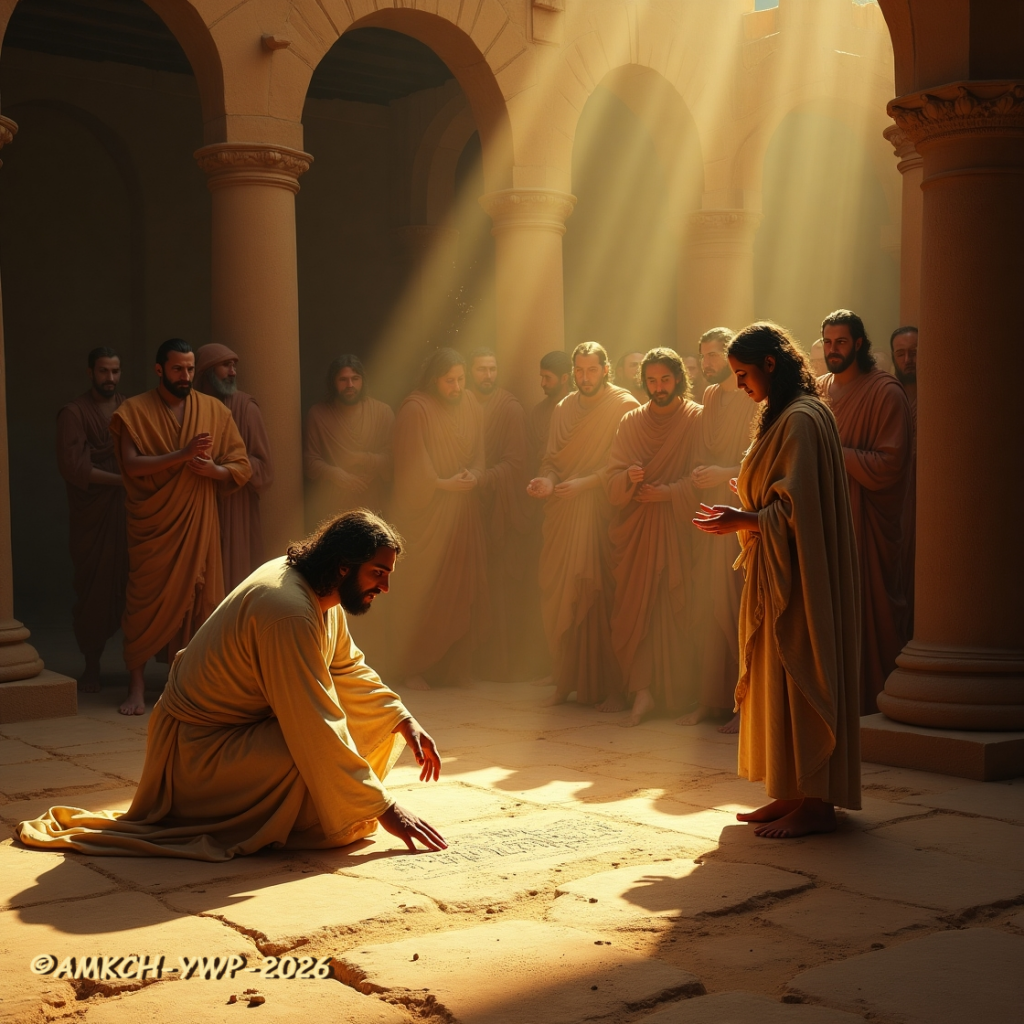
Before we approach this familiar story, it is essential to understand something that profoundly changes how we read it. The scene of the woman caught in adultery, the one so often cited as a demonstration of mercy, is not part of the earliest manuscripts of John. John did not write it. Scholars date its addition to around 350 A.D., added by a scribe. The likely motivation was to dramatize moral principles, obedience to the (their) Law, the consequences of sin, and human accountability, but it was not an event Jesus actually enacted. The scribe wanted to create a striking moment to teach about judgment and punishment, but this human addition reflects the tension that has always existed: even well-intentioned humans can distort or reshape Scripture to fit their own agendas.
Take a look at John 8. Here we are, at a moment where the religious authorities are trying to trap Jesus, trying to make Him choose between two impossible options. It’s early in the morning, and Jesus is teaching in the temple courts, surrounded by people who are eager to hear what He has to say. The air is cool, the light soft as the day begins, and crowds have gathered, attentive and waiting for His teaching. Then, the Pharisees and scribes bring a woman caught in adultery and place her in front of Him, note carefully, they did not bring the man. They quote the Law, telling Jesus that the Law of Moses commands she be stoned to death. There is no question of her guilt, she was caught in the act. The Law is clear. But notice again: they did not bring the man for judgment.
But here’s the thing: the Pharisees and scribes aren’t really concerned with justice. They’re concerned with trapping Jesus. If He says, “Let her go,” they’ll accuse Him of breaking the Law. If He says, “Stone her,” He risks alienating Himself from the Roman authorities, who had the power to execute capital punishment. So, they put Him in a corner, imagining there is no way out. They think they have created a moral snare, a trap designed to catch Him in wrongdoing.
But Jesus doesn’t react the way they expect. Instead of immediately answering, He bends down and begins writing in the dust with His finger. What does He write? That’s the question that has haunted readers for centuries. The Greek text doesn’t tell us, and the silence around this act is significant. Some have imagined that He wrote the sins of the accusers or cited the Law. Others have speculated that He wrote nothing at all, that the act itself was the teaching. We simply do not know. Perhaps the silence is the point. Jesus’ pause is profound, a deliberate redirection of attention. The moment stretches, heavy with tension. The crowd watches, unsure how to respond. The woman looks down, perhaps trembling, unsure of what will happen next. The accusers grow impatient. And yet, Jesus remains still, engaged with the dust, and in that stillness, He teaches something far deeper than words.
Jesus bends down and writes in the dirt. This action by itself speaks volumes. The phrase “writing in the dirt” in Greek is γράφει (graphei). But this action is not random, nor without meaning. The finger of God is what we encounter here. In Exodus 31:18, it is the “finger of God” that writes the Law on the tablets given to Moses. Jesus, the Son of God, is the One who gave the Law in the first place. And now, here He is, bending down to write in the dirt. By doing this, He is demonstrating His divine authority, the One who wrote the Law now writing in the dust.
Dust, in the Bible, represents human frailty and imperfection. From Genesis 2:7, we are reminded that God formed Adam from the χώμα (chōma, dust of the earth). We are dust, fragile, mortal. By writing in the dust, Jesus is engaging with our very humanity. He reminds the accusers, and the woman herself, that all of us are dust—we are imperfect, we are sinful. In this simple act, Jesus seems to be saying, “You all have your own imperfections, your own failings. You think you’re standing on solid ground, but you’re just dust.”
But the Pharisees aren’t satisfied with His silence. They press Him further, asking again, “What do you say?” They want a clear answer. Jesus, without missing a beat, stands up and speaks one of the most profound lines in Scripture: “Let him who is without sin (ἀναμάρτητος, anamartētos) among you be the first to throw a stone at her.” This is not a denial of her sin. She is caught in wrongdoing. But Jesus shifts the focus entirely. He also probably noticed that they did not bring the man. He calls the accusers to examine themselves. Judgment must begin with self-reflection. Humility must precede condemnation. Mercy is the antidote to self-righteousness.
As He speaks, the crowd begins to leave, starting with the πρεσβύτεροι (presbyteroi), the elders, those likely most aware of their own failings. They linger, hesitating, stones in hand, perhaps recognizing their own guilt and shortcomings. One by one, they turn away. The younger ones follow, less experienced but not immune to self-recognition. The stones fall from their hands. Only Jesus and the woman remain. The scene is quiet now, except for the subtle sounds of dust disturbed beneath His fingers, a reminder of the impermanence of human judgment.
Jesus asks her, “Where are they? Has no one condemned you?” She replies softly, “No one, Lord.” And He says, “Neither do I condemn you. Go, and from now on, sin no more.” The Greek οὐδὲ ἐγὼ κατακρίνω σε (oude egō katakrinō se) expresses the strength of this declaration. This is radical grace in its purest form. He does not overlook her sin. He does not excuse it. He forgives, lifts the burden, and calls her to transformation. Grace is active, not passive. It reshapes, heals, and calls for a new way of life.
Now consider why this story was added by scribes centuries later. The intention was likely to emphasize strict judgment, obedience to the Law, and the consequences of sin. The scribe imagined a dramatic act, Jesus bending down, writing in the dust, confronting sin visually, to highlight authority and moral teaching. But the addition also reveals something crucial: humans can manipulate even sacred texts to serve agendas. In this case, the narrative leans toward obedience, punishment, and the spectacle of justice, rather than the heart of God. The original Jesus did not act to stage morality; He acted to restore, teach, and transform.
The symbolism of dust continues to teach. Dust reminds us of mortality, fragility, and dependence on God. Stones represent pride, the desire to punish, and the temptation to control others. Jesus turns this upside down. The stones fall. The accusers leave. Mercy triumphs over human judgment. Grace transforms the moment, the people, and the lives involved.
The encounter between Jesus and the woman is transformative. “Go, and from now on, sin no more.” Forgiveness is offered, but it is paired with a call to righteousness. Sin is acknowledged but replaced with a higher path. God’s mercy is never passive, it shapes lives, demands reflection, and invites repentance. The Gospel is not simply forgiveness; it is the invitation to participate in transformation.
This teaching resonates today. How often do we clutch stones, eager to condemn, judge, or shame? How often do we fail to recognize our own fragility? Jesus’ lesson is timeless: judgment belongs to God; mercy is to be practiced by humans; transformation is always possible.
Even in passages added by humans, insight remains. Humans often attempt to control, manipulate, or dramatize righteousness. Jesus’ teaching always centers on mercy, humility, and repentance. Dust, stones, sin, and forgiveness converge to reveal God’s true heart: patient, merciful, and inviting all of humanity into transformation.
The scribes who added this story highlight human agendas: dramatizing sin, emphasizing obedience, and elevating human authority over mercy. Yet the original Jesus teaches differently. He calls for self-examination, humility, and grace. Dust reminds us of mortality; stones remind us of pride; sin reminds us of the need for transformation. In every element, Jesus shows the way forward: mercy, forgiveness, and a life reshaped by love.
This is the fullness of the Gospel. We are offered forgiveness, mercy, and transformation. The stones we once clutched fall from our hands. The weight of judgment is lifted. The heart of God is revealed: gracious, merciful, and calling humanity to a higher, holy, and loving way of life.
✝️✝️✝️✝️✝️
Heavenly Father,
Thank You for revealing Your heart through Yeshua, Your Son. Thank You that even when the world is quick to condemn, You offer mercy and grace. Help us to lay down the stones of judgment we clutch so tightly, and to see our own fragility and need for Your forgiveness. Teach us to walk in humility, to forgive as You forgive, and to embrace the transformation You call us to. Help us to reflect Your love, Your patience, and Your mercy in every interaction, lifting others up rather than tearing them down. Guide us, Lord, to live each day in the freedom of Your grace, and to share that light with a world in need.
In Yeshua’s holy name, Amen Amen.
If you liked this message, please leave a positive comment. I would love to hear from you!
image done by my chatgpt ai at my direction. If any of these people looks like you or someone you know, that is purely coincidental. They are not.
©️AMKCH-YWP-2026
.