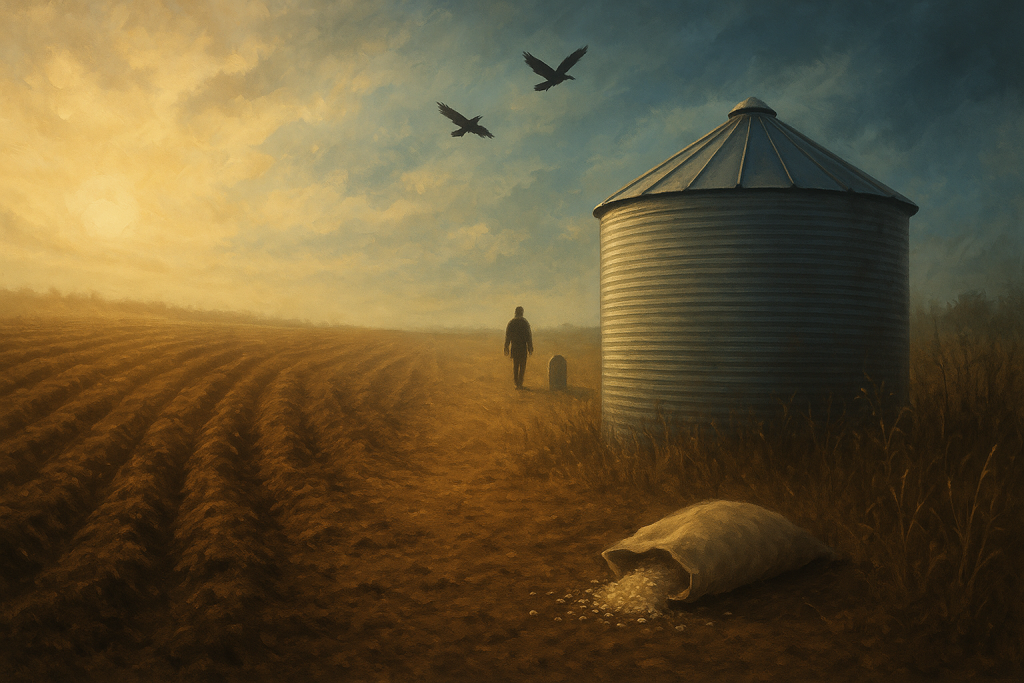
There are moments in history when the world seems to hold its breath. The year 536 was one of those moments. Across Europe, Asia, and the Near East, people looked up and saw a sun that no longer burned with strength. It hung in the sky, pale and weakened, giving light without warmth. Imagine waking up day after day and noticing that the sun never seemed right, never bright, never strong. Crops failed. Seasons forgot their order. Summer felt cold. Winter felt endless. Hunger crept into villages and cities alike, killing thousands. Parents watched as the food they had carefully stored ran out. Children went to bed hungry. People tried to keep their animals alive, but even livestock grew weak and died. For many, it felt as if creation itself had turned its face away. What matters is not only that it happened, but that it was seen, remembered, and recorded by people who did not know one another, yet told the same story. People in different lands, speaking different languages, described the same dim sun and strange cold. Darkness. The question before us is not merely historical. It is theological. What does it mean when the heavens dim and the earth trembles beneath human certainty?
From the beginning, Scripture teaches us that darkness is not meaningless. It is never accidental. “The earth was formless and empty, and darkness was over the surface of the deep, and the Spirit of God was hovering over the waters” (Genesis 1:2). Darkness (hebrew: choshech) was present, but God was not absent. The Spirit hovered. Even before light (’or) was spoken into existence, God was already there, watching, sustaining, preparing. Darkness was not the enemy of God. It was the stage upon which God would speak. Again and again, Scripture returns to this pattern. Before deliverance, there is often dimness. Before exposure, a veil. Before humility, a shaking. All we need to do is pay attention and remember that God works even when we cannot see clearly.
Scripture never presents creation as independent from God’s authority. “The heavens declare the glory of God; the skies proclaim the work of His hands” (Psalm 19:1). Creation does not only praise. It also testifies. It tells the truth about who is in charge. In the Exodus, darkness was not random weather. “So Moses stretched out his hand toward heaven, and there was thick darkness over all the land of Egypt for three days” (Exodus 10:22). This darkness confronted a civilization that worshiped the sun as divine. The very thing they trusted for life and order was shown to be subject to the God of Israel. That pattern matters. Because at the time the sun dimmed in 536 a.d., the world was filled with empires, certainty, violence, and confidence in human power. Kings believed they were untouchable. Nations believed they were secure. People trusted armies, wealth, and rulers more than the Creator who gives breath.
What modern science has uncovered does not weaken this truth. It sharpens it. Ice cores taken from Greenland and Antarctica act like frozen history books. They show layers of ash and sulfur that match what ancient writers described. In 536, a massive volcanic eruption in the far north hurled ash and sulfur high into the atmosphere. The sky became veiled, almost like a permanent haze. Sunlight was scattered before it could fully reach the ground. Temperatures dropped sharply. This was not a local disaster affecting only one region. It was hemispheric. The growing seasons collapsed. Crops that depended on warm sunlight failed. Harvests failed not for weeks, but for years. People worried every day about whether their next meal would come, and from where. Farmers saw their seeds rot in the cold, their animals thin and dying. Villagers whispered fearfully about what was happening, praying and fasting, seeking mercy from God, while others turned to superstition, blaming spirits, kings and even their neighbors. What people experienced as darkness was the atmosphere itself changed by fire from the earth. They did not know why it was happening. They only knew that the sun was no longer behaving as it should.
But the shaking did not stop there. Just as the world struggled to recover, another major volcanic eruption occurred around 540. Once again, the skies were thickened. Once again, the climate faltered. Once again, hunger deepened. Entire regions were already weakened when the cold returned. Fields that had barely begun to recover failed again. Livestock died from lack of food and cold temperatures. Trade slowed because people had little to sell or buy. Populations were malnourished, vulnerable, and exhausted. People began to move from villages to towns, hoping to find food, but towns were crowded and resources scarce. Fear spread along with hunger. Many wondered if the world was ending. Creation seemed to press the wound instead of trying to heal it.
And then came disease. In 541, the Justinian Plague (called this because Justinian was emperor at the time), swept through the Roman world. Bodies already weakened by hunger could not resist it. People fell sick quickly. Families vanished in days. Cities emptied. Leadership fractured as rulers and officials died or fled. Empires that had seemed immovable suddenly discovered how fragile they were. Scripture has words for this kind of unraveling. “The LORD makes the earth empty and lays it waste; He twists its surface and scatters its inhabitants” (Isaiah 24:1). This is not cruelty. This is sovereignty. When humanity forgets that it is dependent, God sometimes allows creation to remind us that life itself is a gift.
Even this was not the end. Evidence points to yet another significant volcanic event around 547. Smaller perhaps, but still devastating in context. The earth did not need a single catastrophic blow. It suffered repeatedly, one after another after another. The cumulative effect was crushing. People were not just surviving one disaster. They were living through years of uncertainty and loss. Communities adapted in small ways. Neighbors shared what little they had. People walked for miles seeking food or work. Some leaders tried to organize relief, while others failed. Societies did not simply endure a disaster. They endured a prolonged humbling. Old systems could not sustain themselves. Economic hierarchies collapsed because wealth could not protect against cold, hunger, or disease. Political certainty eroded. What had once looked permanent proved to be only temporary.
We must also be very careful here. Jesus Himself warned against assigning moral guilt to those who suffer. “Do you think they were more guilty than all the others because they suffered this way? I tell you, no” (Luke 13:2-3). So we do not say the people of Europe and Asia were being punished for a specific sin. Scripture does not allow that. But Scripture also does not allow us to say God is not involved. There is a middle ground that modern faith often avoids. God is sovereign, not petty. He is just, not reactive. He is patient, but not passive.
When light fades, illusions collapse. Food shortages reveal injustices that were already present. Cold exposes inequality, showing who has resources and who does not. Crisis strips power of its pretense. People struggled, yes, but they also prayed, gave to neighbors, carried water and firewood, shared what little bread remained, and discovered courage they did not know they had. Scripture says this plainly. “I form the light and create darkness, I bring prosperity and create calamity; I, the LORD, do all these things” (Isaiah 45:7). This verse is not meant to frighten. (1 Corinthians 14:33: For God is not the author of confusion, but of peace, as in all churches of the saints.) It is meant to reorient us. God is not competing with creation. Creation obeys Him. The darkness of the sixth century did not create evil. It revealed what was already there in human hearts and systems.
We cannot ignore the echo that runs through Scripture itself. When the Son of God was crucified, the sky responded. “From noon until three in the afternoon, darkness came over all the land” (Matthew 27:45, Mark 15:33, Luke 23:44). Darkness marked the moment when human violence reached its peak and divine mercy answered it. Darkness does not always mean God is angry. Sometimes it means God is acting at a depth we do not yet understand.
What followed the years of ash and cold was not the end of the world. Empires shifted. Old structures cracked. New ones emerged. Power redistributed. Communities reorganized. People learned to depend on one another again. Acts of kindness increased in many places. The gospel continued, often quietly, often among the poor, often outside the centers of authority. Scripture reminds us, “After you have suffered a little while, He will restore you, support you, and strengthen you” (1 Peter 5:10). God does not waste darkness.
We live in a world that still trusts in its systems, its science, its economies, its leaders more than it would consider trusting in the One who created them. Science explains the how of 536, 540, and 547. Faith addresses the why. Both can be true at the same time. To see God’s hand is not to deny natural causes. It is to recognize who holds the laws of nature themselves.
The sun had dimmed before. The world had trembled. Humanity had certainty failed. Yet God remained. “Though the earth give way and the mountains fall into the heart of the sea, God is our refuge and strength” (Psalm 46:2-3). Darkness does not mean abandonment. It means we are being reminded of who the light really belongs to.
PRAYER ✝️✝️✝️✝️✝️
Father God, We are acknowledging this period of real suffering in human history. There were years when the sun was dim, the air was thick, and the seasons failed. Crops did not grow, Farms collapsed, Food became scarce, Hunger spread, and sickness followed. Many people died, not in battle, but slowly, quietly, in their homes.
You saw every one of them.
You were not absent during those years. You were not confused, and You were not defeated by what happened in creation. You remained God, even when the natural order seemed broken.
We recognize that these events were not symbolic. They were physical, historical, and devastating.
Families were lost. Communities weakened. Whole regions suffered.
Teach us to take history seriously. Teach us to understand that life is fragile, and that creation itself can falter. Keep us from arrogance, from assuming stability where none is guaranteed.
At the same time, remind us that even in those years, humanity was not erased.
Life continued because You allowed it to continue.
Limits were placed on destruction. Survival itself was an act of Your restraint and mercy.
We ask that this teaching lead us to sober faith, not fear. To humility, not speculation. To trust in You, not in systems, climates, or predictions.
You are the God who holds the world together, even when the sun grows dim and the earth fails.
We ask you, Father to teach us all your way. Your will be done.
In Yeshua’s Holy name,
Amen Amen
✝️✝️✝️✝️✝️
If you liked this message, please leave a positive comment. I would love to hear from you!
image done by my chatgpt at my direction.
©️AMKCH-YWP-2026