I was watching the news, drone strikes over the region, fresh negotiations resurfacing, headlines about Jerusalem and Israel, Iran issuing new threats, Europe and the UN pushing again for a “two‑state solution.” I paused. This isn’t just politics. This is prophecy unfolding in real time.
At first I thought, “Am I seeing connections that aren’t really there?” But then I opened my Bible and began tracing the words in the original languages. berith ‘im harabim (בְּרִית עִם הָרַבִּים, covenant with many) wasn’t just a phrase on a dusty scroll, it’s showing up in the headlines: peace agreements, coalitions, alliances. And the threats, the saber‑rattling, the threats to wipe Israel off the map? The scrolls already spoke of them through prophets like Ezekiel and Joel.
It took nights of reading, checking Hebrew and Greek, cross‑referencing modern events with Scripture. Slowly it became undeniable: the earth is speaking Heaven’s language, the newspapers aren’t just echoing history, the scrolls are unfolding before our eyes.
✝️ ✝️ ✝️ ✝️ ✝️
When Earth Aligns with Prophecy: The Headlines Already Written
You know, it’s one thing to say that Bible prophecy is real. It’s another thing entirely to open your front door, grab a newspaper, or scroll through a feed, and see it unfolding in real time. We’re not waiting for prophecy to start. It’s not coming someday. It’s already underway. The ink was written in heaven long before men ever signed treaties on Earth. And yet here we are, watching the pages of Scripture turning themselves across the deserts and cities of the Middle East.
So let’s walk together, through what’s really happening, what the scrolls already told us, using the exact words God chose when He spoke through His prophets.
We begin where the world is watching: Israel and her neighbors. There is stirring, peace agreements made, tensions simmering, war drums sounding, olive branches offered. But what’s really going on beneath the surface?
Daniel 9:27: “And he shall confirm a covenant with many for one week; but in the midst of the week he shall cause the sacrifice and the oblation to cease…”
Now pause. The Hebrew word there for confirm is gabar (גָּבַר, to strengthen or enforce). This is not a neutral “signing a treaty.” This is enforcing something that already exists. Perhaps a treaty once made, forgotten, twisted, now revived.
The word “covenant” is berith (בְּרִית, binding agreement). Real terms, real signatures. And “with many” is ‘im harabim (עִם הָרַבִּים, with the multitude). Not just a single nation, a coalition.
Ask yourself: have you heard of any agreement in recent years between Israel and a multitude of nations that looks like a renewed peace covenant? Yes. The 2020 “normalization agreements”. The so‑called Abraham Accords between Israel and several Arab nations: United Arab Emirates, Bahrain, Sudan, Morocco, economic cooperation, security deals, open skies, embassies, mutual recognition. Not just tolerance, formal peace.
In ancient Hebrew terms this isn’t “normalization.” It’s karat berith (כָּרַת בְּרִית, to cut a covenant), a covenant being cut, between former enemies, in the name of Abraham. Prophetic theater, old as the scrolls.
That “one week” in prophecy-language refers to a shavua (שָׁבוּעַ, a seven-year period). At the halfway point, three and a half years, the covenant breaks, the sacrifices stop, peace dissolves, judgment begins.
Does that mean the Abraham Accords are the covenant in Daniel 9:27? Not necessarily. But does it look exactly like the kind of agreement Daniel said would appear in the last days? Yes, it does. That should stir every believer’s heart.
Then move with me to Isaiah 17:1: “Behold, Damascus is taken away from being a city, and it shall be a ruinous heap.” The phrase “ruinous heap” there is mish’eh (מִשְׁעֵה, uninhabitable heap, obliterated). Not just defeated, not just politically crushed, uninhabitable, unusable, destroyed beyond recovery. Look at Syria today: war‑torn, devastated, parts of Damascus in ruins, entire neighborhoods abandoned. Isaiah’s prophecy hasn’t finished, it’s still unfolding.
Then there is Joel 3:2: “I will gather all nations, and will bring them down into the valley of Jehoshaphat… and will plead with them there for my people and for my heritage Israel, whom they have scattered among the nations, and parted my land.” The Hebrew for “parted” is chalak (חָלַק, to divide or apportion). And the word translated “plead” is shaphat (שָׁפַט, to judge). So this isn’t a neutral offer. This is a judgment. God Himself stepping into His courtroom over Israel’s land.
Meanwhile, the calls for dividing Jerusalem or creating a “two‑state solution” grow louder in international assemblies. Diplomatic pressure on Israel mounts anew. But the Scriptures call this nothing less than trespass.
And finally 1 Thessalonians 5:3: “For when they shall say, Peace and safety; then sudden destruction comes upon them…” The Greek word used there is aiphnidios (αἰφνίδιος, unexpected, without warning). When the world declares “peace and safety”, that very moment the trap snaps shut. Peace is not the end; it is the setup.
So what must we do with all this? We remember Who is in control. The One behind every headline, every treaty, every war plan: YHWH Tseva’ot (יְהוָה צְבָאוֹת, Lord of Hosts), Commander of heavenly armies. He is not caught off guard. He is not scrambling to adjust “the calendar.”
We don’t fear. We watch. We ready our lamps. We preach the Word while it is still day. We stand, pray, and stay rooted in the truth. The world may be changing. The scrolls already told us everything. Amen.
✝️ ✝️ ✝️ ✝️ ✝️

Jerusalem: The Epicenter of Eternity
You can draw red lines all over maps if you want. You can redraw borders, convene summits, vote resolutions. But there is only one piece of real estate on Earth that both heaven and “hell” care about, and Jerusalem is it. Not because it’s beautiful. Not because it’s powerful. Not even because it is religious. But because God put His shem (שֵׁם, name, authority, essence) there. He didn’t just label Jerusalem. He sealed it with His authority, like a king stamping a royal seal into wax.
And this is no romantic metaphor. There are archaeologists and geographers who note that the topography around Jerusalem echoes the shape of the Hebrew letter Shin (ש), the same letter that begins “Shaddai” (Almighty) and “Shem” (Name). This is not coincidence. This is Creator-level cartography.
Now fast-forward with me. The future isn’t some dreamy after‑life. It’s coming to Jerusalem.
Zechariah 14:4: “And in that day His feet shall stand upon the Mount of Olives, which is before Jerusalem on the east, and the Mount of Olives shall cleave in the midst thereof.”
“Feet” is regel (רֶגֶל, presence, authority, dominion), “shall stand” is ‘amad (עָמַד, to take a firm position, to occupy with intent), “Mount of Olives” is Har HaZeitim (הַר הַזֵּיתִים, mountain of oil trees), “cleave” is baqa’ (בָּקַע, to tear open violently). Not a metaphor. Not poetic license. A literal, tectonic, divine event. Half the mountain moves north, half south. A new valley opens. The earth itself responds.
Why the Mount of Olives? Because that is where He left. Acts 1:11‑12: the angels told the disciples this same Jesus would return in like manner, and they came from the mount called Olivet. The same ground. The same plan.
And He is returning, physically. Visibly. Not to Mecca. Not to Washington. Not to Rome or the Vatican. But to Jerusalem, to fulfill covenant, to vindicate His Name.
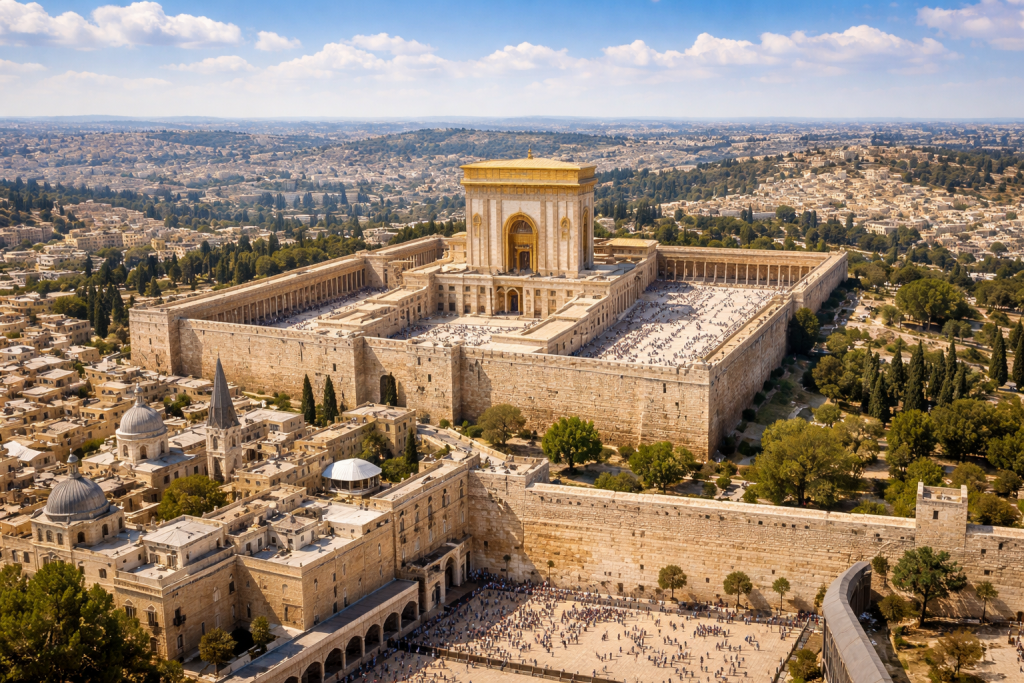
Right now the world is swirling around that city: threats from Iran, diplomatic pressure from Europe and the UN, regional alliances shifting under the guise of “peace process,” rumors of temple reconstruction, religious agitation and security tensions around the Temple Mount. All eyes on Jerusalem, as the focal point of prophecy and global power.
This is not coincidence. This is covenant territory.
Psalm 132:13: “For the LORD has chosen Zion; He has desired it for His dwelling place.” God didn’t randomly pick another city. He chose Jerusalem after careful love and forethought. The Temple Mount may be tense. The Dome of the Rock may sit on ancient foundations. But the scrolls declare: the Temple will stand again. The inner sanctuary, the naos (Ναός, Holy of Holies) described by Paul, must exist for prophecy to continue.
And Psalm 125:1‑2: “As the mountains surround Jerusalem, so the LORD surrounds His people.”
So we don’t cower at the flags or tremble at the news. We keep watch, we pray, we hold fast to the promise: the King is coming. His feet know exactly where to land.
✝️ ✝️ ✝️ ✝️ ✝️

The Footsteps on the Mountain: When the Earth Remembers Its Creator
There’s a mountain just east of Jerusalem. By human standards, not tall. By human logic, not significant enough to shake empires. Yet it is the place where the Son of Man last stood, and where heaven has scheduled His return.
Zechariah 14:4: “And in that day His feet shall stand upon the Mount of Olives… and the Mount of Olives shall cleave in the midst thereof.”
The word “cleave” is baqa’, the same word used when the Red Sea split. Not a crack. A divine rending, a seismic sundering, a valley opening. Half of it north, half south, a pathway formed. That valley isn’t random. It’s an escape route. A route of salvation. A route of doom for some, redemption for others.
Go with me to Acts 1:11‑12. The disciples stand there, eyes upward, as Jesus is taken. Two messengers appear and say, “This same Jesus… shall so come in like manner.” Where were they standing? On the Mount of Olives. And it is from there they returned to Jerusalem. Heaven left a placeholder. He will come back to the same address.
And this isn’t sentimental circle. This is covenant territory. When the glory of God departed the Temple, the same glory paused over the Mount of Olives before leaving (see Ezekiel 11:23). The mountain remembers its Maker, the earth knows what’s coming.
When He returns, He won’t ride a donkey. He won’t be humble. He won’t be ignored. Revelation 19 shows Him riding a white horse, with a sword coming out of His mouth, a broadsword, rhomphaia (ῥομφαία, the truth-sword), not forged in metal, but forged in justice and covenant. The earth will react. The mountain will split. Footsteps echo. The Creator marches home.
There are rumors now, about tombs, about burial grounds on the Mount of Olives, about desperate hope. For centuries, Jewish people believed the Messiah would call the righteous from their graves starting there. They may have been early, but they were not wrong.
We are not waiting for a temple. Not waiting for a war. Not just waiting for signs in the sky. We are watching for footsteps. Because the mountain waits. The earth remembers. And when the King walks down, the ground will quake in recognition.
✝️ ✝️ ✝️ ✝️ ✝️
The Valley Has a Voice: When Nations Gather for War but God Judges Them All
The prophets were not poets with flowery pens. They were seers with divine ink, they recorded the future with words soaked in heaven’s authority. And sometimes they referred to the same place by different names, not pointing to geography, but pointing to purpose.
Joel 3:12: “Let the nations be roused; let them advance into the Valley of Jehoshaphat, for there I will sit to judge all the nations on every side.”
Joel 3:14: “Multitudes, multitudes in the valley of decision! For the day of the LORD is near in the valley of decision.”
That word translated “decision” is charuts (חָרוּץ, a sharp, carved decree), not “people deciding.” This is God’s sword descending. No appeals. Judgment declared.
Why are the nations gathered? Because the scroll of Ezekiel said it would be so. Look at Ezekiel 38–39: a northern confederacy led by Gog of the land of Magog, sweeping down in arrogance, thinking to “take spoil.” The names, Meshech, Tubal, Gomer, Togarmah, Persia, ancient places, yet in the scroll they are spiritual battalions. Thessalonian threats, nuclear posturing, alliances being whispered about now: Iran, Russia, others, the outlines shifting.
Ezekiel 38:16: “And you shall come up against My people Israel, like a cloud to cover the land; it shall be in the latter days…” “Latter days” in Hebrew is be’acharit ha‑yamim (בְּאַחֲרִית הַיָּמִים, end of the end), the final pages of human history. This isn’t just another war. It’s the final exam for the nations.
God does not need to coordinate flowcharts. He simply pulls the trigger. Notice Ezekiel 38:4: “And I will turn thee back, and put hooks into thy jaws…” The Hebrew word ḥāḵaḥ (חָכַח, hook, bridle‑hook), God reins them in, not to negotiate, but to draw them straight into the valley.
When they think they march into victory, they are actually marching into judgment. Joel 3:16 proclaims: “The LORD will roar from Zion, and thunder from Jerusalem; the earth and the heavens will tremble.” The Hebrew sha’ag (שָׁאַג, lion’s roar), the Lion of Judah isn’t meowing. He is roaring before He strikes.
Ezekiel 39:4: “You shall fall upon the mountains of Israel, you and all your bands…” This is no clean-up crew. Bodies left unburied for months, weapons burned for years. This is God marking the land as He did Egypt with blood.
Valleys in Scripture are not places of retreat. They are places of decision, destiny, battle, and judgment. From Abraham meeting Melchizedek to David facing Goliath to Jesus descending into Gethsemane, God meets people in the low places. And now the same Valley of Jehoshaphat, where God once turned the tide for His people, is the stage for final reckoning.
God isn’t just judging armies. He’s settling accounts. When the fire falls, no demon, no prince, no king, no government, no alliance will escape confusion. Because the prophets shouted the warning, the scrolls recorded it, and the valley kept its appointment.
✝️ ✝️ ✝️ ✝️ ✝️
The Sky Will Rip Open: When the Invisible Becomes Unavoidable
There is a sound in heaven that has been rehearsed for eternity, but not yet released. A trumpet no man has blown. A cry no nation can silence. A moment creation itself was built to witness.
Matthew 24:29: “Immediately after the tribulation of those days, the sun shall be darkened, and the moon shall not give her light, and the stars shall fall from heaven, and the powers of the heavens shall be shaken…”
Matthew 24:30: “And then shall appear the sign of the Son of Man in heaven…”
The Greek word translated “shall appear” is phainō (φαίνω, to burst forth into sight). Not fade in. Not rise gradually. The sudden unveiling of something that was there all along; hidden only by mercy and timing.
The “sign” is to sēmeion tou huiou tou anthrōpou (τὸ σημεῖον τοῦ υἱοῦ τοῦ ἀνθρώπου, the sign of the Son of Man). Not vague. Singular. Cosmic. Unmistakable. And the Greek word order places the title at the end, emphasizing: of the Man. The One who once came in flesh is returning in glory.
Next verse: “They shall see the Son of Man coming in the clouds of heaven with power and great glory.” The Greek phrase erchomenon epi tōn nephelōn (ἐρχόμενον ἐπὶ τῶν νεφελῶν, coming upon the clouds) shows not a subtle appearance, but a sovereign arrival. Clouds as His chariot. His throne descending, not ascending. Justice invading the war zone.
And the earth reacts.
Matthew 24:31: “And He shall send His angels with a great sound of a trumpet, and they shall gather His elect from the four winds…” That “great sound” comes from phōnēs megalēs (φωνῆς μεγάλῃ, a loud voice). Not a whisper. A voice that pierces graves, splits realms. Paul echoes it in 1 Thessalonians 4:16: “For the Lord Himself shall descend from heaven with a shout, with the voice of the archangel, and with the trump of God.” The Greek word is keleusma (κελεύσμα, military command, battle cry). This isn’t ceremony. It’s war trumpets. It’s judgment’s call.
Then the dead in Christ rise, anastēsomai (ἀναστήσομαι, to stand up again). Not figurative. Bodily. Physical. Victory in flesh. The ones alive, harpagēsometha (ἁρπαγησόμεθα, to be seized by force). Like a bride snatched from danger before fire falls.
And then heavens tear open. In Revelation we read, “I saw heaven standing open and there before me was a white horse, whose rider is called Faithful and True.” The word ēneōgmenon (ἐνεωγμένον, opened permanently), the veil is ripped once for all. The barrier between heaven and earth is gone.
Out rides the Word, Logos tou Theou. Not as suffering servant, but as sovereign King. His robe dipped in blood, not just His foes’, but His own covenant wounds, now His royal insignia.
A sword comes from His mouth: rhomphaia (ῥομφαία, the truth‑sword). Not a symbol. Not a poem. A broadsword of divine authority, executioner of lies and kingdoms built on deceit.
Isaiah foresaw it: Isaiah 34:4, “All the host of heaven shall be dissolved, and the heavens shall be rolled together as a scroll…” Not metaphor. Cosmic collapse. Universe obeying prophecy.
And His name: “King of Kings and Lord of Lords”, in Hebrew thought that repetition is superlative sovereignty. This is not Jesus. This is the Ruler of Time, the Voice from the burning bush, the Commander of the legions of heaven. When He speaks, creation bows.
The sky will not just open. The King will ride out. The world will either mourn or rejoice. There will be no neutrality.
✝️ ✝️ ✝️ ✝️ ✝️
When Earth Aligns With Prophecy: The Headlines Already Written (Reprise)
This moment we’re stepping into, for heaven it is already declared. Angels rehearsed. Scrolls sealed. Soon the seals break and heaven opens. This is not just future prophecy, it’s a divine appointment. It has a time, a place, a sound, and a King.
Joel 3:14: “Multitudes, multitudes in the valley of decision: for the day of the LORD is near in the valley of decision.” That word “decision” is charuts, a carving with a sword, a decree without appeal. The valley is real. It is full. The Hebrew says hamōn hamōn (הָמוֹן הָמוֹן, multitudes upon multitudes). Crowds not gathering to watch, but to stand trial. And the judge? YHWH Tseva’ot, the LORD of Hosts. Commander of every heavenly army, seen and unseen.
Yes, the same northern army described in Ezekiel 38–39, in coalitions whispered about even now. Russia, Iran, various proxies, global alignments shifting under the guise of “defense pacts.” They may march with weapons, but heaven comes with fire.
Ezekiel 38:4: “And I will turn thee back, and put hooks into thy jaws…” The Hebrew ḥāḵaḥ, God does not negotiate. He reins them in, not to parley, but to deliver.
Then Ezekiel 38:22: “I will plead against him with pestilence and with blood; and I will rain upon him… great hailstones, fire, and brimstone.” The Hebrew nishpat, God executing judgment, not arguing. Not giving warnings. The case is closed before they even lift their spears.
And Zechariah 14:4: “And His feet shall stand … upon the Mount of Olives…” The same feet that once walked Galilean roads, pierced for sin, returning not to suffer, but to reclaim, to restore, to reign.
Then Revelation 19:15: “Out of His mouth goeth a sharp sword, that with it He should smite the nations…” The rhomphaia, not parley, but decisive judgment. Truth does not miss.
What happens to those armies that stood against Jerusalem? Zechariah 14:12: “This shall be the plague wherewith the LORD will smite all the people that have fought against Jerusalem.” Flesh dissolves while they stand. Eyes melt. Tongues rot. Death in standing, divine retribution without mercy, because they chose to fight the LORD of Hosts.
But He does not just destroy. He reigns. He receives the kingdoms of this world, not by treaty, by conquest, but by inheritance. The One they pierced, Yeshua, owns the deed to Earth.
And in that moment: every knee bows, Greek: kampsei pan gonu (κάμψει πᾶν γόνυ). Every tongue confesses, exomologēsētai (ἐξομολογήσεται). Not a whisper. Not a murmur. A shout of full surrender.
The thrones of men vanish. The scroll is opened. The verdict is set. The Kingdom belongs to our Lord and His Christ. Across cosmos, His name, salvation, justice, righteousness, is known.
✝️ ✝️ ✝️ ✝️ ✝️

(PLEASE Excuse this image, apparently ChatGPT doesn’t know that Yeshua is of a medium dark complexion, and dark hair – He was born in Bethlehem… i.e. middle east. So He would look middle-eastern.) ✝️ ✝️ ✝️ ✝️ ✝️
The Eternal Covenant, God’s Unbreakable Promise
But this isn’t just doom and judgment. It is also covenant. Life. Hope. Salvation.
The Hebrew word for covenant, berith (בְּרִית, binding agreement). Not a human contract. A living, breathing promise founded on God’s character, not ours.
God swore by Himself when He promised Abraham:
Genesis 17:7: “I will establish my covenant between me and you and your offspring after you throughout their generations for an everlasting covenant, to be God to you and to your offspring after you.”, this is berith olam (בְּרִית עוֹלָם, everlasting covenant), a covenant stretching beyond time, eternal and unbreakable.
In the New Testament, the Greek word diathēkē (διαθήκη, testament, sacred will) translates berith, deeper than contract, it is a will, a final declaration, a last word.
Jesus, our High Priest, inaugurated a new covenant:
Hebrews 8:10: “For this is the covenant that I will make with them… I will put my laws into their minds and write them on their hearts…”, not ink and paper, but pneuma (πνεῦμα, Spirit), God’s own breath, writing His law inside us.
This covenant is by grace, not works. The Hebrew word chen (חֵן, grace, favor without merit) and the Greek charis (χάρις, grace, unearned favor) speak of unmerited, overflowing love.
And the Hebrew word chesed (חֶסֶד, covenant loyalty, faithful love) describes God’s devotion, fierce, unchanging, refusing to let go.
That is why the Psalmist declares:
Psalm 9:9‑10: “The LORD is good, a stronghold in the day of trouble; He knows those who take refuge in Him.”
God’s covenant is not relic of history. It is present power. Future hope. It anchors our souls when storms rage. It is the foundation beneath the shifting sands of politics, treaties, wars, alliances. When arms on Earth feel too short to reach Him, His arms are wide open to hold us.
So preach this bold truth: God’s covenant is alive. His promises are sure. His love is unbreakable.
✝️ ✝️ ✝️ ✝️ ✝️
The Call to Watchfulness, Eyes Open, Hearts Ready
In the stillness of this moment, while the world scrambles with negotiations and conflict, God calls His people to watch and pray, not with fear, but with sober hope, confidence, and spiritual alertness.
The Hebrew word for watch is shamar (שָׁמַר, to guard, keep safe, be vigilant). It is the same root used when God told Israel to “keep My commandments and statutes.” Watching isn’t passive. It’s active, sacred, holy.
Jesus Himself said:
Matthew 24:42: “Watch therefore, for you do not know what hour your Lord is coming.”
In Greek the word is gregoreō (γρηγορέω, to be awake, to remain alert spiritually). Not sleeping through the battle. Not snoozing while the headlines roar.
Because the enemy prowls like a lion, 1 Peter 5:8 says so. But our strength is not in political maneuvering or alliances. Our strength lies in the Lord, the Host of Hosts, whose armies never tire.
The prophets tell us what to do. Joel 2:1, “Blow the trumpet in Zion, sound an alarm on My holy mountain.” Not panic. Not fear. Alert. Prepare.
Preparation is not passive. It is spiritual action. Sober-mindedness. In Greek the word nephalios (νηφαλίος, clear‑headed, sober, grounded in truth) describes a believer ready for what comes.
We don’t hide behind the world’s politics. We stand firm on the Rock.
Paul exhorted: Ephesians 6:11, “Put on the whole armor of God, that you may be able to stand against the schemes of the devil.” The armor isn’t steel. It is truth, righteousness, peace, faith, salvation, and the Word of God, the Spirit’s sword.
And watchfulness is not merely defensive. It is joyful. Because we know redemption is near. Luke 21:28, when these things begin, lift up your heads.
Hebrew gives us an anchor: qavah (קָוָה, to wait with hopeful expectation). Psalm 130:5: “I wait for the LORD, my soul waits, and in His word I hope.” Not dull waiting. Not passive fear. Eager, fiery, expectant hope that fuels every breath and step.
So here is your call: live awake. Pray without ceasing. Love with covenant loyalty, chesed. Walk as redeemed, as heirs, as ambassadors of a kingdom unshakable by treaties or bombs.
Because when the trumpet sounds, when the heavens rend, those who watch will stand firm. And when the King returns, they will be ready.
Will you?ctation). Psalm 130:5: “I wait for the LORD, my soul waits, and in His word I hope.” Not dull waiting. Not passive fear. Eager, fiery, expectant hope that fuels every breath and step.
So here is your call: live awake. Pray without ceasing. Love with covenant loyalty, chesed. Walk as redeemed, as heirs, as ambassadors of a kingdom unshakable by treaties or bombs.
Because when the trumpet sounds, when the heavens rend, those who watch will stand firm. And when the King returns, they will be ready.
Will you?
✝️✝️✝️✝️✝️
If you liked this message, please leave a positive comment. I would love to hear from you!
image done by my chatgpt at my direction. ©️AMKCH-YWP-2026