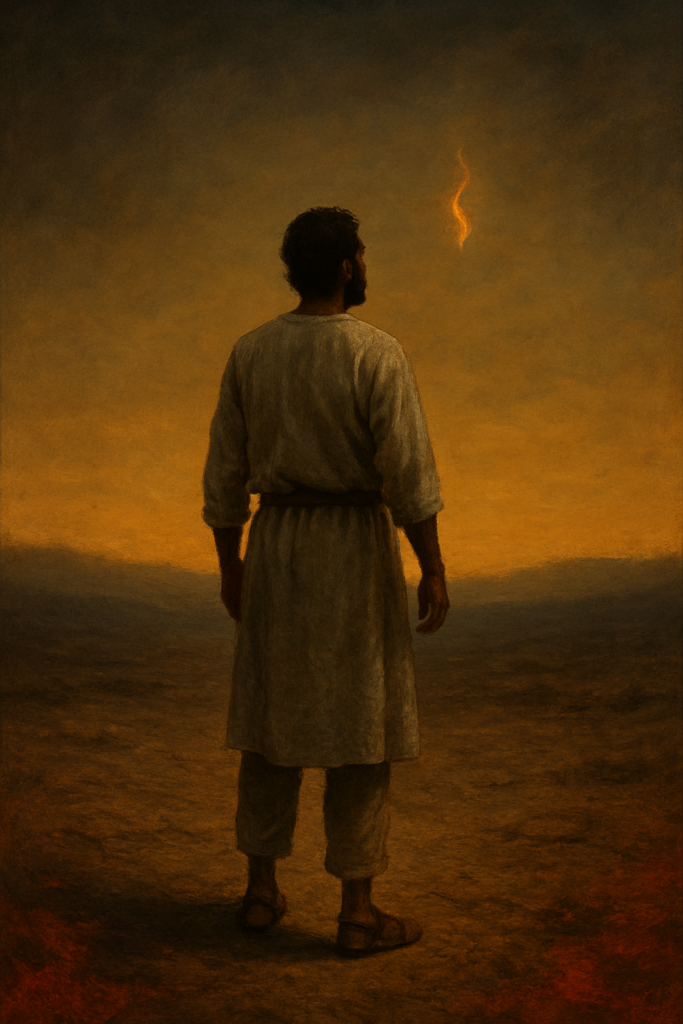
הִנְנִי אֲדֹנָי שְׁלָחֵנִי, Hineni Adonai, shelacheni, “Here am I, Lord; send me.
It’s simple, it’s powerful, and it should come with a warning label.
Because these words, first spoken by the prophet Isaiah in Isaiah 6:8, aren’t a slogan for a T-shirt or a refrigerator magnet. They are the full surrender of a soul that has just been undone, literally undone, in the fiery presence of the Living God. If you say it without trembling, you don’t understand what you’re saying. And if you say it and mean it… you’d better be ready for what comes next.
Let’s go to the text.
In Isaiah 6, the prophet isn’t preaching, he’s not calling down fire, he’s not confronting kings. He’s ruined. He’s face down. And he’s unworthy.
וָאֹמַר אֽוֹי־לִי כִּי־נִדְמֵיתִי כִּי אִישׁ־טְמֵא שְׂפָתַיִם אָנֹכִי וּבְתוֹךְ עַם טְמֵא שְׂפָתַיִם אָנֹכִי יֹשֵׁב כִּי אֶת־הַמֶּלֶךְ יְהוָה צְבָאוֹת רָאוּ עֵינָי
Va’omar oy li, ki nidmeiti, ki ish-teme sefatayim anokhi, uvetokh am-teme sefatayim anokhi yoshev; ki et-haMelekh YHWH Tzeva’ot ra’u einai
“Then I said: Woe is me! For I am undone, because I am a man of unclean lips, and I dwell in the midst of a people of unclean lips, for my eyes have seen the King, YHWH of hosts!” (Isaiah 6:5)
Isaiah isn’t volunteering from a place of strength or confidence or comfort. He is completely shattered. And only after a seraph touches his lips with a burning coal from the altar, symbolizing cleansing and commissioning, does he hear the voice of Adonai:
וָאֶשְׁמַע אֵת קוֹל אֲדֹנָי אֹמֵר אֶת־מִי אֶשְׁלַח וּמִי יֵלֶךְ־לָנוּ וָאֹמַר הִנְנִי שְׁלָחֵנִי
Va’eshma et qol Adonai omer: Et-mi eshlach, umi yelekh-lanu? Va’omar: Hineni, shelacheni
“Then I heard the voice of the Lord saying, ‘Whom shall I send, and who will go for Us?’ And I said, ‘Here am I. Send me.’” (Isaiah 6:8)
Notice something: God didn’t command him to go yet. He just asked, “Who will go?” And Isaiah, still smoking from the coals, volunteered.
But what’s the mission?
Go preach… and they won’t listen. Warn them… and they’ll harden. Speak truth… and they’ll close their ears.
“Go, and say to this people: Hear indeed, but understand not; and see indeed, but perceive not…” (Isaiah 6:9)
In other words: “I’m sending you to be ignored, rejected, and scorned, but go anyway.”
That’s the original context of “Hineni Adonai, shelacheni.”
It is not a cry of personal greatness or destiny. It is the cry of a soul that knows how utterly ruined he is without the cleansing of God, and yet, after being purged, stands up and says: “If no one else will go… I will.”
Now here’s where we get to how it should be said now.
In our generation, the cry has been totally distorted. People want the mantle of a prophet without the fire of purification. They want to be sent by God, but only if it comes with applause, influence, followers, a podcast, and maybe a book deal. They say, “Send me,” but they’ve never first cried, “Woe is me.” They want Isaiah 6:8 without Isaiah 6:5–7.
And let’s be honest: it shows.
Because those truly sent by God do not draw attention to themselves. They don’t market their ministries. They don’t live in comfort while preaching repentance. They carry wounds. They walk alone. They speak hard truths that no one wants to hear. And they do it anyway, because God asked, “Who will go for Us?”, and they couldn’t stay silent.
In Hebrew, the word הִנְנִי (hineni) is more than “here I am.” It’s the same word Abraham used in Genesis 22 when God told him to offer Isaac. It’s a full-hearted, no-holding-back surrender. It means: “I’m fully present. No excuses. No conditions. No turning back.”
So if we say, הִנְנִי אֲדֹנָי שְׁלָחֵנִי today, we’d better mean it like Isaiah did.
Not because it’s poetic. Not because it’s trendy. But because we’ve stood before the holiness of God, been undone by it, and yet somehow, by His mercy, been touched by His fire and made ready to carry His word to a rebellious people.
You don’t say “Send me” because you think you’re strong.
You say “Send me” because you know He is.
You don’t go because the road is easy. You go because He asked, “Who will go?”
And if we, in this generation of confusion, compromise, and counterfeit light, can still fall on our faces like Isaiah and rise up again with lips that burn and hearts that weep,
then maybe, just maybe, we are the ones who must say it.
Hineni, Adonai… shelacheni. הִנְנִי אֲדֹנָי שְׁלָחֵנִי
God, please help us to mean it.
But that wasn’t the end of it.
That cry, “Hineni, Adonai, shelacheni”, didn’t stay sealed in the scroll of Isaiah.
It traveled.
It traveled across centuries, through Babylon, through silence, through Roman roads and Galilean dust…
until it reached a carpenter’s son, drenched in the Ruach, standing in the Jordan, and hearing the voice of the Father thunder,
“This is My Son.”Matthew 17:5, Mark 9:7, Luke 9:35
And when that Son walked, taught, healed, wept, bled, and rose again,
He turned to His disciples, not to ask “Who will go for Us?”
But to say:
“As the Father has sent Me, so I send you.” The fire that touched Isaiah’s lips had now touched their hearts.
So what began in Isaiah’s vision became the commissioning of every follower of Messiah.
What began with “Here am I” would now be lived out by those willing to follow Him wherever He goes.
And so we walk forward, not away from Isaiah, but deeper into him. Because his cry is now our call.
Let’s keep going…
Before Yeshua ever told us to go, He first said “Hineni.”
Only He didn’t say it with words. He said it with a womb. With blood. With wood. With a cross.
Then I said, Behold, I come, in the scroll of the book it is written of Me, I delight to do Your will, O my God… (Psalm 40:7–8)
The Greek in Hebrews 10:7 quotes this, and it becomes completely clear: Yeshua is the ultimate fulfillment of the “Here am I”, the One sent not just to speak the Word, but to be the Word.
He didn’t just say, “Send me,”
He became the Lamb who was sent.
And then, after His death and resurrection, He turned to those who followed Him… and He sent them.
“As the Father has sent Me, I also send you.”
(John 20:21)
Καθὼς ἀπέσταλκέν με ὁ πατήρ, κἀγὼ πέμπω ὑμᾶς.
Kathōs apestalken me ho Patēr, kagō pempō hymas.
And just like Isaiah, they weren’t qualified.
They’d ran.
They’d failed.
They’d doubted.
But He breathed on them and said, “Receive the Holy Spirit”, just like the coal touched Isaiah’s lips, the Ruach touched theirs.
They didn’t volunteer from a platform.
They rose from the ashes of their own shame.
So when He said, “Go,” it wasn’t into ease. It was into a world that would beat them, stone them, burn them, imprison them, crucify them.
And they went.
Not because they were strong, but because He is worthy.
“Go therefore and make disciples of all the nations…”
Greek: Πορευθέντες οὖν μαθητεύσατε πάντα τὰ ἔθνη
Poreuthentes oun mathēteusate panta ta ethnē
The verb πορευθέντες (poreuthentes) is better read as “as you are going” or “when you go.” It assumes motion. Not if, but when.
This isn’t the call for a special few. It is the heartbeat of the whole Body.
This is our “Hineni” moment.
Yeshua doesn’t ask, “Will someone go?”
He says, “You, go.”
Stephen, in Acts 6–7, stood up to speak the truth, knowing he’d be killed for it. He didn’t cry “Hineni” with his mouth. He lived it with his blood.
And just before he died, he saw what Isaiah saw, heaven opened, and Yeshua, the Son of Man, standing at the right hand of God. Not seated. Standing.
As if to say: “You went!”
So now it’s us.
If you’ve ever stood at the edge of His holiness,
If you’ve ever been wrecked by His mercy,
If you’ve ever said, even trembling, “Here am I, Lord…”
Then get up. Push your shoulders back. Keep your heart burning.
Because the time for questions is over.
The world doesn’t need more influencers.
It doesn’t need more polished sermons.
It needs witnesses, martyria, the Greek word for both witness and martyr.
Those who will say:
הִנְנִי, Hineni, “Here am I.”
Not because it’s easy.
But because He is worthy.
And He said, “Go.”
“Go therefore.”
So… the scroll keeps going.
Because even after you say it, “Hineni, Adonai, shelacheni”, and even after you go, and you stand up in that fire and do what He told you to do, there’s something nobody warns you about.
The world doesn’t kill prophets with stones anymore.
It just scrolls past them.
That’s how it works now. You pour out your heart, you speak the truth, you type with trembling fingers and prayer in your chest… and somebody blinks and swipes it away like it never mattered.
Click. Mute. Ignore. Move on.
But you still have to speak.
And if God told you to “Go,” and you didn’t know it meant going there, into this cold glowing mess of noise and pride and arguments and filters and lies, you go anyway.
Because the fire that touched your lips didn’t die out just because they don’t care. It still burns.
Because He said, “Go”, and you go.
You go into the timeline where everyone’s already full. Full of themselves, full of opinions, full of clever little “truths” that cost them nothing. And you bring the real thing. The Word. The blood-covered, Spirit-soaked, holy-and-dangerous truth that won’t flatter anybody but will cut them free, if they let it.
And most won’t.
They’ll call it hate speech. Or outdated. Or boring. Or worse… they’ll pretend it didn’t happen.
They won’t block you, they’ll just silence you. Shadow-ban you in real life. Scroll right past the one thing that could’ve saved them.
And you’re supposed to stay faithful in the middle of that.
You think Isaiah had it hard?
Try speaking the Word of God to a generation that thinks their phone is smarter than God.
But you don’t stop.
You don’t change the message to get more attention.
You don’t water it down to make them like you.
You don’t hide the name of Yeshua just because it makes the demons nervous.
You keep going.
Because the call hasn’t changed. The mission hasn’t changed. The Word hasn’t changed. The King hasn’t changed. And He saw this coming.
He knew you’d be in this day. This world. This battlefield.
He knew the altar would look like a laptop sometimes.
He knew the witness stand would be a blog, a post, a message that one person might read at 2am and never tell you it saved them.
And He sent you anyway.
Because it was never about how many would listen.
It was about who would obey.
And that’s you.
So go ahead. Type it. Post it. Say it. Record it.
Put your face out there if you’re led to. Or don’t, if He told you to stay hidden.
But do not stay silent.
Not now.
Not when the lies are growing louder and louder and the truth has never been more needed.
Say the Name.
Preach the Word.
And when you’re tired, and you will be,
when your words feel wasted, and nobody clicks “like,” and the wolves howl louder than the sheep…
Remember Who sent you.
Remember Who’s watching.
And remember Who will say, “Well done.”
Because this world doesn’t get to decide if you were successful.
It only gets to decide whether it will listen.
And whether they listen or not…
you speak.
You write.
You go.
Because you already said it once, “Hineni, Adonai, shelacheni”, and He heard you.
And He took you at your word.
So now… go again.
Be blessed in Yeshua HaMashiach
Images are done by chatgpt at my direction.