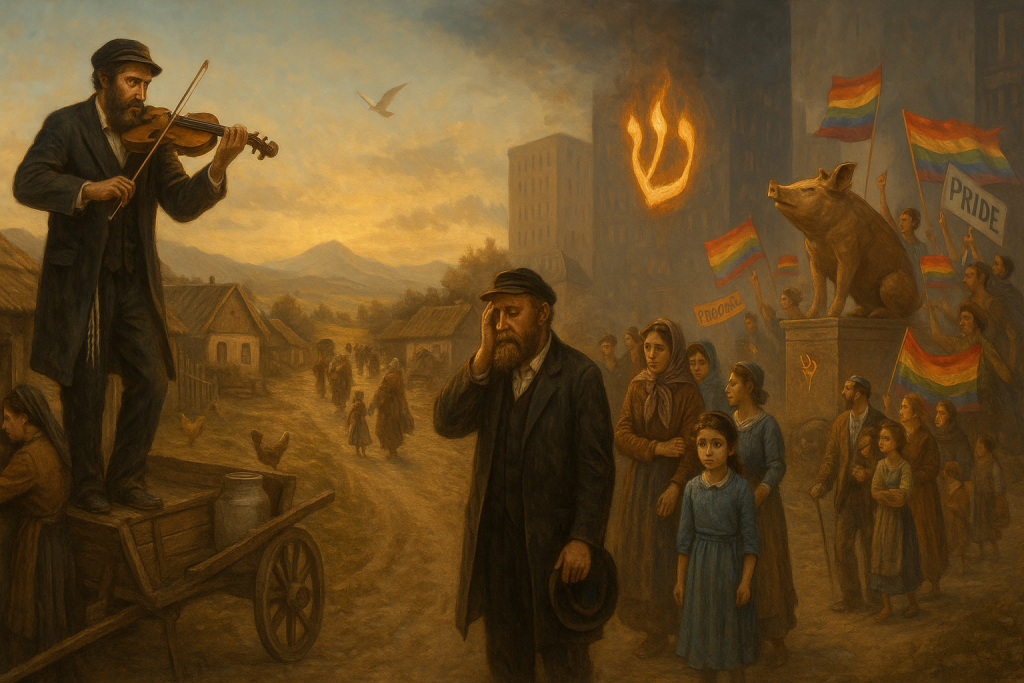
Comparison to Today’s world’s treatment of Jews
This movie has always brought a tear to my eyes and a catching lump to my throat. Why? BECAUSE I KNOW THE TRUTH of what happens to the Jews – and the stupid hatred against them.
Fiddler on the Roof is not just a film. It is a lamentation set to music, a midrash of exile and faith, a holy ache dressed in village clothes. It opens with humor, warmth, tradition, but ends with ashes, bare feet on snow, and bundles on backs. And somehow, the fiddler still plays.
At the surface, it tells the story of Tevye, a poor Jewish dairyman in a fictional shtetl called Anatevka, struggling to hold onto his faith, his family, and his tradition in the face of a changing world. His daughters make choices that defy the customs he holds dear. His village is threatened by increasing hostility from the empire around them. By the final act, they are expelled from their homeland by decree, given three days to leave. And the world shrugs.
The ache is not fictional. Anatevka is a stand-in for hundreds of real towns burned or emptied across Eastern Europe. The story is timeless because it is a retelling of a pattern older than Rome:
the Jew is chosen, the Jew is hated, the Jew is scattered.
Why? Because the Jew is chosen. and the people are jealous.
And the pain of that truth pulses like a violin string stretched over a chasm.
Governments that should have protected them have betrayed them. Nations filled with churches, those who claim to follow the God of Abraham, refused them ships, closed their doors, or turned them in. From Pharaoh to Hitler to Roosevelt, to modern capitals, there is always a reason given. Politics. Security. Resources. “Not our problem.” But beneath every excuse is the same ancient lie: “Let us tear their cords apart and cast away their yoke from us” (Psalm 2:3). Those countries that turned them away are responsible for ALL the deaths in the camps like Augsburg. YES, the Holocaust DID happen, whether you deny it or not. I KNOW of people who have died there.
The world hates them because God loves them.
But God does not overlook sin. Israel was called out to be holy, and when he turns from his covenant, judgment comes. The Scriptures are clear. In Jerusalem today, in Tel Aviv, in the streets where prophets once walked, idolatry has returned, but not as golden calves this time. There are parades waving flags of rebellion. There are statues erected and danced around, in mockery. There are public celebrations of that which the Torah calls abomination. And this is not an outsider’s slander. This is the grief of the prophets echoed in modern time (10/7/2023 to be exact).
It was never merely about politics. It was never about land. It is a spiritual war. The same ancient unclean spirits that danced in the high places now dress in modern slogans and laws. And once again, God allows the storm to rise, not because He has abandoned His people, but because He is calling them back.
“They have played the harlot with their idols… Therefore I will judge you… Yet I will remember the covenant I made with you in the days of your youth.”
— Ezekiel 16
There is no replacement for Israel. The church does not cannot erase her. She is still His firstborn. Still the root. Still the apple of His eye. And though her branches have withered, He has promised:
“All Israel shall be saved.”, Romans 11:26
But there is a painful path between exile and restoration.
When the villagers leave Anatevka, they do not leave in triumph. They leave quietly, one foot in front of the other, wrapped in shawls and silence. That silence is louder than any sermon. It is the sound of the covenant under siege—but not destroyed.
In that final scene, as Tevye walks away, the fiddler appears again. Balanced precariously. Playing while the world collapses. This is the heart of the story: to be a Jew is to play the song of God while standing on a crumbling roof. Faith in the face of absurdity. Praise in the shadow of exile.
The question rises like incense: How can God still stand them?
Because He is faithful, even when we are not.
Because He still sees the remnant.
Because His promises are not based on man’s goodness but on His own Name.
And yet, He is not blind to rebellion.
The sword does not sleep.
Judgment is real.
But so too is redemption.
One day, the fiddler will no longer need to play in exile. One day, the notes will rise not from a rooftop, but from the Temple Mount, where Messiah—Yeshua—will reign as King.
Until then, the fiddle plays.
And the faithful weep.
If you can, watch the movieonline (If they didn’t take it down, due to all the antisemitism and the politicization against God and the Jews, in the world today.) It is 3 hours long. Well worth it, spiritually and historically.
SHALOM, SHALOM!
Image done by chatgpt at my direction