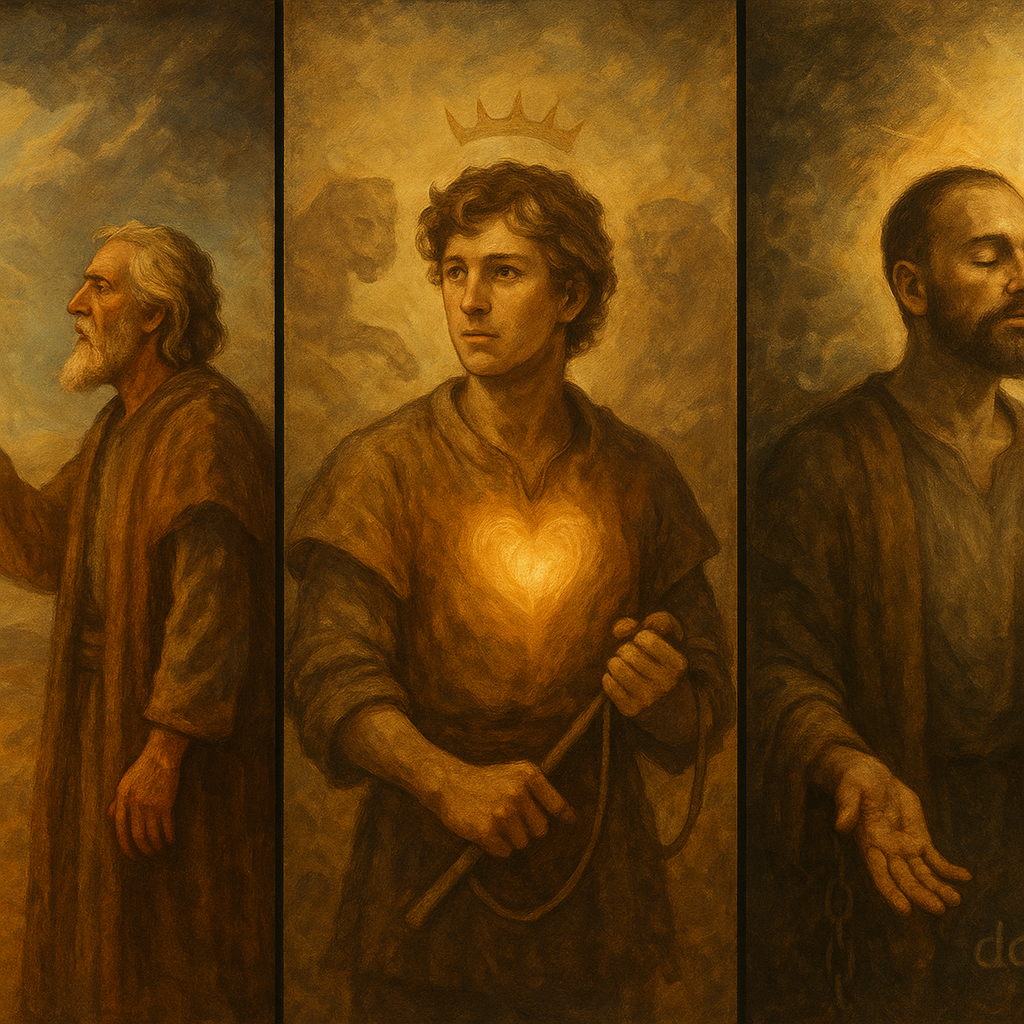
The Kind That Follows God
Moses never wanted the job. The Hebrew root of his name, Mosheh (מֹשֶׁה, drawn out), means “drawn out” because Pharaoh’s daughter drew him from the Nile, but also because Moses was always being drawn out of his comfort zone. He was not an ambitious man; he was a leket (לֶקֶט, gathering of fragments), a man with a past full of brokenness: a murderer (rasah, רָשַׁע, to murder, Exodus 2:12), a present full of hesitation (dabar, דָּבָר, word or speech, Exodus 4:10), and a future that stretched into the wilderness (midbar, מִדְבָּר, wilderness), a place of testing, desolation, and divine encounter.
When God spoke from the bush that burned without being consumed (’esheh lo tokhal, אֵשׁ לֹא תֹכַל, fire that does not consume, Exodus 3:2), Moses did not leap forward. Instead, he said, “Please send someone else” (shalach na ish eileh, שְׁלַח נָא אִישׁ אֶלֶּה, please send another man, Exodus 4:13). His ’anavah (עֲנָוָה, humility, lowliness) was profound. God did not say, “I’ll find someone better.” He said, “I will be with you” (’ehyeh ’imkha, אֶהְיֶה עִמְּךָ, I will be with you, Exodus 3:12). This phrase is powerful; the very name of God revealed earlier in that chapter, ’Ehyeh Asher ’Ehyeh (אֶהְיֶה אֲשֶׁר אֶהְיֶה, I AM WHO I AM, Exodus 3:14), became a promise of presence. God’s presence was the power, not Moses’s charisma or credentials.
Later, when Moses feared God might send an angel instead of Himself, he said, “If Your presence (panim, פָּנִים, face) does not go with us, do not bring us up from here” (Exodus 33:15). Leadership was never about territory or position; it was about the presence of the YHWH, the unchanging covenant God who leads.
Moses was not popular. His people complained, accused, even rebelled. Yet Moses’ response was intercession, not retaliation. The Hebrew word for “intercede,” paga‘ (פָּגַע, to meet, to touch), shows Moses’ closeness to God in those moments. When God was ready to destroy Israel for the golden calf (egel, עֵגֶל), Moses pleaded, “If You will forgive their sin, well and good; but if not, please blot me out of Your book” (Exodus 32:32). That is hesed (חֶסֶד, steadfast love), mercy poured out at personal cost, a shepherd’s heart standing in the gap.
David was different. His name, David (דָּוִד, beloved), was the youngest son of Jesse, the ’achor (אַחֲרוֹן, last one), overlooked by man but chosen by God. When Samuel came to anoint Israel’s next king, God said, “Do not look on his appearance or on the height of his stature; for the LORD sees not as man sees; man looks on the outward appearance, but the LORD looks on the lev (לֵב, heart)” (1 Samuel 16:7). That lev is not just the emotional heart; it is the center of will, intellect, and intention.
David was a shepherd, and leadership started there, in the wilderness with his sheep. He learned courage not on a throne but in secret fights with lions and bears (aryeh, אֲרִי, lion; dov, דּוֹב, bear), long before he faced Goliath the Philistine. The sling and stones were not royal tools; they were humble, tested weapons born of faith and preparation in solitude.
When David faced Goliath, his words echoed emunah (אֱמוּנָה, faithfulness, faith): “Who is this uncircumcised Philistine, that he should defy the armies of the living God?” (’Elohim Chayim, אֱלֹהִים חַיִּים, living God, 1 Samuel 17:26). David refused Saul’s armor because he trusted the yad (יָד, hand, power) of God rather than human strength.
Even when Saul hunted David, David respected the Lord’s anointed, the mashiach (מָשִׁיחַ, anointed one), saying, “Who can stretch out his hand against the LORD’s anointed and be guiltless?” (1 Samuel 26:9). Leadership was obedience to God’s authority, not grasping for power.
David’s leadership was not perfect. His sin with Bathsheba (2 Samuel 11) was a tragic misuse of power. Yet his teshuvah (תְּשׁוּבָה, repentance) was genuine: “Create in me a clean heart, O God, and renew a right spirit within me” (Psalm 51:10). This lev tahor (לֵב טָהוֹר, pure heart) was the core of David’s ongoing relationship with God, showing that leadership is not sinless perfection but continual surrender.
Then comes Paul, born Saul of Tarsus (Sha’ul haTarsusi, שָׁאוּל הַתַּרְסוּסִי), a man educated under Gamaliel, steeped in Torah and halakhah (הֲלָכָה, Jewish law). He was zealous (zelos, ζῆλος, fervent zeal), fierce, and convinced he was defending God by persecuting the church. But then the phos (φῶς, light) of Christ flashed on the road to Damascus, and Saul was blinded (typhlos, τυφλός, blind, Acts 9:8).
The voice said, “Saul, Saul, why are you persecuting Me?” (Acts 9:4). The Greek ego eimi (ἐγώ εἰμι, I am) echoes God’s own self-identification in the Septuagint’s Exodus 3:14 (ego eimi ho on, ἐγώ εἰμι ὁ ὤν, I am the One who is). Saul realized every attack on the church was an attack on Yeshua Himself.
After three days in darkness, God sent Ananias to restore him. Ananias called him “brother” (adelphos, ἀδελφός, brother, Acts 9:17), signaling restoration and new identity, and Saul became Paul (Paulos, Παῦλος, small or humble in Greek). He embraced being tou doulou Christou (τοῦ δοῦλου Χριστοῦ, the slave of Christ). Doulos (δοῦλος, bondservant, servant) is not just servant but one bound willingly in love and obedience.
Paul’s leadership was cruciform (sustauroō, συσταυρόω, co-crucified) with Christ (Galatians 2:20). He led not from power or position but from suffering and weakness. “I will boast all the more gladly in my weaknesses, so that the power of Christ may rest on me” (2 Corinthians 12:9). His scars (stigmata, στίγματα, marks) were not marks of shame but badges of belonging.
He labored tirelessly, often imprisoned, beaten, rejected. Yet he never lorded his authority. “We do not preach ourselves, but Jesus Christ as Lord, and ourselves as your servants for Jesus’ sake” (2 Corinthians 4:5). The Greek word for servant here is doulos again, willing bondage for love.
What unites Moses, David, and Paul? They all led without a throne, without entitlement, without the need for applause or prestige. Their leadership was shaped by presence over plan (Moses and the ’Ehyeh), heart over heritage (David and the lev), and sacrifice over status (Paul and the doulos).
The kingdom of God is upside-down leadership, where the last are first and the servant is master (Mark 10:44). It is about hesed (חֶסֶד, steadfast love), emunah (אֱמוּנָה, faithfulness), and teshuvah (תְּשׁוּבָה, repentance).
The scientific mind marvels at this: the God who orders the stars, holds quantum particles, and commands the laws of physics chooses to lead through those who surrender their will. Leadership by dying to self so that resurrection power can flow is no mere religious cliché; it is a divine principle reflected in the very fabric of creation: life through death, order through humility, authority through service.
So lead without a throne. Lead with a heart beloved by God. Lead like those who have nothing to prove because their worth is already sealed by God’s own berakah (בְּרָכָה, blessing).