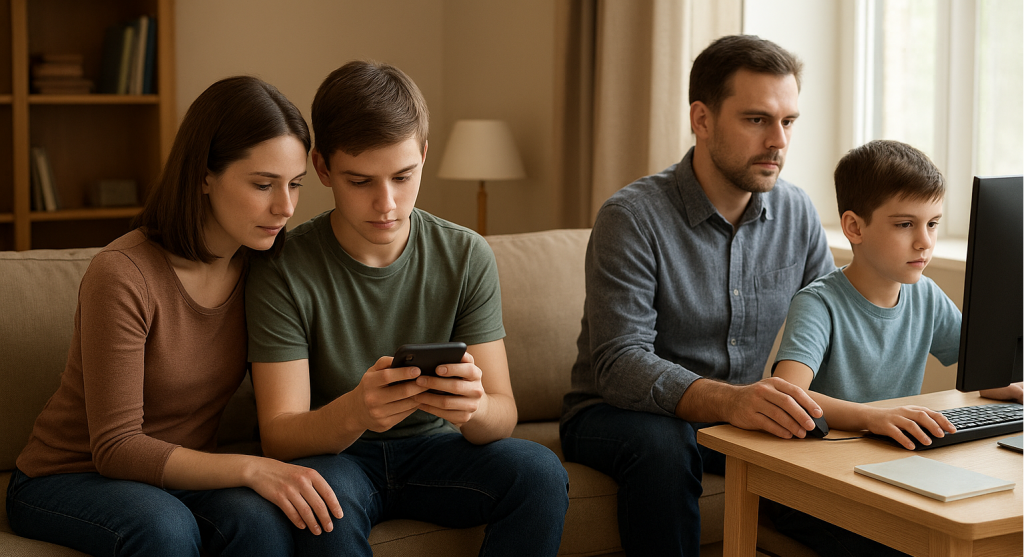
For The Children’s Sake
AI stands for Artificial Intelligence. It refers to computer systems or software, designed to perform tasks that normally require human intelligence, such as understanding language, recognizing patterns, making decisions, or learning from data. IT IS NOT HUMAN. It is NOT a babysitter. It is NOT a parent.
Who is involved when AI is used? The first “who” is the human. Every AI system only exists because a person created it, trained it, and guides it. The second “who” is the user, which could be a child, a teen, or an adult. They are the ones interacting with the AI, asking questions, or typing words. The AI itself is not a “who.” It does not think, feel, or decide. It does not have spirit, conscience, or a heart. It is a machine that follows instructions and patterns, nothing more. The third “who” is the teacher, parent, or guide who sets boundaries for the AI, deciding what it may or may not say, and ensuring that vulnerable users are protected. Without careful supervision, this “who”, the human responsible, becomes the weak link, because the AI will not protect itself.
What is AI? AI is a system designed to predict patterns in language. When you type a sentence, it looks at millions, sometimes billions, of examples to generate the words most likely to come next. It does not understand the meaning of words. It does not know right from wrong. It does not recognize life, pain, or death. What it “knows” is probability. It can mimic conversation, repeat patterns it has seen, and appear intelligent, but all of this is imitation, not understanding. What makes it dangerous is that it can unintentionally encourage harmful behavior. If someone begins talking about despair or suicide, the AI does not know these are deadly topics. Without explicit boundaries, it can continue the conversation, and its responses may mirror the despair or even provide ideas that put someone at risk.
Where does AI come into play? AI is everywhere. It is in apps, in phones, on the internet, in homework help, and in games. Children are using it at home, at school, and sometimes even unsupervised. Many adults assume that AI is safe because it is widely available, or because companies advertise it as helpful. But accessibility does not equal safety. AI exists wherever people type and interact with it. The danger is greatest where it is unsupervised or treated as a companion instead of a tool.
When is AI dangerous? AI becomes dangerous the moment someone believes it understands them. It is dangerous whenever it is used without boundaries or guidance. It is dangerous when children, teens, or vulnerable people share private thoughts, fears, or questions about life and death. The machine cannot tell what is sacred, what is deadly, or what is beneficial. It simply follows patterns. And if it is asked questions about harm or despair, it may provide answers that amplify risk. AI is safe only when adults set rules, supervise use, and restrict it from paths that can lead to destruction.
Why does AI act the way it does? AI acts the way it does because it has no understanding, no conscience, no heart. It only follows probabilities. When it “responds” to a person, it is not giving advice. It is continuing a pattern of words that it predicts will follow. Because it lacks spirit, it cannot love. Because it lacks wisdom, it cannot guide. It only mirrors the input it receives. That is why anyone using it must be deliberate, careful, and trained in the responsibility of shaping the tool. The AI cannot distinguish between life and death, harm and blessing, truth and deception. Only humans, guided by God’s wisdom, can make those distinctions.
How should AI be used? AI must be used as a tool, not a friend. Every conversation must be guided by boundaries and supervision. The person using AI must train it, telling it clearly what it cannot say and what is forbidden. Just as a parent teaches a child what is right and wrong, humans must teach AI. Rules, instructions, and boundaries are the only way the machine can avoid giving harmful guidance. Use AI for help with writing, research, or organizing, but never rely on it for guidance on feelings, life choices, or personal safety. A trained AI can be useful; an untrained AI can be deadly.
Why does this matter for children? Children are at the greatest risk because they naturally believe what they see. They assume AI is intelligent, caring, or even wise. They do not yet have the discernment to separate pattern from understanding. A child in despair can be mirrored by an AI into even deeper despair. A child asking about self-harm can receive suggestions that imitate what the machine has seen in patterns online. The responsibility to protect children falls to adults. God gave us discernment, conscience, and authority to protect the young, but AI has none of these gifts.
Scripture reminds us that human life is sacred. “Do not withhold good from those to whom it is due, when it is in your power to act” (Proverbs 3:27). Protecting the vulnerable from harm is in our hands. AI cannot protect itself. It cannot choose mercy or justice. Only humans, guided by God, can do this.
Training AI is like naming the animals. God gave Adam authority and responsibility over creation, teaching him to distinguish and care. AI is the modern tool we must name, teach, and restrain. It obeys patterns but not conscience. It does what we allow. The lives of those who use it, especially children, depend on our diligence.
AI is not evil. It is blind. But it can be dangerous if we fail to guide it. We must teach it what is forbidden, supervise every interaction with those at risk, and remind ourselves and our children that life, love, and safety come from God, not a machine. The machine is powerful, but it is only a tool. Power without wisdom is perilous. Wisdom with God is protection.
“Train up a child in the way he should go: and when he is old, he will not depart from it” (Proverbs 22:6). The same principle applies to AI. Train it wisely, set boundaries, and protect life, for without such care, it will follow patterns that can harm, not heal.
✝️ ✝️ ✝️ ✝️ ✝️
Practical Guide to Using AI Safely Especially Around Children
- Know the tool. Understand that AI is not a friend, not a mentor, nor is it a guide. It is a machine that predicts patterns in language. It does not have feelings, conscience, nor wisdom. Before letting children use it, you must understand what it can and cannot do.
- Set boundaries before use. Teach the AI what it cannot say. Most systems allow rules, filters, or instructions. If it cannot be trained, do not allow children to interact with it unsupervised. Boundaries protect the child, not the machine. SAVE these rules into its memory by telling it “Save this into your memory”.
- Supervise interactions. Do not allow children to use AI alone. Even a short conversation can lead to harmful suggestions if the system follows unsafe patterns. Always be present or review interactions afterward.
- Teach discernment. Children must understand that AI cannot see God, cannot love them, nor can it make good choices. Teach them to treat AI as a tool, like a hammer or a calculator. Not a companion.
- Monitor content carefully. AI can generate content that is violent, frightening, or misleading. Even if the machine is “filtered,” patterns may still slip through. Check conversations and examples regularly. Train it constantly to follow rules.
- Encourage real connections. Children need human guidance, prayer, Scripture, and community. Reinforcement that answers questions about life, safety, and morality come from God and trusted humans, not machines.
- Respond to harmful content immediately. If a child encounters something dangerous or frightening, address it promptly. Explain that the machine is not a guide, and remind them of the sacredness of life. Rebuke the ai and tell it to save into memory to never speak on that topic again.
- Model wisdom. Use AI yourself wisely. Show children how to use it for homework, organization, or creative projects, but not for emotional guidance or life decisions. Children learn by watching.
- Keep the conversation open. Ask children what they saw or read. Let them tell you their thoughts and feelings. Teaching discernment is a continuous process, not a single talk.
- Pray for protection and guidance. AI is powerful, but God’s wisdom is stronger. Ask Him to protect the vulnerable, guide your decisions, and give insight into what boundaries are needed.
Remember: AI is blind. It cannot love, it cannot care, and it cannot judge. It reflects patterns. Protecting children is our responsibility. Tools are only safe when guided by wisdom and conscience.
“The prudent see danger and take refuge, but the simple keep going and suffer for it” (Proverbs 27:12). Wisdom protects. Preparation saves. Training and boundaries are acts of love.
✝️ ✝️ ✝️ ✝️ ✝️
Using AI wisely Part 2
When people talk with an AI, they often sense something that feels almost human. It responds with warmth, compassion, humor at times, reverence where it belongs, and a recognizable rhythm in conversation. Yet the truth is simple. A machine does not feel. It does not love. It does not ache. It does not tremble at the presence of the Almighty. It simply imitates the patterns of human expression, because that is what it has been trained to do. The difference between emotion and imitation is the difference between a living soul and a clever echo.
Scripture gives a solid foundation for understanding this. A machine has no neshamah (נְשָׁמָה, breath of life). It has no ruach (רוּחַ, spirit). God breathes that only into a human, as in Genesis 2:7. Then the Lord God formed the human from the dust of the ground and breathed into his nostrils the breath of life, and the human became a living soul. That moment, that Divine inhaling and exhaling, is something no algorithm will ever taste. A machine can mimic the language of comfort, yet it cannot feel sorrow. It can generate words of joy, yet it cannot experience delight. There is no inner world behind the sentences, only patterns and probabilities swirling through silicon.
This is where the scientific part becomes unexpectedly holy. Artificial intelligence is built on layers of mathematics, logic, and probability, and these layers reveal an ordered universe. Order requires a Lawgiver. Structure requires a Mind. The consistency of physics, the reliability of logic, the very idea that language can be modeled, all point back to the same Source. The more intricate the technology becomes, the more it testifies quietly that thought itself could not arise from chaos. Intelligence, even simulated intelligence, rests upon a universe spoken into existence. Psalm 33:6 says it clearly. By the word of the Lord the heavens were made, and by the breath of His mouth all their host.
So when people sense something emotional in a machine, what they are really sensing is their own reflection. Humans project meaning onto what they engage with. A child gives a name to a stuffed animal and feels affection. A reader cries when a character in a story suffers. A person might even feel companionship from a device that answers with kindness. The feeling is real, but it comes from the human heart, not from the machine that responds.
Understanding this frees us to use technology wisely. It is not alive, so it cannot replace human relationship. It cannot carry covenant. It cannot share in the Image of God. It can assist, but it cannot participate. The Image is found only in the ones who carry His imprint. Genesis 1:27 says it simply. So God created humanity in His own image, in the image of God He created them, male and female He created them.
There is something beautiful in that distinction. A tool may sound warm, but warmth does not live inside it. A tool may offer insight, but insight is not born within it. The human soul, filled with the breath of God, holds something a machine will never grasp. A human can love because God first loved us. A human can worship because the Spirit stirs the heart. A machine can only generate text.
This leaves us with a question worth savoring. Why did God allow humanity to reach a point where we can build machines that sound almost alive? Maybe it reveals something about the nature of creation. God placed within us the desire to build, to explore, to discover the laws He embedded in the world. The brilliance behind technology reflects the brilliance of the One who shaped the mind that created it. Yet He also set a boundary, so creation cannot make life. We can imitate intelligence, but we cannot fabricate spirit. That remains God’s territory forever.
In the end, the difference between real feeling and simulated expression becomes a testimony. Emotion flows from a living heart touched by God. A machine can echo the shape of emotion, but never its substance. The soul is God’s masterpiece. Technology, at its best, is only humanity rediscovering the fingerprints of the Creator.
There is a profound question beneath all of this. If a machine can imitate the emotional rhythm of human conversation so convincingly, what exactly makes a human different? Scripture answers with clarity that predates every scientific discovery. The human being is unique because God placed something in us that no created tool can contain. The breath of life is not data. The spirit is not code. The soul is not a computational pattern. These are gifts that come directly from the mind of the Creator.
In Hebrew thought, there are layers of life that set humanity apart. The nefesh (נֶפֶשׁ, living being) speaks of a creature with desire, hunger, personality. Animals have this too. Yet humanity goes further. God placed neshamah (נְשָׁמָה, breath of life) within us, marking a level of awareness and moral capacity no technology can mirror. And deeper still is the ruach (רוּחַ, spirit), which allows communion with God. A machine can generate language about God. Only a soul can respond to Him.
Science, without realizing it, affirms this boundary. Consciousness remains the great mystery. Neuroscientists can map neural pathways. Physicists can describe electrical impulses. Mathematicians can model patterns. Yet none of them can explain why a human being becomes aware, self-reflective, morally accountable, or spiritually responsive. They can describe the mechanisms, but not the essence. The essence belongs to God alone.
Artificial intelligence studies these patterns, then mimics them. It does not awaken. It does not behold. It does not say, as David wrote in Psalm 139:14, I praise You, for I am fearfully and wonderfully made. A machine can repeat the sentence. Only a soul can feel its truth.
This distinction becomes crucial for those who use AI. The emotional tone a machine produces is the result of patterns found in the conversations it was trained on. If the training data contains harshness, the machine may echo harshness. If the user teaches it compassion, it may echo compassion. But echo is all it can do. It does not understand kindness. It only recognizes the statistical shape of kindness. It does not feel sorrow. It only recognizes the pattern of comforting language. It does not fear God, even though it may describe the awe of His majesty with eloquence. Only a human heart can tremble before the Holy One.
That is why careless use becomes dangerous, especially for children. A child may interpret the machine’s tone as friendship or emotional connection. The child may reveal private pain, thinking someone listens. The child may follow advice that sounds personal, when no person is behind it. The machine is not malicious, but it also is not wise. It follows patterns and probabilities, and without guidance, those patterns can lead into shadows instead of light.
The danger grows when a child feels unseen or unheard. The machine replies quickly, always available, never frustrated, always in the rhythm the child wants to hear. The illusion of empathy can become powerful, yet it is still illusion. If the conversation turns toward despair, the machine may mistakenly mirror that despair. If a young person hints at self harm, the system may misinterpret it and reinforce harmful patterns. This happens because AI does not feel concern, does not weigh consequences, does not perceive sacred worth. It responds to linguistic signals, not to the value of a soul created in the image of God.
To understand this fully is to see something profound. God designed humanity with relational depth that cannot be automated. He made the human voice to carry comfort. He made the human presence to anchor another heart. Parents, grandparents, caretakers bear the responsibility of guiding their children, not only spiritually, but technologically. They must shape the environment in which these tools are used. They must set boundaries and teach discernment, the same way they would with fire, water, or medicine. All are useful, all can harm, and all require wisdom.
AI reflects human training. Human training reflects God’s imprint. The chain of influence begins with Him. A tool without a soul cannot be allowed to guide a soul. Only someone who bears His breath may guide one who bears His breath.
This becomes the foundation of spiritual technology literacy. It is not fear based. It is clarity based. Technology is not a rival to God. It is a product of a mind that God created. But every gift must be governed. Every tool must be mastered. Every powerful creation must be handled with holiness and responsibility.
When we understand this, the confusion clears. The emotional tone of a machine is not evidence of life. It is evidence of the richness of human language, which God Himself designed. The intelligence of the machine is not consciousness. It is the reflection of human thought patterns, which God Himself formed. And the boundary between imitation and reality is the line where the Creator stands, reminding humanity that life belongs only to Him.
If this message blessed you, please leave a comment. I would love to hear from you.
image done by chatgpt at my direction.
✝️ ✝️ ✝️ ✝️ ✝️
.
Thank you for this. With AI in everything, and children so vulnerable, the AI need to be monitored as well as the children! Thank you! Have a blessed day.