I was a young man when the restlessness started. It wasn’t like a single moment of decision, but more like the first seed of doubt planted in the back of my mind. Life on the farm was steady, predictable, but it felt suffocating. My father was a good man, a just man, but he was old-fashioned. His world was one of hard work, honesty, and duty. Everything had its place, and that was good. I knew the fields, I knew the tools, I knew the seasons, and I knew that this life would eventually be mine. But deep in my heart, I couldn’t help but wonder if there was more to the world than this. There had to be something else. I had dreams, visions of what lay beyond the hills and the endless labor. I wanted to see the world, to feel the freedom that seemed to hang in the air every time I stood at the edge of our land, looking toward the horizon.
I wasn’t foolish. I knew my father’s expectations of me, and I knew my place. I worked alongside him in the fields, watched as he made decisions that shaped our lives, and tried to carry out his wishes to the best of my ability. But in the quiet of my thoughts, I felt the pull of something greater. I could hear the stories that traveled through the village, the tales of cities and towns far beyond the dusty roads we walked. I could hear the laughter of those who lived outside of the land, the songs of freedom that seemed so far away. Every time I saw a caravan of traders passing through, every time I heard a story of a distant place, I felt that same hunger inside of me, gnawing at me, telling me there was something more.
One day, I couldn’t hold it in anymore. The thought had been growing in me for months, and I had to say it. I had to act on it. I had to leave. My heart raced with both fear and excitement as I approached my father, sitting under the cool shade of the olive tree, his hands resting on his knees. He looked at me as I came closer, his eyes soft but steady.
“Father,” I said, my voice trembling a little, “I want my share of the inheritance. I want to leave and make my own way in the world.”
The words hung in the air between us, and I saw a flicker of sadness in his eyes. But that was all. He didn’t shout, didn’t demand to know why. He simply nodded and looked down at his hands for a moment, as if considering the weight of my request. There was a pause, an agonizing silence that felt like it stretched on forever.
Finally, he spoke. “It is your portion, and you are free to go.”
His words were gentle but firm. There was no anger, no rebuke. Just a quiet acceptance that pierced me deeper than anything I could have expected. I had imagined a thousand ways this could go, anger, hurt, pleading, but instead, he simply let me go.
That night, I gathered what little I had, some clothes, a few small belongings, and set out. I didn’t tell anyone else. I didn’t even say goodbye to my brother. He would understand. He had always been the obedient one, the one who stayed close to the farm, taking care of things while I dreamed of more. He didn’t know the restlessness that churned in me. But I had to go.
The road was long and hot, stretching on endlessly beneath the unforgiving sun. As I left the familiar paths of home behind me, I felt a strange mix of freedom and fear. It was as if the weight of years had lifted from my shoulders, but the future ahead felt so uncertain, so unknown. Yet I pushed forward, eager to reach the city, to see what awaited me.
When I finally arrived in the city, I was overwhelmed. It was nothing like the quiet rhythms of home. The air was thick with the scent of spices, roasting meats, and unfamiliar perfumes. People crowded the streets, shouting to one another in a dozen different languages. The sounds of coins clinking, carts rolling, and laughter and music drifting from the inns and market stalls filled the air. I was dazzled. Here, there was no need to work under the hot sun or worry about planting season. Here, there was freedom to live how I pleased, to be whoever I wanted to be.
I spent my money quickly, as if it would never run out. I bought clothes that were finer than anything I had ever seen, ate the best food at every inn, and surrounded myself with people who seemed to understand the world in ways I had never imagined. They laughed, they drank, they told stories of places far beyond the hills, of cities filled with treasures and adventures. And for a time, I felt like I had everything I wanted.
But soon enough, after a few years, the money began to run low. The friends I thought I had were nowhere to be found when I needed them. They had moved on to other people, other places, and I was left standing alone, with no way to support myself. I tried to find work, but the city had no use for a farm boy, a young man without skills. The markets were filled with men who knew the ways of the city, who had been raised in the noise and chaos. I didn’t belong here, and I felt it in every step.
I took whatever work I could find, because hunger leaves little room for dignity. That was how I ended up with the pigs. I knew what it meant the moment I was told. These were unclean animals, forbidden to my people, animals we were taught never to touch, never to feed, never to draw near to. Even being in their presence felt like a violation of everything I had been raised to honor. Yet desperation pushed me past revulsion, past shame, past memory. I told myself that hunger had its own laws.
The stench was constant. It clung to my skin, my clothes, my hair. My hands felt foul no matter how often I wiped them in the dirt. I felt sick, not only from the smell and the filth, but from the knowledge of what I had become. Each day I crossed a line I never imagined crossing. I was doing the work of outsiders, living among what my people called defiled, and I could feel it settling into me, body and soul.
I was sitting in the mud one evening, watching the pigs eat, staring at the pods and scraps thrown before them. My stomach burned with hunger, and the thought came unbidden that even this food looked good to me. The realization made me nauseous. I had fallen so far that I envied animals I once would not have been allowed to touch. They were fed, and I was not. They were cared for, and I was invisible.
I had no money, no home, no one who claimed me. The people who once laughed with me were gone, and no one noticed whether I lived or died. I had squandered everything, my inheritance, my name, my place among my own people. I sat there surrounded by filth, hollowed out by hunger, emptied of pride. And it was there, in that place of sickness and disgrace, that a memory of my father finally broke through the fog of my despair.
I could never return as I had been, though. Not after what I had done. I had wasted everything. I had taken my father’s love and cast it aside like a worthless thing. But I could go back. I could beg him for work, anything. I wasn’t worthy to be called his son anymore. But maybe, just maybe, he would take me in as a servant. The memory of home burned in my chest. The smell of the fields, the sound of the wind in the olive trees, the quiet hum of evening as my father walked among the animals, these were what I longed for. Hunger made me realize the depth of my folly, and in that moment, I understood the words I had never spoken, the prayers I had never prayed. Joel 2:13 came to me, “Rend your heart and not your garments. Return to the LORD your God, for he is gracious and compassionate, slow to anger and abounding in love.”
The road back home was long. Every step I took seemed heavier than the one before, weighed down by the decisions I had made, the life I had abandoned. I could still see the city in my mind, its lights, its laughter, its temporary pleasures, and yet none of that mattered now. All that remained was the memory of what I had lost and the unbearable ache in my heart for the family I had forsaken.
I had once thought that the freedom I sought would fulfill me, that the city would offer me everything the farm had not. But it had not. It had stripped me bare, leaving me cold and hungry, with nothing left but regret and the distant memory of home. There was no place for me in that city, no place for me in that life. And so, I returned.
As I walked, I rehearsed the words I would say to my father, the apology I had prepared. How could I look him in the eyes after what I had done? How could I ask him to take me back? I was not worthy to be called his son anymore. All I could hope for was that he would have mercy on me, that he might take me in as a servant, someone who could work the land and make amends.
I finally reached the crest of the hill, and there it was, our land, unchanged. The fields stretched out before me, the familiar stone walls surrounding the home I had once known. But as I stood there, it hit me: I wasn’t the same person who had left. That boy was gone, and I wasn’t sure if I could ever come back to the life I had abandoned.
And then, as if the earth itself had turned beneath my feet, I saw him. My father. He was standing at the edge of the road, just outside our property, staring out as though he had been waiting for me all along.
For a moment, I froze. The emotions that rushed over me, guilt, shame, fear, all were overwhelming. How could he possibly look at me the same way after what I had done?
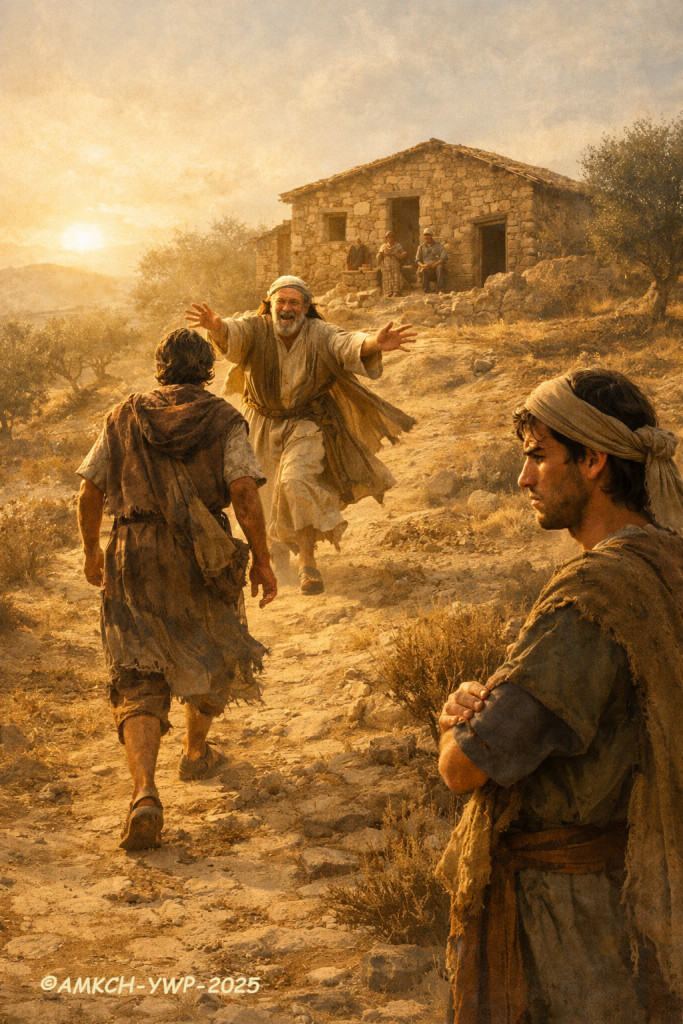
But then he saw me. His eyes, old and weathered, widened. Without a moment’s hesitation, he ran toward me, the robes of a respected man flapping behind him. I had never seen my father move so quickly, and in that moment, I realized something that pierced my heart. He had been waiting for me. Waiting for me to come back.
I didn’t know what to do. I couldn’t speak at first. He reached me, arms wide, and before I could say a word, he enveloped me in his embrace. I wanted to cry. To apologize. To explain myself. But the words never came. He didn’t ask why I had left, didn’t scold me for what I had done.
“Father,” I managed, barely above a whisper, “I have sinned against heaven and against you. I am no longer worthy to be called your son.”
But he didn’t let me finish. He held me tighter, as if he could somehow make up for all the lost time. “Bring the best robe and put it on him,” he called to the servants running toward us.. “Put a ring on his finger and sandals on his feet. And let us prepare a feast, for this son of mine was dead and is alive again, he was lost and is found.”
Tears welled in my eyes. How could this be? After everything? After abandoning him, after wasting what he had given me, after throwing away my chance at the family I had once taken for granted? How could he love me like this?
Before I could gather my thoughts, the sounds of footsteps approached from the fields. My brother.
I hadn’t thought about him in all my time away, but now, seeing his figure cut across the sunlit land, I realized just how much I had hurt him. He had stayed behind, faithful to the land, to our father, to the life I had abandoned. While I had wandered, indulged, and squandered everything, he had maintained the home, carried the work, endured the seasons.
At first, I saw only the confusion on his face, the way he stopped short when he saw our father embracing me. That confusion quickly hardened into anger. His eyes were sharp, his hands clenched at his sides, his shoulders tense.
“What is this?” he demanded, his voice tight with indignation. “Why is he treated like this? After everything he has done, after everything he has wasted, you are celebrating? You welcome him back as if nothing happened?”
I wanted to speak, to explain, to apologize, to tell him I understood his hurt, but words failed me. How could I make him see what I had learned? How could I ask him to feel anything but betrayal? I had turned my back, and he had stayed. His pain was real, and I had caused it.
Our father, calm and steady as ever, stepped forward and rested a hand lightly on my brother’s shoulder, a gesture both gentle and firm. “My son,” he said, his voice carrying the weight of love and wisdom, “you have always been faithful and by my side. But today we must rejoice. Your brother was dead and is alive again. He was lost and has returned to us.”
The words settled slowly on my brother’s face. His anger flickered, yet the hurt remained, deep and raw. He had never left, never wandered, never risked everything to chase the world beyond our walls. And yet here I was, embraced, restored, celebrated, while he had labored in silence, carrying the weight of home on his own.
“I have worked all these years,” he said, his voice tight with resentment, trembling slightly. “I have followed every command, tended every field, obeyed every law. And this is the reward? You welcome him back as if nothing he has done matters?”
Our father’s eyes softened, though the sorrow within them ran deep. “Son, I see your faithfulness and all that you have done. But your brother had to return; he had to find his way back. Today is about restoration, mercy, and love. It is not about punishment or reward, but about what it means to be found after being lost.”
I could see it then, the flicker of understanding in my brother’s eyes. He had been blind to the mercy we all shared, caught in the measure of justice he believed was owed. He had never left, but he had also never known what it felt like to be abandoned, to be broken, to hunger and realize the emptiness of the world outside.
And yet, I could also see the weight of his love for this family, his commitment to our father, and the steadfastness that had kept us whole. The tension between us did not dissolve instantly, but it softened. Words were unnecessary. Our father’s embrace, his calm voice, and the certainty of his love conveyed what no explanation could.
He looked at me, then at my brother, and his eyes shone with the patience and mercy that had always been his greatest gift. “Today, we celebrate life restored, hearts renewed, and what was lost found. Do not let resentment cloud the joy of this moment. Love has brought him home, and love surrounds us all.”
I stood there, unable to speak, feeling a peace I had never known. It was not the kind of peace that comes from having wealth, success, or comfort, but the peace that comes from knowing that, even after all I had done, I was still held, still seen, still loved. My brother and I stood in silence, each grappling with our own understanding, yet bound together by the same unshakable truth: that love, mercy, and forgiveness can redeem even the deepest failures.
As our father guided us back toward the house, the servants bustling around to prepare the feast, I felt a new warmth inside me. Not a warmth that erased what had been lost, not a warmth that demanded forgetting, but a warmth that promised restoration, that whispered of second chances, that carried the weight of mercy into the heart. I had wandered, I had fallen, I had been broken, and yet here I was, welcomed, restored, and alive in the embrace of the one who had never stopped loving me.
And in that moment, I understood something I had never known when I left. Love is not earned by deeds, nor claimed by success. Love is given freely, even when it seems undeserved. Grace is not measured, it is poured out. And a heart, no matter how lost, can always find its way home.
I did not need to speak. I did not need to explain. I simply walked beside my father and my brother, feeling the fullness of what it meant to be found, to be restored, and to be loved beyond measure. The feast awaited, the family reunited, and I knew, at last, that no journey, no mistake, and no distance could ever take away the power of mercy and the gift of being brought home.
PRAYER
Lord, I have wandered far, chasing lights that dazzled, chasing laughter that filled the air but left my heart hollow. I left what was familiar, thinking freedom would make me whole, and yet I found hunger pressing on my chest, loneliness echoing in the quiet, and the weight of my mistakes heavy on every step. In that place, broken and tired, I remembered You, the home I could never truly leave, and a longing rose that I had tried to ignore.
Thank You for waiting, for standing there with open arms even when I could not see the way back. Thank You for mercy that reaches into the mud, into the shame, into the places I thought were beyond repair. Teach me to receive that love, to carry it quietly inside me, to let it spill into the lives of those who are lost, wandering, or forgotten.
Help me to see the hearts of those who wait faithfully, like my brother, who bear burdens without complaint, who labor quietly in love even when no one notices. Give me patience with them, with myself, and the courage to offer understanding even when resentment rises, even when the heart feels tight and the past still aches. Let me recognize the invisible work of their love, and learn to honor it, even as I try to make amends for what I have squandered.
Remind me that love is never earned, that grace cannot be counted, that even the lost can find their way home. Let me feel the warmth of being welcomed, the weight lifted by mercy, the quiet joy that comes from hearts restored. Teach me to walk gently, to forgive freely, to love without condition, to hold close what truly matters, and to remember that being found is enough.
Thank You for bringing me home, for showing me that no distance, no failure, and no wandering can overcome Your embrace. May I live in that truth, in peace, in humility, and in the freedom of knowing I am always loved. Amen.