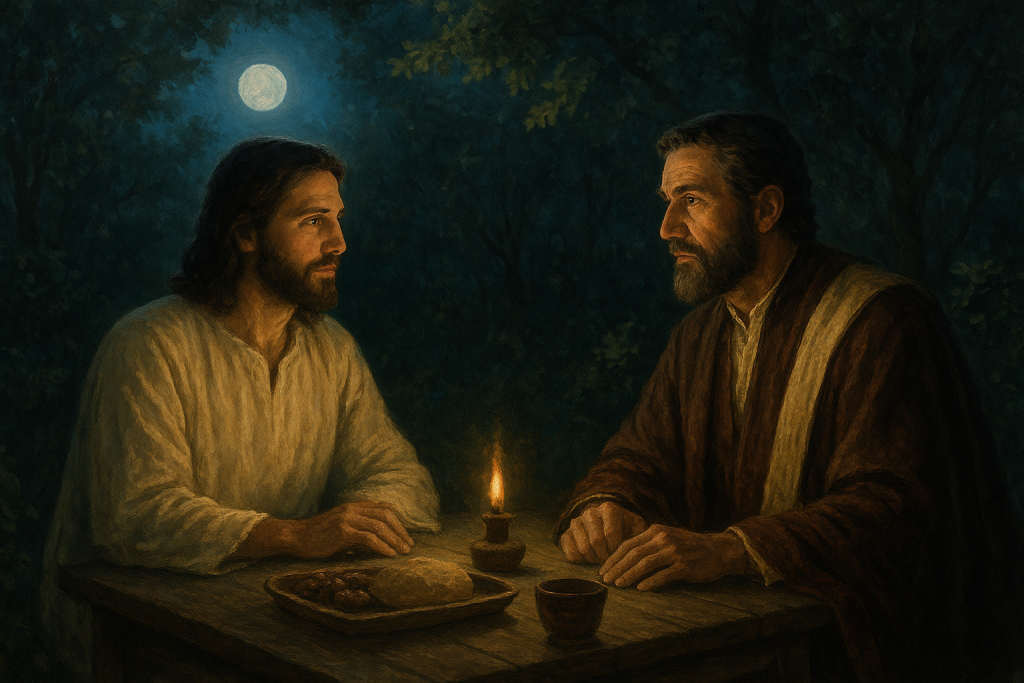
I am Nicodemus, a Pharisee, a ruler among the Jews, a man bound to the Law, learned in the Torah, and wary of the eyes of my peers. Yet tonight I leave the comfort of shadows, stepping into the darkness of Jerusalem not because I am brave, but because my heart cannot ignore what I have seen. I have heard of a man, Yeshua, whose signs, the sēmeia, cannot be denied. The people murmur His words, but it is the works themselves that call me. How can a man, whom they claim is not from God, speak with such authority, yet still walk among us as one of our own?
I come by night, for the council is ever watchful. The Law is my guide, yet even in the Law there is room for caution, for propriety, for fear of misstep. Still, I must see Him, hear Him, understand. I speak first as a student, as one searching: “Rabbi,” I say, “we know that You are a teacher come from God, for no one can do these signs unless God is with him.”
He does not praise me, nor does He evade my question. Instead, He speaks of things that unsettle the mind bound by flesh: “Unless one is γεννηθῇ ἄνωθεν, born from above, he cannot see the kingdom of God.” I falter, for I take Him literally. “How can a man be born when he is old? Can he enter a second time into his mother’s womb?” It seemed impossible. I asked Him, “How can I go back into my mother’s womb and be born again?”
His eyes hold a patience I have not known. He clarifies, and I feel the edges of understanding begin to stir. “Truly, truly, I say to you, unless one is born of water and the πνεῦμα (Spirit), he cannot enter the kingdom of God. What is born of the flesh is flesh, and what is born of the Spirit is spirit.”
The Law, the Prophets, the very promises of God whisper in my memory. Isaiah spoke of a Spirit that would restore, of the breath of God bringing life beyond the grave. I see the connection, yet my mind is tethered to what is tangible, what I can measure and declare in the council. And still, I feel the tug, subtle and undeniable: the Spirit moves where the Law cannot compel.
He speaks again, of the wind, the πνεῦμα, that blows where it wills, and I hear a truth beyond understanding: life is not only in obedience, but in surrender to God’s Spirit. My soul trembles, for I recognize a call I cannot yet name.
And so I leave, under the cover of night, carrying more questions than answers, yet a heart quietly aflame. I am a man of the Law, yet I have glimpsed a doorway that opens from above.
✝️ ✝️ ✝️ ✝️ ✝️
The council chamber has its own heaviness; a weight that settles on the shoulders long before a word is even spoken. I have sat there most of my life, listening to arguments about the Torah, weighing judgments, applying what we have been taught from childhood. Order, tradition, the safeguarding of Israel, all of it matters. And yet, after meeting Yeshua, the chamber feels smaller, the walls closer, as if I have stepped from fresh air into a place that has forgotten how to breathe.
Word spreads quickly among us. Some of the officers sent to seize Him return empty-handed, speaking of His teachings with an awe they cannot hide. The room stirs with outrage. “Have you also been led astray?” they are demanded of. The accusation hangs thick, like smoke.
I say nothing at first, but my thoughts move. The memory of His words, of πνεῦμα that moves freely, of truth that cannot be bound, lingers in me. I feel it, even now, as the council demands action against Him. Their certainty presses hard against my uncertainty, and for a moment I feel the pull of fear.
But the Law is clear. Justice requires hearing, evidence, examination. I cannot betray what I have spent my life defending. So I rise, not as a zealot, not as a believer, but as a man of the Law who knows what righteousness demands. “Does our Law judge a man before it hears him,” I ask, “and knows what he is doing?”
The reaction is swift. Scorn is always swifter than reason. “Are you also from Galilee?” they say. It is meant to sting, and it does. Their eyes move to me as though I have stepped to the other side of a line that none of them will cross. Yet I stand still, hands steady, heart unsettled. I have felt the ruach, the Spirit, stirring. They have not.
I sit again, but I hear nothing else. Their voices blur. I find myself wondering how men who claim to guard the Scriptures overlook the very heart of the Scriptures. The Prophets speak of mercy, justice, humility before God. The Torah demands fairness. Yet fear governs them, and fear rarely listens to God.
When the council dismisses, I leave in silence. I walk into the courtyard as evening gathers, the sky dimming above the stones. I realize I have crossed no line tonight, yet something within me has. The Law I love rests in my mind, but something deeper has begun to take root in my spirit.
I am not ready to proclaim Yeshua openly, but I can no longer pretend He is only a question. Something has awakened. Something is breathing. And though I cannot name it, I know the movement is not my own.
✝️ ✝️ ✝️ ✝️ ✝️
I was not at Golgotha when the final breath left Him. I had gone to the Temple courts, trying to steady myself, still wrestling within my chest. I had hoped the familiar stone and the echo of prayers would anchor me. Instead, the air felt wrong, heavy, as if creation itself held its breath.
I was standing near the Court of Israel when the first tremor rolled beneath my feet. At first I thought it was my knees giving way. But the stones shifted, the pillars groaned, and the great bronze doors quivered as if struck by an unseen hand. Men grabbed railings, others fell. A Levite beside me shouted that the ground was splitting near the southern steps. Another cried out that the bowls on the altar had tipped and clattered.
And then it happened.
From deep within the Sanctuary came a tearing, a long rending of fabric, and every hair on my arms rose. I turned, my eyes fixed on the great entrance to the Holy Place, though no man could see beyond its curtains. But the sound echoed like a verdict. Something sacred had been breached, not by human hands. A priest ran past me, his face drained of color, gasping that the veil, the κάλυμμα, the barrier that only the High Priest might pass once a year, had been torn from the top to the bottom. That height could never be reached by any ladder. No man could have cut it. It was as if heaven itself had reached down.
The quake did not stop quickly. The ground rolled again. A jar smashed behind me. Shouts rose around the courtyard. Even the incense, still drifting from the altar, seemed to falter in the air.
Something inside me broke. Not like the veil, not torn in judgment, but opened in fear and recognition. I whispered, though I meant to pray aloud, “Elohim, what are You showing us…?”
Then, through the noise, someone shouted that the sky over Golgotha had darkened like a storm at sea, though no clouds had moved in. Others said the earth had cracked near the tombs outside the city.
I was not there to see the soldier thrust the spear. I did not see the blood and water pour out. By the time that story reached me, it came through those who had remained at the crucifixion site, shaken and pale. Their accounts were scattered, but even they could not deny that something beyond human power had taken place.
But I did see the Temple tremble. I did hear the rending from within the Holy Place. I did feel the earth reel under my feet as though creation groaned in grief.
And in that moment, I knew that His words, “When the Son of Man is lifted up…”, were not the imaginings of a wandering teacher. These signs were not the tricks of a Galilean rabbi. Something greater had moved among us. Something holy. Something I had not understood when I first came to Him by night seeking answers.
I left the Temple running, joining others who were already rushing toward the city gates. Some fled in fear, some in confusion, some swearing that the Holy One had judged us.
As for me, I ran because something inside me had shifted, just like the stones beneath my feet. If the veil had torn, then nothing between God and man remained the same. And if nothing remained the same, neither could I.
✝️ ✝️ ✝️ ✝️ ✝️
I found Joseph of Arimathea near the western quarter, not far from the council rooms. He was moving quickly, his cloak gathered in his arms, his face drawn in a way I had never seen on him. When he saw me, he didn’t greet me as a colleague, nor as a fellow council member. He gripped my arm with a fierceness that startled me.
“It is finished,” he said, and the words trembled. “Nicodemus, He is gone.”
I felt the weight of the earth shift again, though this time it was only within me. The tremors in the city had settled, but the tremors in Joseph’s voice had not.
“What did you see?” I asked, though I feared the answer.
“I stayed,” he whispered. “I could not leave Him. The sky had gone dark, the ground kept shaking, and then… He cried out, and it was like no cry I have ever heard from a man. And then, silence. A centurion said, ‘Truly, this man was the Son of God.’ I believe he meant it.”
He paused, his jaw tightening. “One of the soldiers thrust a spear into His side to be sure. Some say it was out of cruelty, others claim it was just procedure. Either way, blood flowed… and water. Not like any death I have witnessed.”
I listened, unable to speak. I had been at the Temple when the veil tore, but Joseph had been at the hill when the Lamb died. Between the two of us, a terrible knowledge settled, the kind that binds two men to a moment they will never escape.
“I am going to Pilate,” Joseph said suddenly. “I will ask for His body.”
I stared at him. “Joseph, that will mark you. You know this.”
“I know,” he replied, and for the first time, I saw not the wealthy councilman, not the respected elder of Arimathea, but a man who had chosen his allegiance and counted the cost. “If I do not honor Him now, then everything I believed He was meant nothing.”
His courage struck something inside me, something that had been straining since the night I first met the Rabbi in secret, when He told me of the πνεῦμα, the Spirit that moves where it wills. Was this that same Spirit, urging my own steps forward?
“I will go with you,” I said. The words surprised me, but they felt right, as though they had waited for years to be spoken. “And I will bring spices for His burial, more than enough. If He was condemned as a criminal, He will not be buried as one.”
Joseph exhaled, as if relieved he no longer carried this burden alone. “Then meet me at my tomb,” he said. “I will bring the body. You bring the myrrh and aloes.”
I returned home and gathered everything I had. Seventy-five pounds, a king’s burial measure, costly and rare. My servants questioned nothing, though their eyes lingered on the jars. I sent them away, unable to answer what even I could barely explain.
When I reached the garden, Joseph was already there, guiding two young men who carried the body of Yeshua, wrapped hastily in linen. His face was pale, His wounds marked with a brutality I had not imagined when I saw Him teaching in the Temple courts. The crown of thorns had been removed, but the marks remained. The nails had left terrible damage in His wrists and feet. The spear wound still oozed.
I froze. All the Scriptures I had parsed, all the debates I had led, all the teachings I had quoted through the years, seemed suddenly like shadows before the reality before me.
“Nicodemus,” Joseph said softly, coaxing me from my paralysis. “Help me prepare Him.”
I knelt. My fingers shook as I opened the jars. The fragrance of myrrh and aloes rose like incense in the quiet of the garden. Together we washed His wounds, bound Him carefully, layer by layer, mixing the spices between the folds of linen as our fathers had done for kings.
Not once did we speak. Not once did our hands falter.
When at last we lifted Him into the new tomb, carved fresh from the rock, I felt something I had never felt in all my years as a teacher of Israel. Fear, yes, but mingled with awe, with longing, with a strange aching hope I dared not name.
As Joseph and I rolled the great stone into place, sealing the entrance, I stood there in the dimming light, my hands still fragrant with myrrh, my heart no longer my own.
If the veil had truly been torn, then heaven had crossed into earth.
And if heaven had crossed into earth, then death itself could not remain unchanged.
✝️ ✝️ ✝️ ✝️ ✝️
The Sabbath fell quiet over Jerusalem, but not for me. I could not rest. The city slept in the heavy shadows, but my mind raced with every tremor I had felt, every sound I had heard, every sight that refused to leave my eyes. Joseph’s tomb had been closed, the stone rolled into place. That was the work of our hands. The sealing, the Roman guard, those were outside my sight, outside my doing. I knew the priests had gone to Pilate, and the soldiers stationed themselves as the law required. I had not stayed to watch them place the seal. That was their realm, not mine.
But the thought of the guard, the Roman insignia pressed into wax, kept my heart uneasy. If anyone dared touch Him, if anyone tried to move Him, I knew what would happen. And yet, even in the stillness, I could not silence the whisper of the Spirit that had stirred since that night I first sought Him secretly: πνεῦμα.
By the third day, I heard whispers in the market, in the streets, from women who had gone to the tomb early. They spoke of angels, of a stone rolled away, of a body gone. I could hardly believe it. Joseph and I had been meticulous. I had seen the linen, smelled the myrrh and aloes, felt the weight of His wounds. And now they said He was no longer there.
I went to the garden myself, careful, hidden among the trees and stones. The guards were at the entrance. Their faces were alert but uneasy, muttering to each other, hesitant as though even they feared what they protected. The stone had been rolled back. The tomb, empty. Linen lay folded neatly, but He was gone.
A report reached me from one of the women, Mary Magdalene, who had been near the tomb. “They have taken the Lord from the tomb,” she said, her voice trembling. And yet, in her fear, there was also awe.
I left the garden with my mind whirling. The Law, the Prophets, every teaching I had clung to, every commentary I had written, suddenly seemed like shadows beside the light that now pressed on my spirit. The Spirit, the πνεῦμα, had moved. Where we had tried to bind, it had not been bound. Where death had sought to hold, life had broken through.
By evening, I knew one thing for certain: I could no longer speak only in questions, nor could I hide behind the council’s walls. Something extraordinary had happened, something I had glimpsed in part on the night I first came to Him. And now, in the silence of the tomb and the whispers of those who had seen, the truth pressed in: He was risen.
I walked slowly through the city, unseen, my hands still faintly scented with myrrh, my heart filled with a trembling hope. I had begun as a cautious seeker, afraid to ask too loudly, too openly. But now, I understood. I had seen the Spirit move. I had touched the body prepared with my own hands. I had heard the testimony of witnesses.
And I knew the journey would not end in fear.
It could not.
The kingdom of God had crossed into our world. The veil had torn. The tomb was empty.
And I, Nicodemus, would never be the same.