Let’s take a close look at Galatians 6:3. In it, Paul warns, “If anyone thinks they are something when they are not, they deceive themselves.” Let these words hit with the force they should. They expose the dangerous delusion that many of us carry: our tendency to overestimate our worth and inflate our self-importance. It’s not just a minor flaw; it’s a deep-rooted deception that can poison our hearts and lives. The Bible doesn’t treat this lightly, and neither should we. This verse is not a gentle nudge; it’s a sharp, urgent warning against pride, self-righteousness, and the spiritual blindness that arises from self-deception.
Self-deception creeps in very subtly. It doesn’t always announce itself as pride; often, it masquerades as confidence, competence, or spiritual maturity. When we believe we are more than we truly are, we put on a mask that blinds us to our real state. We become obsessed with how we compare to others. Worse still, we convince ourselves that we’re more important, more holy, or more deserving than those around us. This is pride (ὑπερηφάνεια: hyperēpháneia) with a capital P, and it is utterly destructive, especially in Christ’s eyes.
When we fall into the trap of self-deception, we begin to think that the more we know, the more we’ve accomplished, the more spiritual we become, the higher our “status” is in the eyes of others. It often turns into boasting, not just with words, but with actions, even as bullying or dominating behavior. We wear our accomplishments on our sleeves, flaunting our knowledge, our position, our success as if they somehow make us superior. Whether it is knowing more Scripture, excelling in law, holding positions of authority in church or government, or having a more impressive list of accomplishments, the heart remains the same: “I am better than you.” This mentality is toxic. It blinds us to our own weaknesses, fosters resentment, and crushes humility under the weight of self-exaltation.
Consider Nebuchadnezzar, the king of Babylon, whose empire stretched across nations. His name was feared and respected, and his city dazzled with walls, palaces, and gardens, monuments to human achievement. Yet he trusted in himself, declaring, “Is not this great Babylon, which I have built by my mighty power and for my majestic honor?” (Daniel 4:30). God allowed him to experience total humility, removing reason and making him live among the beasts of the field until he recognized the sovereignty of the Most High. Nebuchadnezzar’s restoration came when he lifted his eyes to heaven and acknowledged God, saying, “I blessed the Most High, and praised and honored Him who lives forever” (Daniel 4:34–37). His story demonstrates that pride blinds the heart, while humility restores clarity and a correct relationship with God. Even in power, he was nothing without God’s recognition. No position, achievement, or human admiration can substitute for dependence on the Creator.
Uzziah, king of Judah, provides another illustration. He began his reign in faithfulness, walking with God, and he was blessed with military victories, prosperity, and the admiration of his people. Yet Scripture tells us, “But when he was strong, his heart was lifted up to his destruction” (2 Chronicles 26:16). Uzziah overstepped the boundaries God had set, entering the temple to burn incense, an act reserved for priests. His pride blinded him to God’s command and led to leprosy, a visible mark of God’s judgment. Success, talent, and position can feed the illusion of self-sufficiency, leading to isolation and correction. Pride does not only affect the individual; it often tempts those around them to justify themselves, follow, and in doing so, spreads deception.
Korah, a Levite, illustrates the communal danger of pride. He gathered 250 leaders to challenge Moses and Aaron, saying, “You have gone too far! For all the congregation are holy, every one of them, and the Lord is among them. Why then do you exalt yourselves above the assembly of the Lord?” (Numbers 16:3). Korah’s words seemed pious, but his heart was filled with envy and ambition. He coveted authority not given to him and questioned the divine order established by God. The consequences were immediate and devastating. The earth opened and swallowed Korah and his followers (Numbers 16:31–33), while fire consumed the 250 men offering incense in rebellion (Numbers 16:35). Self-deception, when rooted in ambition and comparison, can fracture fellowship and invite judgment. God’s order is perfect, and attempts to elevate oneself above His will result in destruction.
In the New Testament, the rich young ruler presents a more personal and subtle example. He approached Jesus, asking, “Good Teacher, what must I do to inherit eternal life?” (Mark 10:17). He had kept the commandments from youth and thought himself righteous. Yet his wealth and self-perception created a barrier between him and God. Jesus said, “Go, sell all that you have and give to the poor, and you will have treasure in heaven; and come, follow me” (Mark 10:21). The man walked away sorrowful (Mark 10:22) because he could not surrender his wealth, a symbol of his self-reliance and status. Pride can masquerade as diligence, obedience, or goodness, hiding its presence while separating us from God.
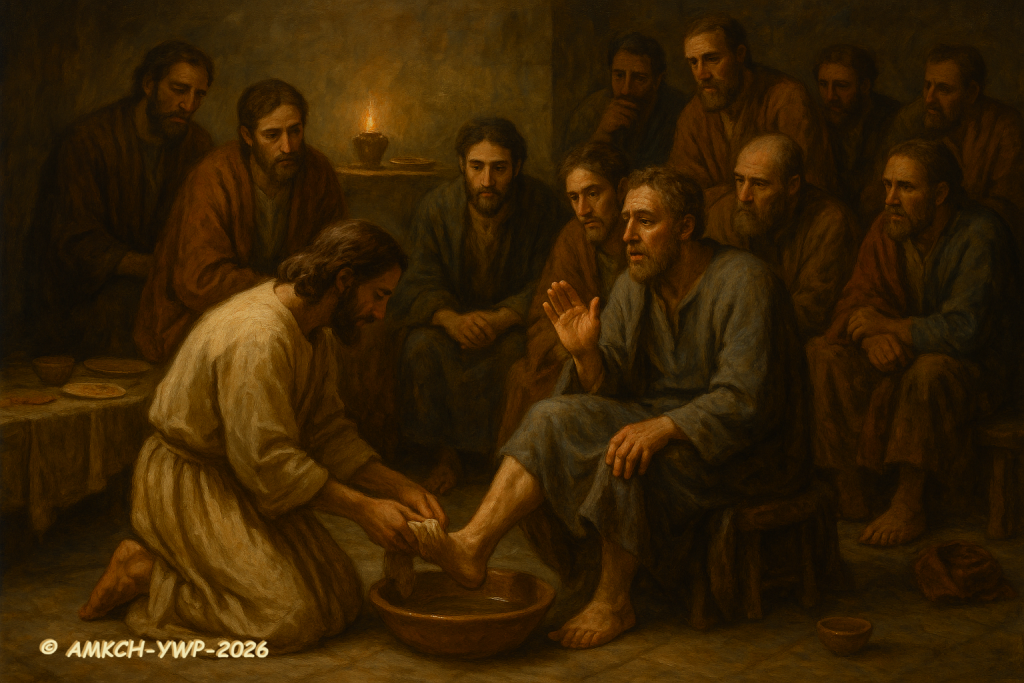
Even Peter, one of the closest disciples of Jesus, struggled with self-importance. On the night before the cross, Jesus rose from the table, laid aside His outer garments, and began washing the disciples’ feet (John 13:4–5). This act, reserved for servants, shocked Peter. He initially refused, saying, “You shall never wash my feet” (John 13:8). Peter’s pride showed itself in his desire to protect status and misunderstanding of true greatness. Jesus responded, “If I do not wash you, you have no part with me” (John 13:8). Only after Peter submitted did he say, “Lord, not my feet only, but also my hands and my head” (John 13:9), learning that humility and service are inseparable from true fellowship with Christ. Initial resistance to humility is common, even among those closest to Jesus. Submission, not status, is the way to fully participate in God’s work.
In the early church, Paul’s message targeted those ensnared by ego. The Galatians were misled by teachers claiming adherence to the Law of Moses was necessary for salvation. Their pride swelled as they looked down on others who did not follow the law as they did. Paul confronts this delusion with the truth: righteousness is not earned by works. No one can claim spiritual superiority. Salvation is a free gift from God. Thinking otherwise is self-deception.
Pride can appear subtly today. A teacher may feel superior because of knowledge, a minister may equate influence with authority, a parent may believe their children’s achievements reflect their own worth. Public figures, sports champions, politicians, and business leaders can achieve fame yet stumble when they trust in themselves rather than God. Galatians 6:3 warns that such self-perception is spiritually dangerous. The antidote is humility. Recognizing that gifts, talents, and successes are from God frees us to serve others, foster unity, and bear one another’s burdens. Humility dismantles ego, strengthens community, and restores perspective, allowing God to work through us rather than around pride.
This is not just about law-keeping or religious boasting; any form of self-exaltation falls under this warning. Measuring worth by knowledge, accomplishments, or status deceives both ourselves and others. Such an attitude spreads division, jealousy, and competition, replacing love and unity. Pride isolates and builds walls, while humility knits the body of Christ together. Humility shatters illusions of superiority, recognizing every good thing as a gift from God. It brings dependence on Him and allows us to serve others with love, free from comparison or expectation.
True humility (ταπεινοφροσύνη: tapeinophrosýnē) does not degrade the self; it focuses on Christ. Our worth comes from Him, not achievements or accolades. Boasting in knowledge, works, or perceived spirituality is self-deception. Galatians 6:3 invites us to embrace humility as a way of life. Pride may promise recognition, power, or success, but only humility, submission, and service align the heart with God’s will and bring true joy, peace, and fellowship. By lifting our eyes beyond self and trusting God, we open ourselves to His work, receiving strength for service, insight for community, and clarity that no human measure can provide.
In a world that celebrates self-promotion, the Kingdom of God calls us to a different standard. Jesus washed the feet of His disciples, showing that greatness is measured by humility and service, not power, wealth, or titles. True greatness is the heart of a servant, willing to serve without expectation. Galatians 6:3 calls us to confront our egos, to see ourselves as we are, and to walk in the grace that sustains us. Without Christ, we are nothing. Security, worth, and purpose come only through Him.
A person who grasps this truth has nothing left to prove. They no longer need to compare themselves or boast. Their focus is to reflect Christ’s love. They see everyone as equals, lead by serving, love by giving, and boast only in the cross. Pride isolates and divides; humility restores community. Galatians 6:3 is a call to action. Stop deceiving yourself. Humble yourself. Recognize your identity in Christ. Walk in freedom, letting go of pride, inflated self-image, and boasting. Live as Christ lived, and let the world see His love and grace through you
Prayer:
Yeshua, my Lord and Teacher, I come to You with honesty, laying down all pride. Reveal any place where I have thought myself something apart from You and show me the ways I deceive myself.
Forgive me for comparing, judging, or looking down on others. Teach me humility, that I may serve without expectation and see every brother and sister as a gift from You. Let me boast only in Your cross, mercy, and love.
As You washed Peter’s feet, show me how to submit my pride to Your service. Keep me from self-deception, and guide my words and actions to honor You.
Thank You for grace that restores, patience that corrects, and love that never fails. May my life testify to Your mercy and glory.
In Your Holy name, Amen Amen
✝️✝️✝️✝️✝️
If you liked this message, please leave a positive comment. I would love to hear from you!
image done by my chatgpt at my direction. If any of these people looks like you or someone you know, that is purely coincidental. They are not.
teaching and image©️AMKCH-YWP-2026