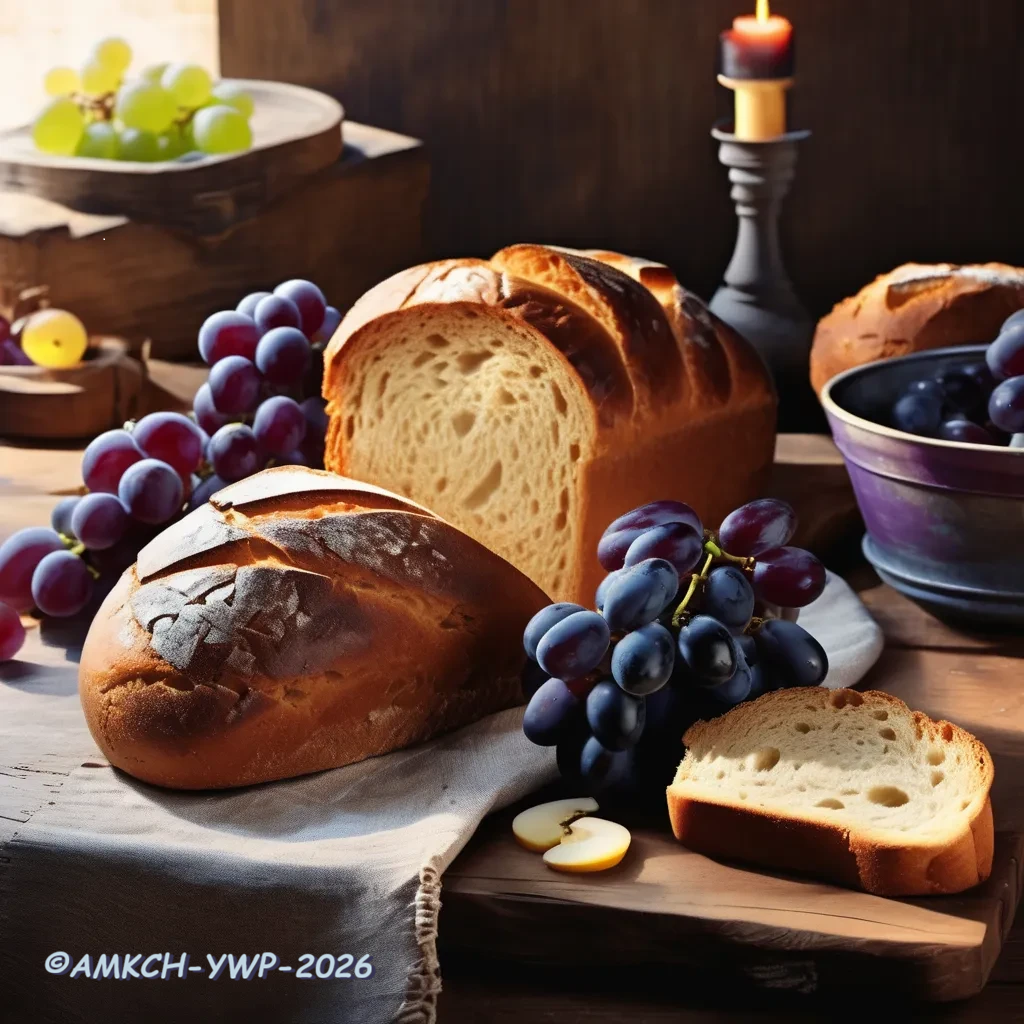
Jesus’ words in John 6 are packed with deep meaning, and while they may sound strange at first, they hold an essential truth about life and faith. In this passage, He tells the people that unless they “eat the flesh of the Son of Man and drink His blood,” they cannot have life in them. This statement did not fall into a vacuum. Jesus spoke these words to people who lived and breathed Torah, who understood covenant language, sacrificial language, and the meaning of blood as life. The shock was not because He was unclear, but because He was painfully clear. He was not softening the message. He was drawing a line between surface belief and true union with Him.
The Greek word translated “eat” in this passage shifts as the discourse unfolds. Early in the chapter, the word phagō φάγω means to eat in a general sense. But beginning in John 6:54, Jesus deliberately changes His wording to trōgō τρώγω, a word that means to chew, to gnaw, to actively consume. This change is not accidental. It intensifies the meaning. Jesus is no longer speaking of a polite or symbolic tasting, but of a full, personal participation. This is not casual belief. This is internalization. This is taking Him in so completely that He becomes part of the believer’s very being.
When Jesus speaks of His “flesh,” the Greek word is sarx σάρξ. This is not a spiritualized word. It refers to real, embodied life. The Word did not float above humanity. He became flesh. He entered human weakness, suffering, hunger, and death. To “eat” His flesh is to accept Him as the incarnate Son, not an idea, not a teacher alone, but God come in human form, offering His life fully and willingly.
The word for blood is haima αἷμα, and to a Jewish audience, this word carried immense weight. Blood was never consumed. Blood belonged to God because life is in the blood, as taught in Leviticus 17. Blood was poured out on the altar for atonement. So when Jesus speaks of drinking His blood, He is pointing directly to His sacrificial death. He is declaring that His life will be poured out, and that this poured-out life must be received by faith if anyone is to live.
This is not a literal command to consume His body and blood as physical food and drink. The wider context of the chapter makes this clear. Jesus repeatedly equates eating and drinking with believing, coming to Him, and receiving Him. In John 6:35, He says plainly that the one who comes to Him will never hunger, and the one who believes in Him will never thirst. Hunger and thirst are spiritual conditions. The eating and drinking He speaks of are spiritual actions, but they are no less real for being spiritual.
What Jesus means is that in order to truly live, we need to fully take Him into our lives, not just hear His words, not just accept Him, but receive Him completely. This receiving Him is not passive. It is covenantal. When food is eaten, it is broken down, absorbed, and becomes part of the body. It fuels strength, movement, and endurance. In the same way, Jesus is saying that His life, His sacrifice, His obedience to the Father, and His resurrection power must become internalized within the believer. He is not added to life. He becomes life.
This is why Jesus repeatedly ties this teaching to belief, not ritual. The people had eaten the loaves the day before. They were full physically, yet still hungry spiritually. They wanted signs. They wanted provision. Jesus offers Himself instead. He is not interested in being useful. He is offering to be essential.
By accepting His sacrifice on the cross and His resurrection, we are accepting the true source of life. The Greek word for life used throughout this chapter is zōē ζωή, not bios. This is not mere biological existence. This is divine life, the life that comes from God Himself. It is the same life Jesus speaks of when He says He came that we might have life, and have it abundantly.
When Jesus says that those who “eat His flesh and drink His blood” will have eternal life and be raised up on the last day, He is anchoring this teaching in the hope of resurrection. Eternal life is not only a future promise. It begins now, but it does not end at death. The phrase “last day” appears repeatedly in John 6, emphasizing that faith in Christ carries resurrection with it. Death does not sever the relationship. It completes the waiting.
This promise would have resonated deeply with those who understood the hope spoken of in Daniel 12, the resurrection of the righteous. Jesus is identifying Himself as the means by which that resurrection becomes possible. He is not pointing to a system, a temple, or a future sacrifice. He is pointing to Himself.
In John 6:55, Jesus says, “My flesh is true food, and My blood is true drink.” The word translated “true” is alēthēs ἀληθής, meaning real, genuine, not shadow, not copy. This language echoes the contrast between shadow and fulfillment found throughout Scripture. The sacrifices, the manna, the feasts all pointed forward. Jesus stands as the substance.
His sacrifice is not symbolic nourishment. It is actual spiritual sustenance. Without Him, the soul starves, no matter how religious the activity may be. His death and resurrection are not add-ons to faith. They are its foundation. Remove them, and nothing remains that can give life.
Then in John 6:56, Jesus deepens the statement even further by saying, “The one who eats My flesh and drinks My blood remains in Me, and I in him.” The Greek word for “remains” is menō μένω, meaning to abide, to stay, to dwell continuously. This is not a momentary experience. This is an ongoing state of union.
This is covenant language again. Mutual indwelling. God does not merely visit. He abides. The believer does not merely acknowledge. He remains. This is not about rules, rituals, or external conformity. It is about shared life. The Messiah lives within the believer, and the believer lives within the Messiah. This is the heart of relational faith.
In John 6:57, Jesus grounds this union in His own relationship with the Father. Just as the Son lives because of the Father, so the believer lives because of the Son. Life flows downward in perfect order. From the Father to the Son, from the Son to those who believe. This is not independence. This is dependence, and it is intentional.
The Christian life is not self-powered. It is sustained life. Jesus does not improve our strength. He becomes our source. This is why attempts to live the faith apart from Him always collapse into exhaustion. Life was never meant to be carried alone.
In John 6:58, Jesus returns to the manna comparison. The manna was miraculous, daily provision, but it was temporary. It sustained bodies, not souls. Those who ate it still died. Jesus is not criticizing the manna. He is completing its meaning. He is the bread that does not perish, the provision that does not expire.
The manna had to be gathered daily. Jesus offers Himself fully and finally. He is not replaced. He is not repeated. He is sufficient. Those who receive Him receive life that does not end, because its source is eternal.
So when Jesus says we must eat His flesh and drink His blood, He is inviting us into a covenantal union that goes far beyond surface belief. It is not shock language for effect. It is truth spoken plainly. To receive Him is to live. To refuse Him is to remain hungry. There is no middle ground.
This is the heart of the gospel. Christ given. Christ received. Christ abiding. And from that union flows eternal life, resurrection hope, and a relationship that death itself cannot break.
Amen Amen.
✝️✝️✝️✝️✝️
Daily Feeding on the Bread of Life
Each day, set your heart on Yeshua, the Bread who came down from heaven. Quiet your mind and recognize that He is present with you now. Speak to Him simply: “Yeshua, I receive You. I take You into my life as my life, my strength, my nourishment.” Let the words settle in your heart, knowing that He is already with you.
Open the Scriptures and linger on the passages that speak of Him as life and sustenance. Let John 6:35–58 wash over you. Take your time with the words, imagining that each verse is food for your soul. Hear Him say that those who eat His flesh and drink His blood have eternal life. Receive Him fully, not as an idea or a symbol, but as the One who sustains your life from moment to moment. Let Him sink into your thoughts, your feelings, your choices, your very being.
Speak to Him in a prayer of faith. Tell Him, “Yeshua, Bread of Life, I receive You. I take Your flesh and Your blood into my life. Abide in me, and let me abide in You. Nourish me with Your life.” Let the words flow naturally, silently or aloud, letting them become the rhythm of your heart. Know that He is already dwelling in you as you dwell in Him.
Turn your mind to His life, His obedience, His sacrifice, and His resurrection. Consider how the life that flows from Him can flow through you, into your words, your actions, your love, your patience, your service. Let your daily choices reflect His life, allowing His presence to guide, strengthen, and nourish everything you do.
You may take bread and wine, or juice, as a reminder of His gift. As you do, say quietly, “I feed on You, Yeshua. You are my life.” Let this moment root you in the reality that He is the true Bread from heaven, sustaining you eternally.
End this time by resting in Him, feeling His life within you. Repeat quietly, “I am Yours, Yeshua, and You are mine. Live in me, flow through me, now and forever.” Let this abiding become natural, continuous, a daily experience of receiving Him, being nourished by Him, and walking in the life He gives.
No church, no ritual, no building is needed. All that is required is a heart that receives Him, a life that abides in Him, and a trust that the Bread He gives is enough. This is the daily rhythm of those who live by His life, the prayer of faith that brings eternal life now, flowing into every moment, every action, and every breath.
ALTERNATIVE PRAYER ✝️✝️✝️✝️✝️
Yeshua, Bread of Life,
I receive You. I take You into my life as my sustenance, my strength, my very life. I do not seek signs, nor do I hunger for wonders apart from You. I do not chase understanding or earthly provision. I receive You, Yeshua, for You are the Bread that came down from heaven, given by the Father, sent for my life.
I take Your flesh, given for me, and Your blood, poured out for me. I take them not as symbols only, but as life itself, the life You offer to those who believe. Let Your flesh become my life, and let Your blood become my nourishment. Let every part of me be filled with You. Let nothing within me resist the Bread that sustains eternally. Let nothing in me seek satisfaction apart from You.
Abide in me, Yeshua, and let me abide in You. Let Your life dwell in me as I dwell in You. Teach me to feed on You daily, not once or casually, but continually, with my whole being. Let Your presence become my presence, Your obedience my obedience, Your sacrifice my life. Let me be united with You so completely that nothing can separate me from Your love and Your life.
I trust You, Yeshua, for life now and for the resurrection on the last day. I trust that those who receive You, who eat Your flesh and drink Your blood, will live, and that life will never end. Let me live in that reality now, carrying Your life within me, letting it flow through me to others according to the will of the Father.
Keep me, Yeshua, from hunger for anything else. Let no temporary bread distract me. Let no fleeting satisfaction draw me away. You alone are sufficient. You alone are the Bread that gives eternal life. Keep me nourished, kept, and strengthened by You alone.
I receive You, Yeshua, as my life, my sustenance, my true food and drink. I abide in You, and You abide in me. Let this union be steady, unwavering, and faithful, now and forever. Let Your life flow through me, as You promised, that I may live as You live, and that Your resurrection may be my hope, my strength, and my joy. In your Holy Name, Amen Amen
If you liked this message, please leave a positive comment. I would love to hear from you!
image done by my chatgpt at my direction.
Teaching and image©️AMKCH-YWP-2026
.