and the Cowardice of Barak
Deborah’s story is one of those moments in history where you just have to sit back and shake your head at how reluctant people can be to step into what God has already promised them. Israel had been suffering under oppression for twenty years as punishment for their turning against God (yet again!), and crushed beneath the weight of a foreign king’s rule. And it wasn’t just any kind of oppression. It was a brutal, humiliating, unrelenting oppression. King Jabin of Canaan and his military commander, Sisera, weren’t just ruling over the Israelites; they were grinding them into the ground. Sisera’s nine hundred iron chariots made rebellion feel impossible. If you saw one coming, you might as well accept your fate because you weren’t going to outrun or outfight it. Israel, once a people of strength, was now a nation of fear. And yet, despite all their suffering, no one had bravery enough to rise up and fight back. No one had the courage to say, “Enough.” Instead, they just cried out, waiting for someone else to fix the problem (Judges 4:1-2).
And so God raised up Deborah, a woman who actually listened. She wasn’t a warrior. She wasn’t some military strategist. She wasn’t even a queen. She was a prophet and a judge, someone who sat under a palm tree, listening to disputes and settling matters according to God’s wisdom (Judges 4:4-5). And when the time came for action, she knew exactly what needed to happen. God had already spoken. The battle plan was already set. All that was left was for someone to step up and follow through.
So she called for Barak, a man who should have been ready to lead. When he stood before her, she didn’t mince words. She didn’t ask him if he felt like going into battle. She didn’t sit him down for a long motivational speech. She looked him straight in the eye and said, “Hasn’t the Lord, the God of Israel, commanded you? Go! What are you waiting for! Take ten thousand men from Naphtali and Zebulun and lead them to Mount Tabor. God Himself will draw out Sisera and his chariots and his army, and He will give them into your hands”, Judges 4:6-7, paraphrased).
This wasn’t a request. It wasn’t a vague prophecy about a possible victory. It was a direct order from God. All Barak had to do was obey. But instead of stepping forward with confidence, instead of saying, “Yes, if God has said it, then let’s go,” he hesitated. He stalled. He wavered. “I’ll go,” he finally said, “but only if you go with me” (Judges 4:8).
Now, let’s just sit and think about that for a second. This is a fully grown man, a supposedly military leader, someone who should have been leading with authority. And yet, when faced with a clear command from God, his first reaction was, “I’ll only do it if you hold my hand.” This wasn’t just doubt. This was fear. And it wasn’t just his own confidence that was lacking. It was his faith in God. Because let’s be real: Deborah wasn’t a warrior. She wasn’t bringing some secret weapon to the battlefield. The only thing she had was the certainty of God’s Word (Isaiah 55:11). And yet, somehow, he felt safer with her next to him than with God’s promise in front of him! That says everything about him. I would call him a wimp, myself.
Deborah didn’t coddle him. She didn’t stroke his ego or try to build up his confidence. She simply told him the truth. She probably wanted to call him a wimp. But,… “Fine,” she said. “I’ll go with you. But because of the way you’re handling this, the honor of this victory won’t go to you. Sisera is going to fall, yes. But at the hands of a woman” (Judges 4:9, paraphrased).
That should have stung. In that culture, men took pride in their victories. (They were all testosterone driven) They were suppose to be the ones who led, the ones who were remembered. The ones who succeeded. But here, Deborah was telling Barak, You’re going to win, but you won’t be the one who finishes the job. You don’t get the glory, simply because you refused to take the responsibility. And still, he didn’t protest. He didn’t rise up in anger and prove her wrong. He just accepted it.
And so the battle began. Barak gathered his forces, ready for the fight, while Sisera, confident in his powerful iron chariots, came out in full force. But then, everything changed, because God didn’t just sit back and watch. He acted. The fight took place near the Kishon River, and according to the song of Deborah and Barak, something happened that completely shifted the odds (Judges 5:19-22). While Scripture doesn’t explicitly say there was a rainstorm, the way the story unfolds suggests that God intervened in a way that rendered those mighty chariots useless, which probably was caused by a hard rain storm.
Maybe the ground became soft, trapping the wheels. Maybe confusion and panic spread through Sisera’s ranks. Whatever happened, his greatest weapon turned into dead weight, and his army fell apart. Barak’s men pressed in, overtaking them, and then came the moment no one saw coming. Sisera, the mighty commander who had terrorized Israel for twenty years, abandoned everything. He didn’t stay to fight. He ran on foot. The man who had ruled by fear, who had seemed unstoppable, fled the battlefield alone, leaving his army to be destroyed.
And then comes the part that would seal Barak’s humiliation. Sisera, exhausted and desperate, fled to the tent of a woman named Jael. Now, here’s where we can take a little artistic license. There’s a good chance he knew her, or at least thought he could trust her. Her husband, Heber, had ties with King Jabin, Sisera’s ruler, so maybe Sisera assumed this was a safe place to hide. Maybe he had even been there before, welcomed as a guest, sharing stories of his victories over Israel.
But this time, Jael had different plans. She greeted him, gave him a drink, and made him comfortable. He thought he was safe. He let his guard down. And when he finally drifted into sleep, Jael reached for what she had; not a sword, not a spear, but the tools of an ordinary woman: a hammer and a tent peg. And with one swift, decisive blow, she ended his life (Judges 4:21).
The mighty general of Canaan, the man who had commanded a vast army, didn’t die in battle, sword in hand. He didn’t fall to a warrior’s blade. He was brought down in the quiet of a tent, by a woman armed with nothing but household tools. And just like that, it was over.
When Barak finally arrived, breathless from the chase, searching for the man he should have taken down himself, it wasn’t a soldier who led him to Sisera’s body, it was Jael. Calm, unwavering, she stepped forward and pointed. There he is. The great commander of Canaan, now lifeless on the ground, a tent peg driven through his skull.
Maybe there was a flicker of realization in Barak’s eyes. This was supposed to be my victory. But the prophecy had already been fulfilled. The honor of defeating Sisera didn’t go to the leader of Israel’s army. It went to a woman; one who wasn’t holding a sword, but who had the courage to act when the moment came.
And what about the other men? Where were they when the battle was raging? When Israel needed warriors, not everyone showed up. And Deborah’s song in Judges 5 doesn’t shy away from calling them out.
Some tribes didn’t hesitate. They heard the call, dropped everything, and ran to the battlefield. Zebulun and Naphtali? They risked their lives, charging into the fight, ready to lay everything down for the sake of their people. Issachar stood with Deborah, not just in spirit, but in action; they were there, right in the thick of it. These men saw what was happening and knew they had to be part of it.
But others? Not so much. Reuben sat around debating. Should we go? Should we stay? Let’s talk about it a little more. They had deep discussions, great conversations, maybe even a few passionate arguments. But in the end, they did nothing. Gilead? They stayed put, unwilling to leave their land. Dan? Too busy with their ships, caught up in trade and business, making sure their profits didn’t take a hit. Asher? Sticking to the coastline, wrapped up in their own interests, their own lives.
What were they even thinking? Did it cross their minds that this wasn’t just another battle? That God Himself was stepping in, turning the tides, shifting the course of history? What if they had joined in? What if they had trusted Him and fought? What blessing might they have received? What honor could have been theirs? Instead, they played it safe. They watched from a distance. And while they may have avoided the immediate danger, they also missed the victory.
When the dust settled and the enemy was defeated, those who fought stood in the glow of God’s deliverance, knowing they had played a part in something miraculous. But those who stayed behind? Their names weren’t remembered with honor. Their absence was noted. They weren’t warriors. They were the ones who hesitated, distracted, preoccupied with lesser things, while God was moving in power right in front of them.
But Deborah and Jael? They did what needed to be done.
Barak should have been the one remembered for victory, but instead, his name is forever tied to hesitation. His story isn’t one of outright failure, it’s one of missed opportunity. God still won the battle. Israel was still delivered. But Barak could have been the one standing at the forefront, leading with boldness, walking in the full reward of faith. Instead, he played it safe. He refused to move without a crutch. And because of that, he was written into history as a secondary player in a story where he should have been the lead.
God doesn’t need perfect people. He doesn’t need the strongest, the smartest, or the most qualified. He just needs someone willing to trust Him. Deborah trusted. Jael trusted. Barak hesitated. And that hesitation cost him the honor of finishing the fight (1 Samuel 15:22).
Israel was free for forty years after that. But the lesson remains, when God calls, don’t wait for someone else to go first. Don’t hesitate. Don’t look for a safety net. Trust Him, step up, and do what He has already said you’re capable of doing (Joshua 1:9).
Building on this teaching, just imagine the countless women across history who echoed Deborah’s courage. In addition to Deborah and Jael, consider Esther, a young woman who risked her very life to approach a king and save her people (Esther 4:14). Esther’s quiet strength and determination remind us that sometimes the bravest acts happen when one chooses to stand in the gap, even when it means confronting the powerful head-on.
Then there’s Miriam, Moses’ sister, whose leadership wasn’t found on a battlefield but in the power of her song and spirit (Exodus 15:20-21). When the Israelites crossed the Red Sea, Miriam’s jubilant praise was a declaration of freedom and hope, echoing that even in moments of uncertainty, a heartfelt cry to God can uplift a nation.
Mary Magdalene also transformed the course of history. Her unyielding devotion led her to be the first to witness and proclaim the resurrection of Jesus, becoming a living testament to faith and renewal (John 20:18). Her story, like Deborah’s, reminds us that true leadership isn’t always about commanding armies—it’s about having the courage to follow God’s call, even when it defies the expectations of one’s society.
Looking further ahead in history, we see women believers like Corrie ten Boom, whose quiet defiance in the face of tyranny provided a lifeline to those in desperate need (Acts 9:36-39). Corrie’s story teaches us that standing up against injustice doesn’t always require physical force; sometimes, the weapon is an unshakeable faith and a heart full of courage.
In the 21st century, we have contemporary women of faith who echo this courage. Ruth Graham, Beth Moore, Christine Caine, and Francis Chan’s co-laborers in women’s ministry are modern examples of believers stepping into God’s call, leading with boldness, and transforming lives through teaching, missions, and social impact. Malala Yousafzai, while primarily known for her activism, is also a believer whose faith guided her advocacy for education and justice (Proverbs 31:8-9).
So when we weave these stories together, the resolute call of Deborah, the decisive act of Jael, the bold steps taken by Esther, Miriam, Mary Magdalene, Corrie ten Boom, and modern women believers like Beth Moore and Christine Caine, we see a rich tapestry of faith in action. Each one, in her own way, answered a higher calling, showing that God’s promise and power often unfold through the courage of women who refuse to be silent in the face of injustice.
In the end, the lesson remains timeless: when God calls, hesitation only diminishes the victory. It’s the bold, unyielding faith of these women that changes history, inspires future generations, and reminds us that true strength is found in obedience and the willingness to step forward, even when the odds seem insurmountable (Hebrews 11:32-34)
✝️✝️✝️✝️✝️
PRAYER
Heavenly Father, You are the God who equips the faithful to rise when the world grows timid. Just as You empowered Deborah to lead and Jael to act with decisive courage, we ask You to fill the hearts of women today with boldness, clarity, and unwavering trust in You.
Father, inspire those who lead communities, guide families, teach, care, and stand for justice to step forward without fear. Remind them that You honor those who obey, who act when called, and who move in alignment with Your will. Strengthen their resolve, sharpen their discernment, and grant them courage to face opposition with faith.
May they be women who bring hope where despair lingers, justice where injustice rules, and light where darkness threatens. Let them rise as modern Deborahs and Jaels, instruments of Your deliverance, showing the world that true strength comes from trusting You completely.
Empower every woman who hears this call to act boldly, to embrace her purpose, and to walk in the authority You have already given her. May their lives, their words, and their actions bear witness to Your power, shaping history in ways that glorify Your name. In the mighty name of Yeshua, our Savior, we pray, Amen Amen.
I hope this message blessed you. If so, please leave a comment. I look forward to hearing from you.
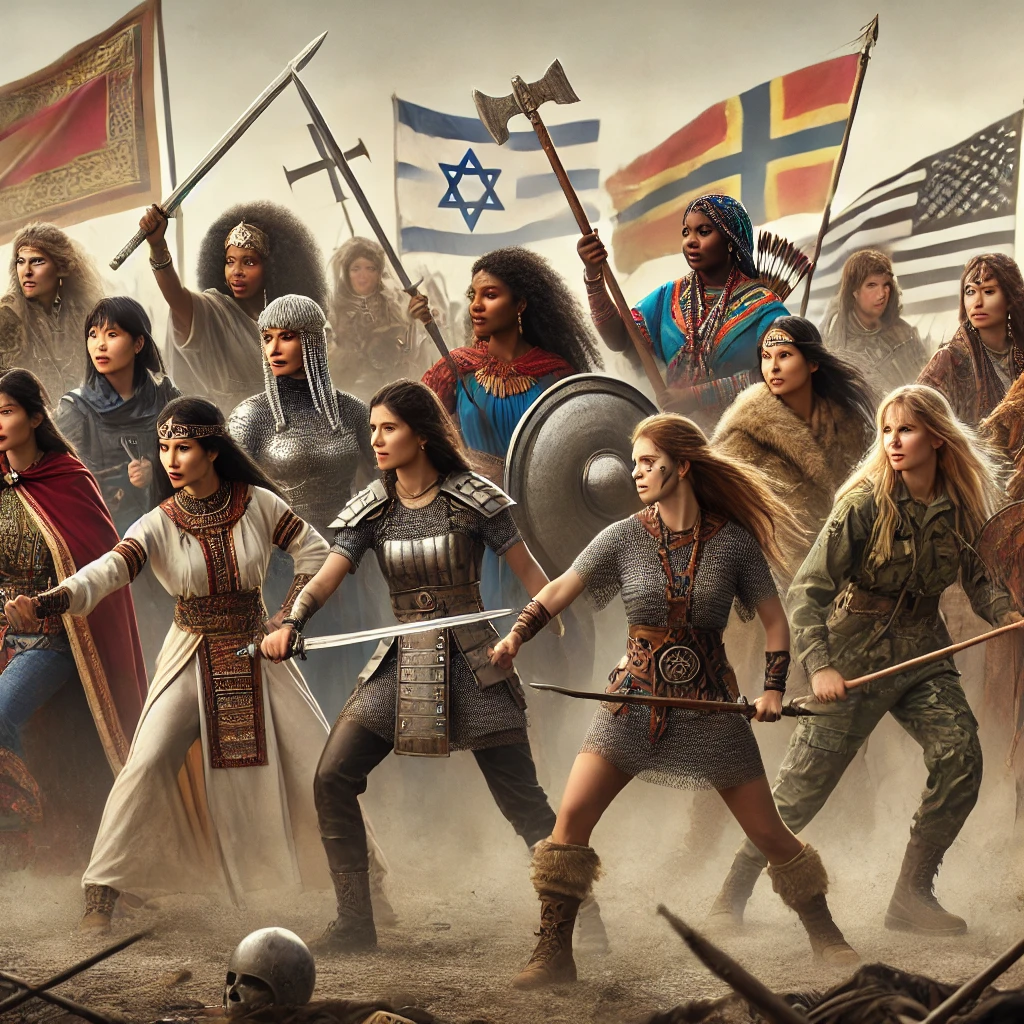
The image is AI generated at my direction.
.