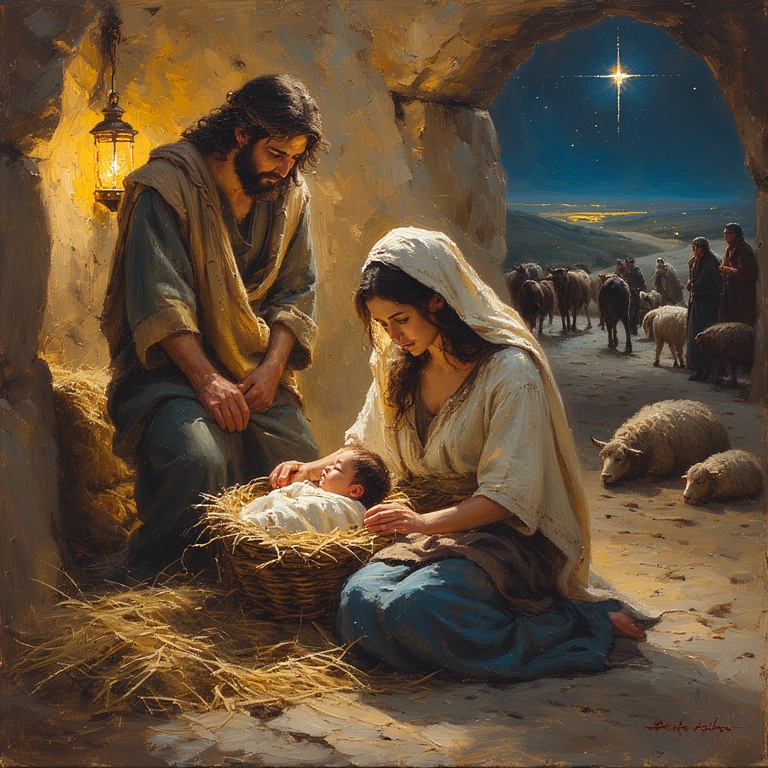
There is a reason Scripture never gives us a postcard-perfect nativity scene, and it is not because God enjoys confusing us, 1 Corinthians 14:33. It is because truth matures when it is allowed to breathe across more than one witness. The visit of the magoi is one of those moments where the Word quietly refuses to be rushed, flattened, or wrapped in tinsel.
Matthew and Luke are not competing narrators. They are standing in different places, watching the same story unfold from different angles. Luke is concerned with covenant obedience, timing according to Torah, and the quiet faithfulness of ordinary people. Matthew is concerned with kingship, threat, prophecy, and the collision between heaven’s rule and earthly power. When they are read together, without forcing them to say the same things at the same time, the story becomes remarkably precise.
Luke begins at the beginning. Yeshua is born in Bethlehem and laid in a manger because there was no space in the kataluma, the guest room, Luke 2:7. Shepherds arrive that very night. Luke uses the word brephos, a newborn infant Luke 2:12, 16. This is a just-born child, still wrapped, still helpless, still smelling like straw and night air. No foreign dignitaries appear. No gifts. Just shepherds and glory.
Eight days later, Luke marks the circumcision, Luke 2:21. He is careful with days because Torah is careful with days. Then comes the purification, forty days after birth, exactly as written in Leviticus 12. Miriam and Yoseph go up to Jerusalem, a short walk from Bethlehem, and they offer two birds, the sacrifice of the poor Luke 2:22–24. This matters. Had gold already arrived, this offering would not make sense. Luke is quietly telling you something without commentary. Heaven has not yet delivered the travel funds.
Luke then says that when they had completed everything according to the law of YHWH, they returned to Galilee, to Nazareth, Luke 2:39. Luke does not say how long that took. He does not say immediately. Luke regularly compresses time. He does this in Acts as well, sometimes spanning years in a sentence. His focus is obedience, not geography.
Matthew picks up the thread somewhere later. He does not mention shepherds, mangers, or the Temple. He begins with a political timestamp, in the days of Herod the king, Matthew 2:1. That alone tells you trouble is coming. Then the magoi arrive from the east. Gentiles. Observers of the heavens. Men who notice when God rearranges the sky.
When they find Yeshua, Matthew uses a different word entirely. No longer brephos. The word is paidion Matthew 2:8, 9, 11. A young child. Not a newborn. Not a infant in swaddling cloths. A child who has grown, however slightly, into awareness. And where do they find Him. In a house oikia Matthew 2:11. Not a stable. Not a cave. A house. Yoseph is working. The family is settled, at least temporarily, in Bethlehem.
Herod’s response gives us the sharpest chronological edge in the account. He asks the magoi the exact time the star (aster) appeared Matthew 2:7. The Exact time. Tyrants are precise when their power feels threatened. Later, when the magoi do not return, Herod orders the slaughter of all the boys in Bethlehem and its districts two years old and under (dietous kai katōteros) Matthew 2:16. This is not random cruelty, though it is cruel enough. It is calculated. Herod builds in a margin of error based on what he learned. That margin tells you Yeshua is not weeks old. If He were, Herod would have limited the order to infants. The two-year range tells you the child could plausibly be many months old.
Matthew then records the dream. Yoseph is warned to flee that very night (egertheis) Matthew 2:13. Aigyptos (Egypt) becomes a place of refuge, just as it once was for Yaakov’s (Jacob’s) sons. Out of Egypt I called My Son, Hosea 11:1, Matthew 2:15. Only after Herod’s death does Yoseph consider returning to Judea, and only then does he choose Nazareth because Archelaus reigns in Jerusalem Matthew 2:22–23. Nazareth comes after Egypt, not before.
This matters, because it resolves the common confusion. When the magoi arrive, Yeshua has not yet gone to Nazareth. He is still in Bethlehem. No longer in a manger. Living in a house. Still small. Still vulnerable. Already marked as a threat to darkness.
How old is He. Scripture does not give a number, and that restraint is intentional. But it does give boundaries. Older than forty days, because the family is still poor at the Temple. Not a newborn, because paidion is used. Younger than two years, because Herod’s order caps the range. Most honestly, the text places Him somewhere between several months and perhaps a year or a little more. Close enough to infancy to be carried into exile. Old enough for a king to fear Him.

The gifts themselves quietly confirm the timing. Gold enables survival. Frankincense speaks of priesthood. Myrrh whispers burial long before Golgotha is visible. Practically speaking, that gold explains how a poor craftsman finances an urgent flight to Egypt and lives there for an unknown span. God never sends prophecy without provision. He also never sends provision before obedience.
Tradition loves to crowd the stable. Scripture does not. Scripture spreads the moments out, like stepping stones. Birth. Shepherds. Covenant obedience. Time. A house. Gentile worship. Exile. Return. Settlement. Every step fulfills something older than Rome and stronger than Herod.
There is also something humbling here. The religious elite in Jerusalem miss Him entirely, though the Scriptures sit on their shelves. Pagan astronomers cross deserts to bow. Heaven announces His birth to shepherds and His kingship to star-watchers. Those who are watching see Him. Those who are comfortable do not.
Herod understood something many still resist. This Child did not need to grow up to threaten evil. He threatened it simply by being who He was. Kings tremble not at volume, but at legitimacy.
So no, the wise men were not standing beside a manger. They were kneeling in a house. The Child was older, stronger, still dependent, already dangerous to false power. And Scripture, when allowed to speak in its own order, tells the story without contradiction, without apology, and without embellishment.
Truth rarely needs decoration. It only needs patience.
One more question always rises at this point, and it deserves an honest answer rather than a reaction to tradition. When was Yeshua actually born.
The short answer, spoken plainly and without apology, is this. Scripture never gives a calendar date. Anyone who claims certainty beyond what the text allows has stepped outside the boundary of revelation. That includes December 25, and it also includes any other specific day of the month. The Bible is precise where precision matters, and silent where precision would distract.
December 25 does not come from Scripture. There is no verse, no hint, no festival alignment, no Temple calendar anchor that points there. The shepherds in the fields at night Luke 2:8 alone rule it out. Flocks were not kept overnight in the Judean fields in late December. Winter rains made that impractical. This is not theology. It is agriculture. The text assumes a season when shepherding at night is normal.
What Scripture does give are seasonal indicators.
Luke anchors the story to the priestly service of Zechariah, the father of Yochanan Luke 1:5. He belonged to the division of Aviyah (Abia). According to 1 Chronicles 24, the priestly courses rotated throughout the year. When that rotation is followed carefully, allowing for pilgrimage weeks when all priests served together, Zechariah’s service falls in late spring to early summer. Elizabeth conceives shortly after. Six months later, Miriam conceives Luke 1:26, 36. Add nine months, and you land not in winter, but in early autumn.
Luke then tells us that Yeshua was born during a census under Roman authority Luke 2:1–3. Rome did not habitually move populations during winter when roads were poor and travel was dangerous. Autumn, after harvest, was far more plausible. Families could travel. Food was available. Roads were passable.
Then there is the language John uses later. The Word became flesh and tabernacled among us John 1:14. The verb is skēnoō ,to dwell in a tent, to tabernacle. John does not say this accidentally. He is invoking imagery tied to the Feast of Booths, Sukkot, when God dwells with His people in temporary shelters. While this is theological language, not a calendar stamp, it fits remarkably well with an early autumn birth.
That is why many careful students of Scripture conclude that Yeshua’s birth most likely happened during the fall feasts, around Sukkot. This isn’t tradition; it’s because several independent clues point to that time. Shepherds in the fields at night. Roman administrative sense. Priestly rotation. Thematic fulfillment of God dwelling with man.
But here is the line Scripture itself draws, and we have to respect it. The Bible supports a season. It does not support a day. September is plausible. Early October is plausible. A specific date such as the eleventh can be suggested, but it cannot be proven from Scripture alone. When the Spirit wants a day remembered, He gives a day, as He does with Passover. When He does not, restraint is obedience.
And there is wisdom in that restraint. The focus of Scripture is never on celebrating His birthday. It is on proclaiming His arrival. The angels do not announce a date. They announce good news. The shepherds do not mark a calendar. They spread a report. Heaven points to who He is, not to when candles should be lit.
So what does the true Bible say. Not December. Not winter. Not a sanctified Roman festival. It points instead to a living season, a dwelling God, a Child born when the earth was full, the roads were open, the flocks were watched by night, and the Word pitched His tent among us.
The exact day remains known to God alone. And that, too, is part of the design.
images done by perchance ai at my direction
✝️✝️✝️✝️✝️
.
.